At the source of the tainted oil scandal, Kuo Lieh-cheng was fined 48 million; authorities in the country rarely use aerial photography to inspect illegal factories.
After the Kaohsiung City Health Bureau fined Chang Guann Co., the company that sold inferior lard, NT$50 million under the Act Governing Food Safety and Sanitation, the Pingtung County Health Bureau today also fined Kuo Lieh-cheng NT$48 million for refining recycled swill oil into cooking oil and supplying it to Chang Guann.
The Pingtung County Health Bureau said that originally the bureau had found only 20 tonnes of Kuo Lieh-cheng's swill oil and recycled waste cooking oil; calculating at a market price of NT$20 per kilogram, Kuo Lieh-cheng's illicit profit from selling illegal oils and fats was estimated at NT$4 million. Later, when it learned that the Food and Drug Administration of the Ministry of Health and Welfare had found from Chang Guann records showing purchases of a total of 240 tonnes of Kuo Lieh-cheng's swill oil, it therefore fined Kuo Lieh-cheng NT$48 million.
In addition, a rare move of using aerial drones to inspect unregistered factories has appeared in the country. The Pingtung County joint inspection task force today inspected unregistered food manufacturing factories, deploying aerial drones to join the inspection operation. The Pingtung County Government said that in the future, if inspection personnel encounter factory grounds or environments they cannot enter, they will use aerial photography to capture real-time images for assessment, breaking through the inspection bottleneck of being "unable to get in the door."
The Pingtung County Government pointed out that the aerial drone deployed this time was a "quadcopter," which can be fitted with a high-definition digital camera; the body weighs only 1.2 kg, is light and easy to carry, and can be operated independently by a single person. It can fly up to 500 m, and with a fully charged battery it can fly continuously for 20 minutes. Most conveniently, it has a wifi function, so that when shooting in the air it can transmit images to a smartphone, allowing the operator to grasp the images immediately.
At the central government level, the Food and Drug Administration of the Ministry of Health and Welfare today published a list of products that have been restocked after switching oils, with a total of 36 businesses and 67 product items registered as restocked. Products that have been discontinued, as well as businesses that have switched oils but are unwilling to be included on the list, are not on the list.

The Food and Drug Administration also responded to Premier Jiang Yi-huah's declaration yesterday of "strengthened food safety measures," including heavier criminal liability and fines, higher whistleblower rewards, a central whistleblower hotline, segregated control of oils and fats, waste oil recycling management, implementation of three-tier quality control, and food traceability.
The Food and Drug Administration said it had sent a letter on the 16th asking county and city health bureaus to raise whistleblower rewards, and was studying an amendment to the "Regulations Governing Rewards for Reporting Violations of Food Sanitation Cases," hoping to raise the proportion further from the original 5%-10% of the fine. The central whistleblower hotline has been set up; the public can call 02-27878200, and dedicated staff will record and manage cases in accordance with the "Procedures for Handling Public Petitions and Reports."
On segregated control of oils and fats, the Food and Drug Administration will coordinate with the Council of Agriculture, the Ministry of Economic Affairs and the Environmental Protection Administration, and will not allow industrial or feed oils to enter the food industry, with heavy penalties for violators; imports of oils and fats will have border controls strengthened, a policy of segregated importation of oils and fats established, and compound import regulations set. Waste oil recycling falls under the Environmental Protection Administration's remit, and food businesses must dispose of it in accordance with the "Waste Disposal Act" and related regulations.
On implementing three-tier quality control, edible oils and fats will be subject to mandatory self-inspection from October 31, and mandatory third-party verification from January 1, 104 (2015); a central food and drug inspection team will be established to cooperate with local health bureaus to strengthen inspections of source production areas and manufacturing plants. On food traceability, edible oils and fats will be given priority for implementation from October 31.
Regarding mandatory verification, the Food and Drug Administration said it would verify not only products but the entire production system and process, including whether the sources of raw materials comply with the "Regulations Governing Food Safety Control Systems." In addition, manufacturers of bulk livelihood materials, including starch, flour, sugar, salt, soybeans, wheat and corn, will also be given priority for mandatory self-inspection in 104 (2015), and will implement traceability from July 104 (2015).
The Food and Drug Administration said that since the Chang Guann inferior lard incident broke out, the cumulative confirmed fines under the Food Safety Act have amounted to NT$129.14 million, with NT$15.5 million still in the process of being issued. The larger fines include NT$50 million for Chang Guann in Kaohsiung, NT$48 million for Kuo Lieh-cheng in Pingtung, NT$5 million for Bald Lu Pancake Master in New Taipei City, and NT$6 million for Chiaosheng in New Taipei City, among others, with as many as 21 businesses fined.
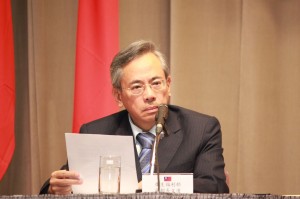
Minister of Health and Welfare Chiu Wen-ta also appeared at the press conference today and shook hands with each reporter present in thanks, saying that no further tainted products had been found, and that today 23 metric tonnes of problem products were destroyed on a large scale in Taoyuan County. He hoped the public and the government would continue to work together to root out evil completely.