The EU food traceability system prevents tainted food, tracing the flow of food within four hours
Dadu's tainted oil was not found to contain gossypol, which causes reproductive toxicity, and some of the oils could only be deemed to have false labeling; after the labels were changed, they could still be put back on the market. Moreover, the Ministry of Health and Welfare admitted that even if it clearly labeled which oils were blended, testing alone still could not confirm this; it was necessary to go to the factory to compare formulas and import-export data. In fact, with globalization and the development of the food processing industry, food safety crises have appeared in every country, and the "food traceability system" has emerged in response and is becoming increasingly important.
In the European Union, from the moment a food is planted and takes root to the moment it reaches a consumer's stomach, every stage has computerized records that can be checked; in the United States, fresh goods imported from a hundred miles away can be traced to the name of the farm where they were produced within 4 hours; in Japan, every cow has its own ID card from birth. In this oil-mixing incident, only by inspecting factories and comparing customs import-export data were the operators' illegal acts uncovered, showing that to treat food safety at its root, it is still necessary to return to source management. The experience of the aforementioned countries may serve as a reference for Taiwan.
In Response to Food Safety Issues, Countries Mostly Adopt Food Traceability Systems
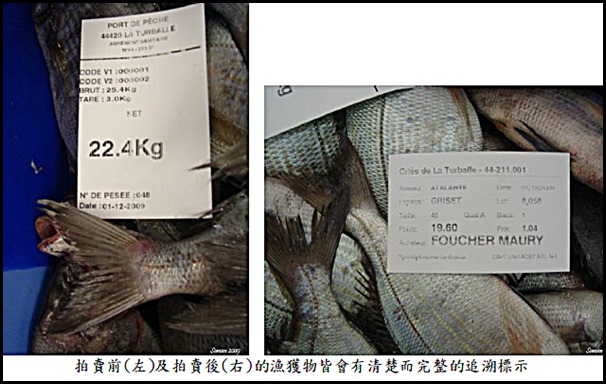
At the RUNGIS wholesale market in France, what comes into view is styrofoam containing all kinds of fish; this is Europe's largest wholesale market for fruits and vegetables, meat and poultry, and flowers. Wang Hui-wen, a former technical specialist at the Bureau of Standards, Metrology and Inspection of the Ministry of Economic Affairs, went abroad in 2009 to study France's hygiene management system for fishery products. In her report she wrote: "There are complete management measures and hardware facilities here, and even local Parisians come to stroll around. It is a great pity that, faced with all kinds of fresh ingredients, one cannot enjoy them either, 'because only legally registered wholesalers can conduct buying and selling here.' Fishery products are packed in styrofoam containers and labeled in batches on that basis, and can only be placed within the prescribed areas..."
Starting in the 1990s, Europe successively faced mad cow disease and the threat of genetically modified foods from the United States. In addition, the EU emphasized the free movement of goods and people; wine produced in France might appear on a German family's dining table 1 hour later. Therefore, if a food safety problem occurred, it would be difficult for other countries to escape it. In 2002, the EU published the "White Paper on Food Safety," requiring food and feed to leave batch data at every point in the supply chain, and if necessary, manufacturers had to provide relevant data within 4 hours.

Japan has a cattle identification and meat traceability system, and consumers can also learn the source of the meat. Source: http://www.nlbc.go.jp/g_kotai/about.asp
Using Townships as Certification Units to Let Operators Self-Regulate
Looking across the EU and Japan, even though there are mandatory legal requirements, governments mostly set only basic principles and leave the final piece of the puzzle to operators. But are Taiwanese operators capable of doing this? "Actually, EU regulations only require 'traceability'; other matters are left to each country to legislate on its own, and their merchants, for the sake of goodwill, will find ways to write all kinds of processes in detail. Taiwanese manufacturers, by contrast, look at where the law is written and find ways to identify where the loopholes are." Hsu Fu pointed out the predicament of Taiwan's system incisively.
An expert who declined to be named believes that the manpower and funding for back-end inspection are a major challenge for every country. In order to make farmers self-regulate, Japan's agricultural cooperative organizations (similar to the concept of Taiwan's farmers' associations) require that any product bought and sold through the organization must meet pesticide residue and production standards; for some government certification labels, inspections are even conducted with townships as the unit. As long as one farmer's product is found not to meet standards, the entire township loses its label, thereby making farmers supervise one another and self-regulate.
But the EU system is not flawless either. At the beginning of this year, the EU erupted with the "horse meat mixed with beef" scandal that shocked the world, highlighting the awkward situation in which the EU has no single regulatory body and each country's management is out of step.
Fragmented, Multi-Headed Management Creates Gaps in Oversight
Taiwan's food management has similar shortcomings. Agricultural products not yet on the market fall under the jurisdiction of the Council of Agriculture; processed products and those after market launch fall under the Ministry of Health and Welfare; GMP and some processing plants fall under the Industrial Development Bureau of the Ministry of Economic Affairs. People familiar with the industry point out that Taiwan's various ministries and commissions are unwilling to cooperate: "Often I want to do something on my side, but the official next door will not nod in agreement." Industrial-grade maleic acid was exactly what flowed into food under this kind of gap.
In response, experts say that under Japan's Cabinet there is a Food Safety Commission that carries out cross-ministerial integration and consultation, managing everything from fresh foods and processing to packaged retail in a single chain. Although Taiwan has a similar food committee, it remains only under the Ministry of Health and Welfare.
Hsu Fu also said that the key point of a product traceability system is not quality, but knowing the source of every food, so that if there is harm, losses can also be controlled: "That is, clearly telling consumers where the rice, eggs, and chicken legs in a lunchbox come from." Although countries around the world are still exploring food traceability systems, Taiwan can turn this wave of food safety crisis into a turning point and, by drawing on the experience of other countries, establish a food traceability system suited to Taiwan.