Don't pick wildflowers by the roadside; the poisonous weed Parthenium hysterophorus can be identified with an app
Parthenium weed (Parthenium hysterophorus), an invasive alien species regarded internationally as a "poisonous weed," has been steadily expanding its territory in Taiwan, increasing rather than shrinking, and last month reports were received one after another from Taichung City's urban districts, the Pinglin Forest Park in Taiping, and coastal areas, sounding an alarm for species protection. Huang Shih-yuan, director of the Taiwan Endemic Species Research Institute (TESRI), who has studied it for more than 20 years, said parthenium weed can trigger allergic reactions in humans and takes over large amounts of farmland, and that there are also cases abroad of livestock being poisoned after accidentally eating it, so it must not be taken lightly.
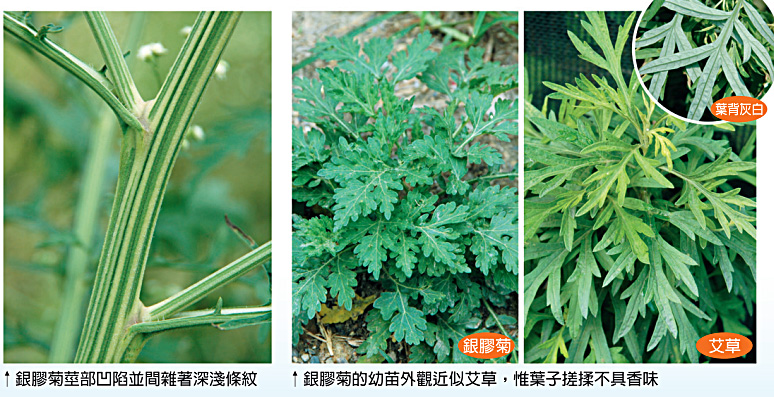
But because parthenium weed looks like mugwort (Artemisia argyi) at ordinary times and, when flowering, resembles baby's breath (Gypsophila paniculata), members of the public sometimes mistake it and take it home to grow, creating a blind spot in control. However, TESRI and the Forestry Bureau have now developed an app and a database, and they hope the public will distinguish carefully when out on trips and not casually take wildflowers home.
The Forestry Bureau urges that parthenium weed be controlled mainly by manual or simple-tool uprooting; on farmland, agricultural machinery can be used to turn it under; after uprooting, the plants can be placed in black plastic bags to rot down or dried and then burned. Because the glandular hairs, short hairs and pollen of parthenium weed easily cause allergic reactions in humans, the Forestry Bureau reminds the public to wear long-sleeved clothing, gloves and a mask when carrying out control work, and to wash their hands as soon as possible after contact.


Allergenic and toxic; manual uprooting is best
As for control methods, manual uprooting is currently the most ideal. Huang Shih-yuan said that if parthenium weed covers too large an area of wasteland or farmland, drugs such as glyphosate, paraquat and glufosinate can be used, but from the standpoint of environmental protection these are not recommended; controlled burning can be used instead.
In addition, where land use permits, a cultivator can be used to turn the soil continuously for 2 or 3 years to suppress the growth of seeds in the soil. Huang Shih-yuan said that although parthenium weed is an annual herbaceous plant, each plant grows for a different length of time, and it can be seen flowering almost year-round, which means control must maintain the principle of "clear it away the moment you see it."
Therefore, if the soil is only turned 1 or 2 times, seeds remaining in the soil still have a chance to sprout, "so either uproot it by hand quickly, or keep going over it with the machine again." However, according to current domestic and international information, apart from taking over growing space from crops, parthenium weed has no other effects; but cases abroad indicate that cattle and livestock have been poisoned after accidentally eating parthenium weed, while no related cases have been reported domestically so far.
Huang Shih-yuan pointed out that parthenium weed is toxic, and contact with human skin will trigger allergic reactions, so when removing it one must wear long-sleeved clothing and gloves, and inhaling the pollen may also cause rhinitis. However, in animal experiments, long-term feeding of parthenium weed to cattle and sheep caused liver and kidney lesions, but there is no direct data or research on the exposure dose that harms the human body. "As long as you avoid contact, and wash your hands as soon as possible after touching it, there is no need to worry too much."
But he reminded that parthenium weed seeds may be spread by the tires of people's vehicles, so when the public goes out, they can check whether parthenium weed or soil is stuck between the tire treads. And TESRI also launched the "Taiwan Wild Plants" app in February, allowing the public to get to know wild plants while out on trips, while the Forestry Bureau also has a "Global Invasive Species Database" available for lookups.