Land speculation is rampant nationwide; scholars say controlling farmhouses is a stopgap measure, while national spatial planning addresses the root cause.
Who exactly does the farmhouse regulation amendment affect? And how do farmers who actually work the land view these disputes? Upstream and Downstream analyzes the impact of this farmhouse regulation amendment from the perspectives of agricultural finance, national spatial planning, and rural development. This article examines, from the angle of national spatial planning, whether the amendment affects farmers' lives.
─────────────────────────────────────────────────────────────────────
The problem of illegal farmhouses is serious. After news broke in mid-May that the Council of Agriculture was amending the regulations, many young farmers and civil society groups applauded, while some legislators and farmers' associations pushed back strongly. Many people on the front lines observing agriculture believe that the direction of blocking land speculation is correct, but the government has never had a higher-level regional plan; planning rural production and residential zones would indeed make farmers worry about their right to live there, thus giving self-interested politicians an opportunity to exploit the issue and make a fuss.
Curbing Farmland Speculation, Those Who Actually Farm Applaud
"3 or 4 years ago I bought one hectare of farmland. The elderly owner was tired and didn't want to farm anymore, and the next generation didn't want to take over either. I originally offered just over 4 million for the one hectare, but in the end the agent pushed it up to 5 million. Fortunately I could still afford it, though now I'm carrying a loan. Now one hectare here has been speculated up to 10 million."
An organic farmer in Hualien said helplessly that land prices here double every year, and real farmers simply cannot afford it. "Thank goodness I bought back then, otherwise it would have been bought up by outsiders. That was a piece of organic farmland that had been cultivated for 20 years...."
10 million per hectare is not even the highest price. Zhong Qinghui, director-general of the Meinong Farmers' Association, said that Meinong farmland has been speculated up very high in recent years; in some places one fen of land costs 5 million, which equals 50 million per hectare. However, after Yilan announced strict farmhouse controls this year and news of the Council of Agriculture's amendment spread, although farmland prices did not drop all at once, at least they stopped climbing, and transaction volume also declined. "This amendment's effect on suppressing farmland speculation is very obvious."
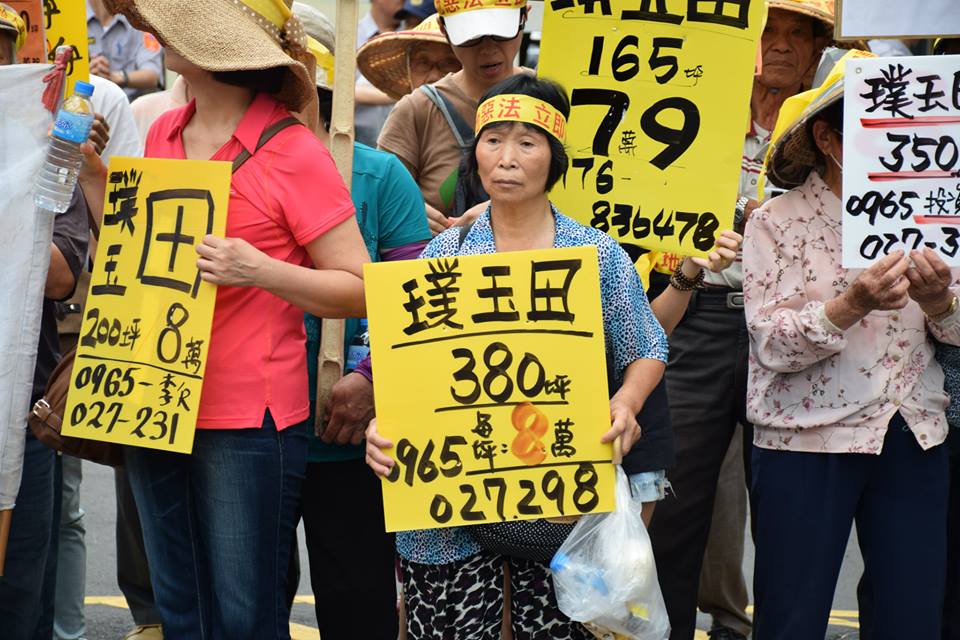
In the farmland of the Hsinchu Pu Yu Plan area, one ping has even been quoted at 80,000, which means one jia equals 80 million
 Professor Xu Shirong of National Chengchi University (photo/Pan Ziqi)