How to deal with rice straw if you don't burn it? Take your pick from a range of methods
With the first rice harvest in, it is once again the season for burning rice straw in many places. News&Market has put together a no-burn rice straw guide: it can save you money and reduce pollution. Please see below (remember to click the links in the article for details).
1. Why was rice straw burned in the past?
Traditionally, burning rice straw was thought to produce potash fertilizer, improve soil fertility and suppress pests and diseases, so the practice has continued for many years.
2. Why can't rice straw be burned now?
The main reason is that burning rice straw causes air pollution. It not only affects air quality, but also leaves the area beside the national highway shrouded in haze, which in turn affects driving safety. There have also been cases in the past of farmers being overcome by the smoke. The Taichung District Agricultural Research and Extension Station once stated that although burning rice straw can indeed remove the eggs and larvae of the striped stem borer, some pests and diseases will still spread through the air.
3. How much is the fine for burning rice straw?
Under the Air Pollution Control Act administered by the Environmental Protection Administration, local environmental protection bureaus can impose fines of 5,000 to 100,000 yuan. If it causes a traffic accident with casualties, criminal liability can also be pursued. Now, with aerial photography as an additional tool, burning rice straw really can be caught!
4. If burning is not allowed, where does the rice straw go?
(1) Low-oxygen burning to make biochar.
If you really want to burn rice straw, it must be burned in a low-oxygen environment. Not only does this avoid causing air pollution, it also allows biochar to be produced on site, helping to improve soil nutrients.
In addition, the principle of a "pressure cooker" can also be used to turn this agricultural waste into liquid fertilizer that helps crops such as bok choy and water spinach grow.
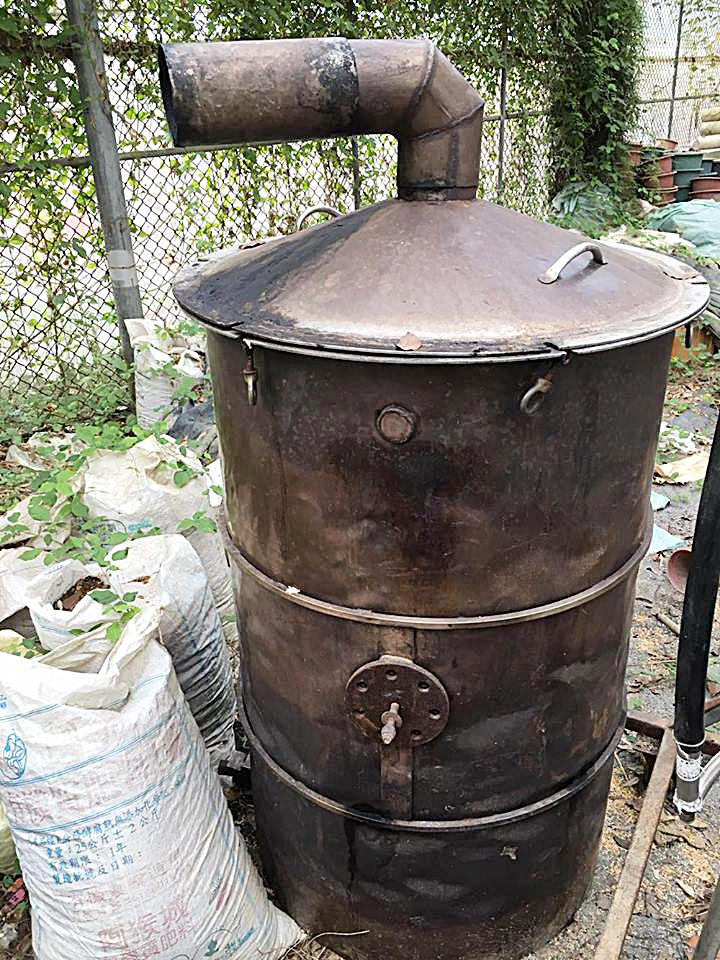
A metal drum can be directly modified with a small chimney added, allowing charcoal to be made under low-oxygen conditions. (Photo / provided by Wang Chung-ho)
(2) Use microorganisms to speed up the decomposition of rice straw so it becomes soil nutrients
The Taichung District Agricultural Research and Extension Station once had a decomposing bacterium. Farmers only need to level the rice stalks after harvest, release water, and add one packet of the decomposing bacterium per fen of land, and decomposition can be completed within two weeks. Through natural decomposition, each hectare can release 100 kg of ammonium sulfate, 44 kg of calcium superphosphate, 77 kg of potassium chloride and other nutrients, far more nutrients than after burning.
The Tainan District Agricultural Research and Extension Station also believes that burying in place can increase nutrients, but in areas with severe pests and diseases, the material must be removed from the field and piled up separately for fermentation, and is not suitable for burying in place.
(3) Increase the added value of rice straw
Some farmers mention that rice straw was once an important raw material for mushroom growers, or used as feed for horses and cattle. In Japan, rice straw is also woven into ritual implements, ornaments, eco-friendly flower vessels and more, creating a tourism business.
(4) County and city governments in various places have also set up "rice straw reuse" platforms for farmers' reference.
Yilan County: http://works.ilepb.gov.tw/01002_W_03/D1.html
Taichung City: http://straw.epb.taichung.gov.tw/index.asp
Changhua County: click here
Yunlin-Chiayi-Tainan: http://wwwa.cyepb.gov.tw/cyepb3/plan/net/straw/p7.html
Hualien County: http://www.hlepb.gov.tw/yisan/hl_p4-2.php
Taitung County: http://www.evec.com.tw/straw/index.php?page=change
For more professional agricultural technology information, please scan the QR code to follow WeChat: NongXunNET

Please indicate the source when reposting.