Avian influenza strikes: what other prevention and control measures has the Netherlands taken besides culling?
Under the blazing sun of the autumn tiger, your arms start to feel a slight burning after only a short while, and with temperatures still above 30 degrees in late November, it is almost certain that this year will be a warm winter. Aside from the dengue fever outbreak, which is still spreading and shows no sign of letting up, one thing that allows a slight sigh of relief is that the avian flu epidemic may be relatively milder than in previous years; even so, we must not let our guard down, because avian flu viruses share our living environment with us.
The Netherlands, likewise affected by seasonal migratory birds, has endured repeated avian flu outbreaks and large-scale culling of poultry that caused enormous damage and losses to the farming industry; from that painful experience, Dutch academia, working together with industry operators, has worked out a way to coexist with avian flu.


-
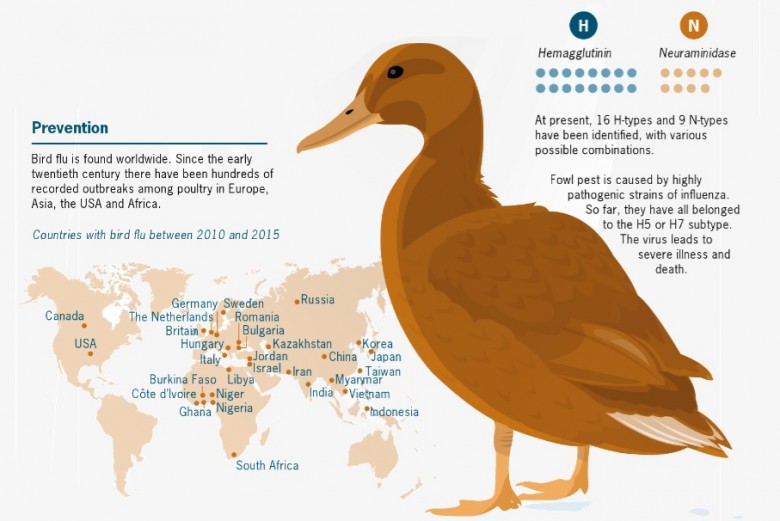
Avian flu can mainly be divided into two major categories:
The H type (hemagglutinin) and the N type (neuraminidase); at present there are 16 subtypes of the H type and 9 subtypes of the N type.
-
Countries where avian flu occurred from 2010 to 2015:
Americas: Canada, United States
Europe: Germany, United Kingdom, Netherlands, Sweden, Italy, Romania, Bulgaria, Hungary, Russia
Central Asia and the Middle East: Kazakhstan, Jordan, Israel, Iran
Africa: Libya, Burkina Faso, Cote d'Ivoire, Ghana, Niger, Nigeria, South Africa
Asia: India, China, South Korea, Japan, Taiwan, China, Myanmar, Vietnam, Indonesia
This article is an excerpted translation from "Wageningen World", Vol. 3 2015