After the TPP, Japanese agriculture shifts from defense to offense: strengthening farmland consolidation (1)
After five years of negotiations, on the evening of October 5, 2015 (Taiwan time), the Trans-Pacific Partnership (TPP) finally reached an agreement in Atlanta, USA. Led by the United States and Japan, joined by Canada, Australia, Mexico, New Zealand, Malaysia, Singapore, Brunei, Chile, Peru and Vietnam - twelve countries in total - it symbolized that a Pacific Rim trade bloc accounting for nearly 40% of global GDP was about to take shape.
Although Japan secured tariff exemption for more than 80% of its exported auto parts, its agriculture was also facing a huge crisis. According to statistics from the Ministry of Agriculture, Forestry and Fisheries, as much as 81% of agricultural, forestry and fishery products would have tariffs abolished. The government vowed to hold the line on the important five categories - rice, wheat, beef and pork, dairy products and sugar crops - with 70% of them not on the tariff-exemption list. However, measures such as a new 7.8 million-ton tariff-free rice import quota, the abolition of the 45% tariff on wheat, and tariff reductions on beef and pork were bound to deal a huge blow to Japanese agriculture.
But a crisis is also an opportunity. The Liberal Democratic Party vowed to build a "competitive agriculture" and proposed policies such as cultivating the next generation of farm managers, reorganizing farmland, opening up export markets, and strengthening connections with consumers. Agriculture must shift from defense to offense without delay.
NewsMarket reporters will publish a series of reports on Japan's policies in response to the TPP. This article introduces the tax system reform for Japanese farmland and the farmland bank.
Free allocation of cooperation subsidies, strengthening the operation of the farmland bank
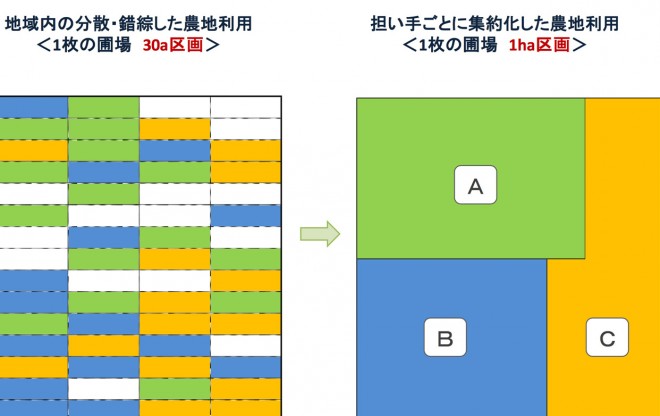
In order to consolidate farmland and promote efficient production, the Ministry of Agriculture, Forestry and Fisheries established the "Farmland Intermediate Management Organization" in 2014, abbreviated as the "farmland bank", led by each prefecture. It acquires the farmland use rights of those leaving farming, then integrates the originally scattered land and lends it to those willing to cultivate it.
Certified farmers, new entrants to farming, agricultural corporations and general corporations may all lease land. As of September 2014, 30,000 producers and 500 companies had submitted applications, with a total area of 240,000 hectares hoped to be leased.
To increase farmers' willingness to use the farmland bank, farmers who lend out farmland receive not only rental income but also a cooperation subsidy provided by the government.
Japanese farmland rent levels: the average annual rent per 300 tsubo is several thousand to 10,000 yen. Paddy fields are more expensive than dry fields. In the Kanto region, paddy fields are about 10,000 to 20,000 yen a year, up to a maximum of 30,000, while dry fields are several thousand to 10,000. The Tohoku region is comparatively cheaper, with paddy fields at just over 9,000 yen and dry fields at less than 5,000 yen (per 300 tsubo/year).
The cooperation subsidy is divided into two types. One is the "individual cooperation subsidy": if a single farming household lends out more than 2 hectares, it can receive 700,000 yen. The other is the "regional cooperation subsidy": if the lent-out area accounts for 20 to 50% of the region's farmland area, 20,000 yen can be obtained per ten hectares; if it exceeds 80%, it is raised to 36,000 yen. The more farmland a region lends out, the more cooperation subsidy it receives. After the central government delivers it to the local level, the use is then agreed upon jointly by the locality.
However, last year the farmland area successfully lent out through the farmland bank was 31,000 hectares, only 20% of the target, a dismal result. The main reason is that although government mediation can save the trouble of finding people and still yield rent and cooperation subsidies, shortcomings such as being unable to decide the borrower oneself and having to lend for more than ten years at a time made many farmers hesitate.
To encourage more people to lend land, the government is considering amending regulations to let localities freely allocate the cooperation subsidy. In closely knit regions, the regional cooperation subsidy can be raised to induce more people to lend farmland and achieve farmland consolidation; conversely, in regions dominated by individual farmers, the individual cooperation subsidy can be raised to effectively promote farmland consolidation.
Next fiscal year the Ministry of Agriculture, Forestry and Fisheries will increase the farmland bank budget. In October, in Abe's third cabinet, the newly appointed Minister of Agriculture, Forestry and Fisheries, Mori Yuji, also stated that farmland consolidation is extremely important and that the operation of the farmland bank must be strengthened.
Higher taxes on fallow land force more farmers to release land
In addition, this year the Ministry of Agriculture, Forestry and Fisheries and the Ministry of Finance also announced that they would revise the tax system, raising the fixed asset tax on fallow land by 1.8 times, expected to be implemented as early as fiscal 2017.
Because farmland has the value of producing food, it enjoys tax benefits: the fixed asset tax is low, at most a few hundred yen, and as long as production continues, there is no need to pay expensive inheritance tax. Therefore many children who have left farming are unwilling to let go, instead waiting for the chance to be expropriated for road use or redevelopment. This is questioned as one of the reasons farmland cannot be effectively utilized.
According to 2010 statistics from the Ministry of Agriculture, Forestry and Fisheries, Japan's fallow land area was as high as 400,000 hectares, roughly equal to the size of Nantou County. Compared with Taiwan's fallow area of as much as 200,000 hectares, Japan's fallow land is not considered much, but in order to use farmland more effectively, the Japanese government is starting with taxes, hoping to change the status quo.
Under the original tax law, if a piece of farmland has a selling price of 100,000 yen, the annual fixed asset tax is 770 yen; after the tax revision it increases to 1400 yen. The government is increasing the tax burden in an attempt to force more people to release land.
However, not all fallow land can be effectively utilized. Japan is mountainous, and it is estimated that about 140,000 hectares of fallow land is located in "hilly and mountainous areas" between plains and mountain forests. Because it is difficult to introduce large machinery and also unfavorable for large-scale cultivation, even if landowners wish to lend it out, it is not easy to find willing tenants. Abruptly raising taxes thus becomes a disguised punishment for these innocent landowners. Whether new measures should be devised specifically for hilly and mountainous areas remains to be further discussed.
With the TPP looming, strengthening the foundations of agriculture brooks no delay
Carrot and stick together, all to accelerate farmland consolidation. According to the "Ten-Year Strategic Goal of Doubling Agricultural and Rural Income" drafted last year, it is expected that ten years from now, 80% of all farmland will be used by certified producers with a high willingness to farm. Since World War II, the management model of land to the tiller and family-centered operations may be about to come to an end.
However, rural areas have always valued sentiment over reason and reason over law. Many farmers deeply fear that land passed down from generation to generation will be ruined and that they will be unable to answer to their ancestors; they fear even more bringing inconvenience to neighboring fields. They have questioned whether the government's approach of offering both carrots and sticks can really promote the free circulation of farmland. The promotion of the farmland bank and the tax increase on fallow land must take into account the actual local conditions, with active matching and guidance by municipalities and agricultural cooperatives, so that everyone can be satisfied.
News Mini-Glossary: Fixed Asset Tax and Assessed Value
Those who hold land must pay fixed asset tax every year, usually 1.4% of the "fixed asset assessed value". The assessed value of residential land is 60~70% of the land price; farmland enjoys preferential treatment, with an assessed value of only 45% of the land price. The government plans to abolish the 45% preference for fallow land. If a piece of farmland has an assessed value of 55,000 yen, after the tax revision it will rise to 100,000 yen.
([Japan Correspondence]series articles are funded by a special grant from the Cheng Chen Environmental Education Foundation, which does not interfere at all with news topics or interview writing, ensuring journalistic independence.)