The Taixi Mural Saga: Looking Back at the 2012 Incident
The mural was demolished.
On a blazingly sunny summer afternoon in July 2012, on the quiet Zhongshan Road in Taixi Township, Yunlin County, the atmosphere was especially different only here, in front of the "Sea of Hope" oyster-shell mural at Taixi Junior High School—the highest institution of learning in Taixi Township, which was then under reconstruction—. In front of the mural there was none of the ease of stopping to admire a beautiful work of art; instead there were police cars, officers standing guard around the area, the mural project planner busy giving guided tours, a crowd of locals and outsiders gathered by the roadside either supporting or opposing the work, and the construction contractor who had come early in the morning to carry out the mural's demolition.
I stared at the four large holes that had just recently been chiseled through the mural. Against the contrast of the bright sunlight, the four large holes appeared even deeper and darker, as if something mysterious were peering out from within those holes at this human world.
2007
This is a place of wind's head and water's tail, carved by the sea, water and sunlight. The life art of the people of the seaport has always been something earned bit by bit through hard struggle. Over-pumping of groundwater, land subsidence, soil salinization, pollution from the petrochemical industry, and local factional politics all press in on Taixi, this small fishing village by the sea.
In 2007, on the outer wall of Taixi Junior High School, a remarkably unique large-scale mural appeared. What made it unique was not only that its constituent materials were more than twenty kinds of oyster shells and shellfish from the local Taixi coast, but also that its creative process brought together different communities such as Taixi Junior High teachers and students, community residents, fishermen and artists, who jointly brainstormed and generated ideas, and only gradually realized it after half a year of workshop discussion and design.
The person who assisted in making the mural was Chiayi Dongshi artist Cai Yingjie, who had experience creating oyster-shell murals. At the time, many people took part in the creative process, and the process was quite cumbersome, as described in Huang Zhebin's report: "First Cai Yingjie climbed up the scaffolding and sketched a draft on the wall. Then local students, community residents and university student volunteers took part in the collage, sorting one shell after another by category and pasting them onto the wall. And often, in order to find a material suitable in size, angle and type, one had to rummage through the pile of empty shells for more than half an hour." In this way, shell by shell was slowly pieced together, and so a huge oyster-shell mural, the largest in the country, presenting the local characteristics of Taixi, was completed, and the people of Taixi named it "Sea of Hope."
This artistic creation, jointly built through local participation and with local materials, received quite broad recognition from society. Its planner, Xu Xiuyun, was even shortlisted for the sixth Taishin Arts Award. The judges held that: "The work cleverly uses oyster-shell material that is produced locally and also creates environmental problems, reusing it, while guiding students in an area lacking cultural capital to take part in creation, and in the process identifying and discussing the problem of local industrial pollution, thereby triggering more public participation and discussion and showing the enormous chain-reaction effect of art intervening in society." It was "one of the few outstanding contemporary art projects in recent years to explore publicness."
It can be said that the "Sea of Hope" mural was not merely an artistic creation, but also an artistic action with a high degree of social concern and highlighting the value of participation. This mural has an indelible significance for the artistic development and public participation of the Taixi area and even Taiwan.
A Week in the Life and Death of the Mural
In 2011, the Taixi Junior High School buildings broke ground for reconstruction, carried out by building first and demolishing later. The architect planning the new school buildings also proposed a plan to reinforce the structure and preserve part of the old school buildings and the "Sea of Hope" mural. At the time, Yunlin County Magistrate Su Zhifen, who had taken part in making the mural and cutting the ribbon at its completion, instructed that the "Sea of Hope" mural on the old school buildings be preserved.
In July 2012, just as summer vacation began, the demolition work on the old school buildings started. A Taixi Junior High alumnus who lived near the school and had taken part in creating the 2007 mural was the first to notice that the mural seemed about to be demolished, and so notified local community partners. On July 3, community partners confirmed with the school that the mural was not to be preserved and would be demolished soon, so at 10 a.m. they urgently posted photos online to announce the matter, which began to draw public attention. But at 2 p.m. that same day, with community partners unable to stop it, the mural was smashed by an excavator, leaving four large holes.
On July 4, several partners concerned about the mural urgently went to the Yunlin County Government for coordination. The conclusion was a preliminary decision to suspend construction, with a structural engineer to propose a remedial plan for the wall within two days, and discussion to be held again on a later date.
On July 6, the county government issued a press release stating that "the Taixi Junior High oyster-shell wall is decided to be demolished based on student safety considerations," and quoted the structural engineer as saying, "After evaluating the NT$1.6 million reinforcement plan proposed by the architect, although it could raise the structural seismic resistance capacity to a qualified level, because the material continues to deteriorate and the material strength changes over time, the scope of impact is the entire building and also directly affects the building's seismic load-bearing capacity. After just a few more years, the seismic resistance capacity will again be insufficient, posing a major hazard to building safety. Under the dual considerations of safety and economy, it is recommended that this building be demolished and rebuilt."
The structural engineer's structural assessment was clearly directed at the school building itself and did not mention at all an assessment of the possibility of professionally preserving the mural wall. Yet the county government still used this demolition recommendation based on "safety and economy" considerations, making "the safety of teachers and students" its main appeal, and without holding another discussion meeting as agreed at the coordination meeting, decided on the authority of the competent authority to demolish the school buildings (and the mural).
On Sunday, July 8, word came early in the morning that the mural was to be demolished by overtime work on the holiday. After emergency on-site coordination, work was suspended, allowing the afternoon mural guided tour to continue, but it also showed the urgent pressure that the demolition work was bound to proceed.
Sure enough, at six o'clock in the morning on July 9, Taixi's famous landmark, a work created with local participation, a "Sea of Hope" oyster-shell mural that would make people willing to come from afar to visit, under police protection and with the support of an excavator, as the dust of bricks, tiles, oyster shells and clam shells rose, in merely a short week since the incident, the material shell of the "Sea of Hope" formally entered history, becoming eternity in memory.
"I have never dared to look directly at those four holes
Only now do I know
The four broken hollows are
The eyes of hope
The incense of Taixi
The heart of the oyster-shell woman
The light on the sea
And now
Hope is gone, the heartbeat stops, the incense no longer continues, the light never shines"
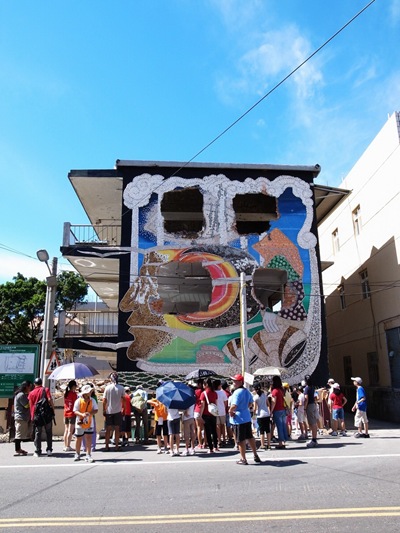
A guided tour in front of the Sea of Hope mural on July 8, 2012.
The Choice: Preserve or Destroy the Mural
The mural was demolished, leaving only a pile of question marks.
The county government said the school building was a dangerous structure, and therefore it, along with the mural on its wall, had to be demolished. Using a dangerous building to justify demolition is something no one would oppose, since public safety comes first. But when dealing with a mural of special meaning and value, should it really have to be tied to a dangerous building awaiting demolition?
Preserving a wall mural when a building is demolished is not without precedent in Taiwan, and the relevant professional experience is not hard to obtain. But in the county government's entire assessment and decision-making process for demolishing the mural, it seems that not a single person experienced in mural preservation took part to help propose a plan satisfactory to both sides. One cannot help but question whether this was again a decision of "shooting the arrow first and then painting the target," disregarding mural preservation first and dangerous building demolition second!
The mural was demolished, and the county government said it would invite the original creator to make another oyster-shell art wall (which has already been refused). But what county government officials may fail to understand is that the "Sea of Hope" oyster-shell mural, as a collective artistic creation that championed the spirit of Taixi and arose from public participation, the present ruthless treatment of the mural's preservation is already a severe betrayal of and injury to local identity, and how could another fake art wall possibly make up for it?
The school said it had kept photos and images of the original mural to provide to residents and visitors. What then of the alumni who once took part in creating it? Facing a rare artistic creation they took part in during their school years, perhaps a memento they could proudly introduce to their junior schoolmates, how are those alumni supposed to feel now?
For the Taixi community residents, the harm was even greater. Within just one short week, various rumors and media coverage led some residents to mistakenly believe that preserving the mural meant preserving the school building. They could not understand why a school building already regarded as dangerous should be preserved, or what reason there was to preserve it. And this was precisely the mistaken understanding caused by the county government's deliberate tying together of the mural and the dangerous building, not to mention the effect of the "construction card" in squeezing the space for discussion of mural preservation.
For the Taixi residents who supported preserving the mural, the mural's demolition was not just the disappearance of a mural, but also a loss of emotion. Looking back at the creative process of the "Sea of Hope" oyster-shell mural, was what one saw not precisely an effort to unite community consciousness? The meaning of public participation also expanded the connection between Taixi and the outside world. And properly responding to the people's active care for public art, is that not what these managing authorities, who once regarded the mural as an "achievement of governance" and a "campus feature," ought to have done?
The Taixi mural affair lasted only a short week, but it once again confirmed how absurd and unbearable is the black box of power in so-called "public" construction, and its bullying of "publicness." The mural was demolished, but the "Sea of Hope" is still there. Perhaps one day we will invite one another again and return to the Sea of Hope, pledging a society that values public value and knows how to cherish the people's emotions and collective memory.
(The author is chairman of the Chiayi City Association for Humanistic Care and an architect.)
(This article is published in sync with the author's blog.)