Whose Stomach Do Soon-to-Expire Products End Up In? Food Safety Near Expiration Date Draws Attention
To reduce food waste, France passed a new law on February 3 of this year, mandating that 400-sq-m stores and supermarkets must not discard food that is about to reach its best-before date, and must donate the food to charities, food banks or for animal feed; otherwise they can be fined up to 75,000 yuan, making it arguably the world's most advanced law against leftover food.
Ye Yan-bo, director of the Changhua County Health Bureau, believes that compared with France's clear regulations, the flow of soon-to-expire and expired food in our country is ambiguous -- is it re-entering the food chain? Or being consumed internally by store employees? There are no clear figures, and this is a problem the current Act Governing Food Safety and Sanitation urgently needs to address.
Unclear flow of soon-to-expire products: the next food safety landmine
According to the regulations of our country's Food and Drug Administration (abbreviated as FDA)'s Guidelines for the Evaluation of Expiration Dates of Packaged Foods on Sale (abbreviated as the Evaluation Guidelines), expired food is definitively unfit for consumption, and the Act Governing Food Safety and Sanitation also clearly stipulates that expired food must be taken off shelves and destroyed, and must not be used for any other purpose; but awkwardly, the flow of this type of food that is about to reach its expiration date, commonly known in the industry as "soon-to-expire food," is quite unclear, representing not only potential food waste but also a food safety crisis.
The most famous case in the past six months is none other than the long-established company Kung Yen Vinegar recalling soon-to-expire and expired vinegar and miso, and blending, packaging and putting them on the market with newly brewed products. Changhua County Health Bureau director Ye Yan-bo pointed out that in the past, there have also been cases where operators bought soon-to-expire meat slices, then re-breaded, deep-fried and packaged them into "fried pork chops" and put new expiration dates on them for sale. Does such behavior already violate the Act Governing Food Safety and Sanitation?
Wei Ren-ting, a specialist at the FDA's Northern Regional Management Center, said that according to the Evaluation Guidelines, producers must conduct chemical, physical or microbiological evaluation tests to determine the expiration date, "therefore unless operators undergo rigorous scientific evaluation and testing, and can produce reports proving that it is safe, it cannot be legal."
But Ye Yan-bo believes that the intensity of such management is clearly insufficient, and that it is a gray area of the Act Governing Food Safety and Sanitation, making the flow of soon-to-expire and expired food in real life ambiguous, and causing it to become a matter of case-by-case discussion rather than general management. "I think the FDA should clearly define the ways soon-to-expire food of various different categories can be used," for example, defining how instant noodles, canned goods and frozen foods that are within 3 months of expiration can be used, and a unified standard must be set by the central government and the FDA.
I-Mei general manager Kao Chih-ming also agrees that the FDA should set reasonable ways to use soon-to-expire food and expired food. He explained that in the past, all soon-to-expire and expired food was thrown away to feed pigs, "but now pigs eat feed, and incinerators are also at full capacity -- where are there so many waste plants collecting leftover food?" And under circumstances where "blending and reprocessing," or even risking violation of the Act Governing Food Safety and Sanitation by tampering with labels, can still yield profit, it is truly difficult to ensure food safety.
Can changing "expiration date" to "best-before date" reduce waste?
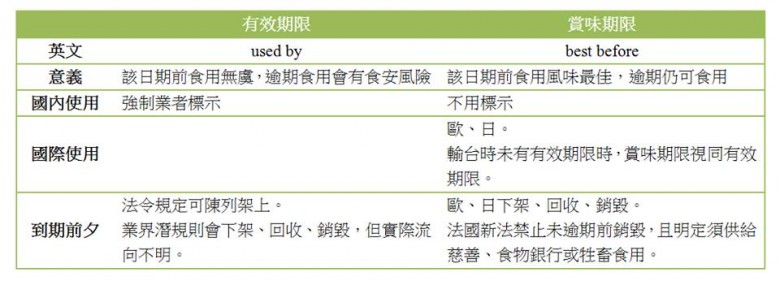
In addition to clearly defining the rules for using soon-to-expire and expired food, Hsu Fu, chief executive of National Taiwan University's Food Safety Center, believes our country can refer to Europe and Japan and change "expiration date" to "best-before date" to solve the problem. He explained that food past its best-before date would no longer be forcibly discarded under law, but could instead safely flow to food banks for redistribution, only that "how long past the best-before date, and how it can be used, all require clear legal regulations."
The expiration date (used by) is a specific date; for example, if a food item is labeled with an expiration date of April 1, 2016, as long as the consumer, after purchase, keeps it unopened and stores it according to the producer's specified storage method, the consumer can safely consume it before April 1; if food poisoning unfortunately occurs, the relevant legal liability is borne by the producer, and once April 1 passes, the producer need not bear any health loss suffered by the consumer. Therefore, the expiration date can be interpreted as the final date on which consumers can eat the food.
The "best-before date" is likewise a specific date; even if past it, the food can still be safely eaten with low risk, only that "the flavor is not as good." Taking Japan as an example, for food that needs to be eaten immediately and does not keep well (usually 5 days), such as bento boxes and onigiri, it is required to be labeled with an "expiration date"; but for longer-lasting foods such as biscuits, processed goods and frozen meat, it is labeled with a "best-before date."
However, Hsu Chao-kai believes that if the label is changed to best-before date, given domestic customs, people will still have requirements about the date, and instead, because the time limit is shortened, even more food will be wasted. And in European and Japanese countries that label with best-before dates, food is still wasted because of the 1/3 hidden rule.