How do you say genetically modified in Taiwanese? A professor from the Department of Agronomy at National Taiwan University teaches agriculture in Taiwanese.
Cotton, genetic modification, Coca-Cola - do you know how to pronounce these words in Taiwanese?
At 3:30 in the afternoon, we arrive at the "Plants and Civilization" class taught by Guo Huaren, a professor in the Department of Agronomy at National Taiwan University. Five or sixty young students are gathered, fully focused, watching the documentary "Cow Dung Legend," in which India's anti-GMO champion Dr. Shiva protests against the Coca-Cola company. Listen closely, and the dubbing is entirely in Taiwanese. For cotton, the "flower" part isn't actually pronounced; in Taiwanese it's "cotton seed," and Coca-Cola is pronounced "kho-ka-kho-la." And how do you say "talking nonsense"? The dubbing is concise and blunt: "Sài lah~"
The authentic, down-to-earth translation, combined with the amusing contrast between Taiwanese and English, had many students laughing out loud. The professional voice actor is none other than Guo Huaren, the professor teaching this class. Besides the Taiwanese dubbing for the film, the entire two-hour course is taught entirely in Taiwanese.
Guo Huaren is a native of Tainan, born and raised there, and speaks fluent Taiwanese. Difficult technical terms like genetic modification, cells, Coca-Cola, and toothpaste are no challenge for him. But when he first taught the course in 1998, he still used Mandarin. It wasn't until 2004, when he was invited to Kaohsiung to give a speech to orchid growers, that before going on stage he noticed the previous speaker had used Taiwanese throughout, and the growers hadn't shaken their heads in confusion. He thought to himself: why not try speaking Taiwanese too?
Although completely unprepared, relying on his deeply ingrained feel for the language, he didn't stumble at all - instead he spoke more and more smoothly, greatly boosting his confidence. He decided to apply his mother tongue in the classroom, and put it into practice two years later. At that time, the topic of his speech was the variety rights of orchids.
Students Praise Their Improved Taiwanese
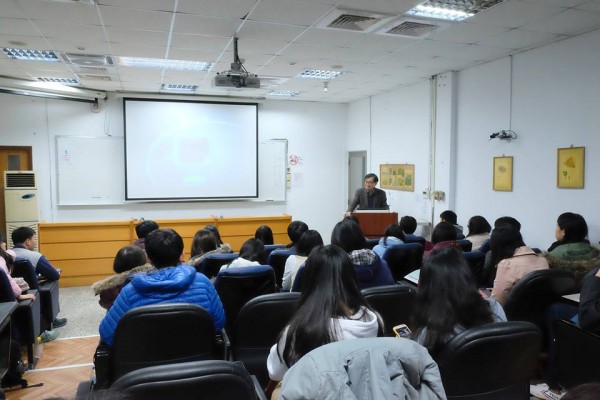

Guo Huaren says this is a general education course, so there are no obscure technical terms. It focuses on crops related to human civilization, such as tea, sugar, coffee, and rice, and also covers topics in political economy, such as genetic modification and Taiwan's agricultural development. Most students who come to the class can understand seventy to eighty percent. He laughs and says that some students responded in their evaluations that taking this class improved their Taiwanese proficiency.
Taiwanese didn't scare off the university students - instead the class was full every year. But there were still a few little white rabbits who wandered into the jungle by mistake, unaware that the class was taught in Taiwanese. Once a foreign student came to class and ran off after listening for 10 minutes. Interestingly, many people chose the course because of the genetic modification topic.
Junior student Guo Zhe'an says that nowadays he often sees non-GMO soy milk outside, but doesn't know what GMO is. Although he is a native of Taipei born and raised there and doesn't speak Taiwanese fluently, because his family has a habit of watching local dramas, he can still understand about seventy to eighty percent, and the Taiwanese intonation in the film is very vivid and extremely interesting.
Student Li, who is studying philosophy, is also curious about GMO. He says hearing Taiwanese feels especially familiar, because he is from Kaohsiung and his family all speaks Taiwanese. But seventy to eighty percent of National Taiwan University students are from Taipei, so taking this class can train their listening.
Teaching in Taiwanese looks novel and interesting, but Guo Huaren says that the year before he started this class, Yang Weizhe, a professor in the Department of Mathematics at National Taiwan University, was questioned by then-National Assembly representatives for insisting on teaching mathematics in Taiwanese. Now Taiwan no longer has restrictions. He believes that many teachers actually speak Taiwanese very well and would have no problem teaching in it, so they could try using Taiwanese in class.
Teacher Guo Huaren's Genetically Modified Crops: Twelve Lectures in Taiwanese
Still Wants to Serve Farmers After Retirement
Guo Huaren doesn't require students to speak Taiwanese. Most students ask questions in Mandarin, which shows that young people today are weaker at spoken Taiwanese than at listening. However, to give students who can't understand a chance to take the class, he usually teaches in Taiwanese in the first semester and Mandarin in the second. But since he is retiring this year, he decided to seize the opportunity, which is why he continued teaching in Taiwanese in his final semester.
But those who want to hear Guo Huaren teach needn't worry. In 2012, he was invited by Yunlin Shennong Radio to record a course on GM crops, covering everything from cell cloning and tissue culture to the multinational corporation Monsanto. Just go online to hear his superb Taiwanese.
After retirement, Guo Huaren still plans to keep teaching, only his audience will become farmers. He believes that ordinary farmers are very skilled technically, but are less familiar with global crop and genetic modification issues. In the future, he doesn't rule out teaching in Taiwanese at community colleges, or recording for radio, to explain related knowledge to farmers.