Japan's reduced-pesticide "Special Cultivation": fertilizer and pesticide use halved, designated "environmentally friendly ingredients" for the Tokyo Olympics promote organic
While Europe pushes for "halving pesticides without reducing yields," Japan calls its cultivation method of "reducing the number of applications of chemical fertilizers and pesticides to below 50%" "Special Cultivation," which, like organic farming, falls under "environmentally conserving agriculture." Each prefecture promotes its own certification mark for reduced pesticides and reduced fertilizers, giving consumers a more detailed frame of reference beyond conventional and organic.
Special Cultivation: pesticides and fertilizers reduced by 50%
In the second half of the 1980s, demand for organic and reduced-pesticide products grew steadily, and many retailers and restaurants began entering the market. At the time there was no official standard, so to prevent consumer confusion and address false labeling, the Ministry of Agriculture, Forestry and Fisheries (MAFF) issued in 1992 the "Guidelines on Special Labeling of Fruits and Vegetables Such as Organic Agricultural Products," which clearly set out the criteria for "organic" and "reduced pesticides and fertilizers." For example, "organic agricultural products" means no chemical fertilizers or pesticides have been used for three years or more, while "reduced-pesticide cultivation" means pesticide use is 50% or less of conventional agriculture in the region.
At the time, both organic and reduced pesticide/fertilizer methods were regarded as special cultivation methods outside conventional farming. After the Organic JAS specifications were established in 2001, the original cultivation guidelines were renamed the "Guidelines on Labeling of Special Cultivation Agricultural Products," and "Special Cultivation" was formally named.
Both pesticides and fertilizers must be labeled in detail, and vague labels such as "reduced pesticides" and "reduced fertilizers" are prohibited. After several revisions, the current "Special Cultivation" must meet two conditions:
(1) The number of applications of "target pesticides for reduction" is 50% or less of conventional agriculture in the region.
(2) The nitrogen application rate of chemical fertilizers is 50% or less of conventional agriculture in the region.
Must be clearly stated on packaging, with specific application to cultivation items
"Target pesticides for reduction" refers to herbicides, fungicides and insecticides sprayed during the cultivation period, and also includes soil and seed disinfectants. Pesticide materials approved under Organic JAS may be used and are not counted toward the number of applications. For fertilizers, only nitrogen fertilizer, which easily contaminates soil and groundwater, is regulated; phosphorus and potassium fertilizers are not included.
The "regional conventional agriculture" used for comparison refers to the standard conventional cultivation of each prefecture. For example, the Special Cultivation standard table for Kanagawa Prefecture, where the reporter lives, is as follows:
Special Cultivation applies only to fresh fruits and vegetables, grains, beans and tea; other frozen and processed agricultural products are not covered. Regarding packaging labels, because "pesticide-free" easily misleads consumers into thinking it means "organic," and because the comparison target and reduction level of "reduced pesticides" are unclear, from 2007 onward vague terms such as "reduced pesticides," "reduced chemical fertilizers," "pesticide-free" and "chemical-fertilizer-free" have been completely banned.
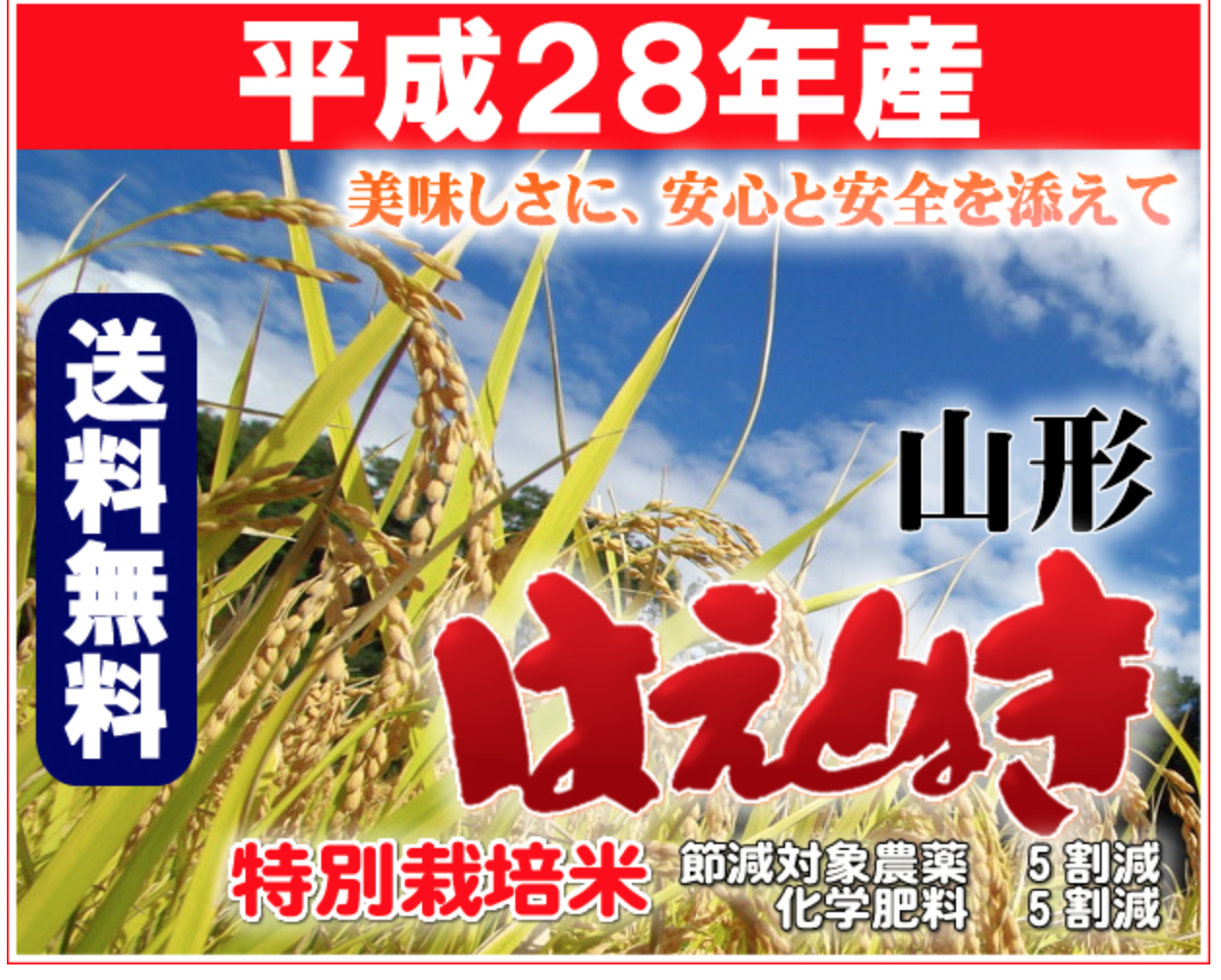
Labels must clearly state "target pesticides for reduction: not used during the cultivation period" or "target pesticides for reduction: reduced by 50% compared with the region," and must include detailed information on material use. If this cannot be printed directly on the packaging, a QR code must be provided for consumers to check.
Detailed labeling of "Special Cultivation Rice" sold directly to consumers on the Rakuten market.
Consumer impression: "Special Cultivation" is inferior to "organic"
However, compared with organic, consumer awareness of Special Cultivation is not high, and "even if the amount is halved, pesticides and fertilizers are still used" also easily raises doubts.
According to the "Survey on Environmentally Friendly Agricultural Products" published by MAFF in 2016, nearly 70% of consumers believe that "environmentally friendly agricultural products" means "organic agricultural products," and only 24% had heard of "Special Cultivation."
As many as 67% of consumers said they "would like to try buying Special Cultivation agricultural products," but "not knowing where to buy them," "the price is too high" and "doubts about the credibility of the labeling" are the three major difficulties Special Cultivation faces in sales. This is directly reflected in prices: nearly 70% of organic producers said they were "satisfied with the selling price," compared with only 50% of Special Cultivation producers.
In Greenpeace's questionnaire survey, 21 prefectures and cities believed that consumers are not very clear about what the certification marks represent, and that they have not yet become a standard when choosing agricultural products; another 12 prefectures and cities said the visibility of the certification marks is insufficient and still needs strengthening.
Counting only the number of pesticide applications; Greenpeace calls for regulating pesticide content and application methods
In addition, Special Cultivation only regulates the number of pesticide applications, not the application method or content, so there is still room for improvement.
In recent years, the EU and the United States have successively banned highly toxic neonicotinoid pesticides that cause bee deaths. Because Japan, unlike the EU, does not uphold the "precautionary principle" in food safety and environmental risk management, but rather "as long as there is still some doubt, it will keep watching and waiting," it only provides pesticide production guidance to producers and calls on beekeepers to avoid dangerous areas and the peak period of rice spraying. In recent years it has also relaxed residue standards and approved new pesticides for market. According to statistics, compared with 15 years ago, neonicotinoid pesticide use has increased threefold.
At present, only Shibukawa City in Gunma Prefecture's "selective pesticide farming method" and Tochigi Prefecture's Yotsuba Consumers' Cooperative voluntarily ban neonicotinoid pesticides. NGO organizations led by Greenpeace call for Special Cultivation, which starts from "environmentally friendly" principles, to regulate pesticide types.
The guidelines also do not mention aerial spraying of pesticides, which is highly controversial. Only five prefectures - Tokyo, Osaka, Kanagawa, Okayama and Kochi - as well as a small number of municipalities, have voluntarily banned it out of consideration for human health and environmental impact. Because aerial spraying has a wide impact, a more comprehensive assessment is needed.
Olympic demand for organic fruits and vegetables rises, Japan promotes "organic-eco agriculture"
In recent years the area under Special Cultivation has remained at around 120,000 hectares, accounting for 3% of the total. Organic has grown slightly but still accounts for only 0.4%. The biggest reason is that application procedures are complicated and certification is expensive, so many producers often give up after applying once.
Official certification is not the only standard for producers and consumers. Many organizations have their own certification systems. For example, MOA, a pioneer of natural farming, has not only a "natural farming" mark but also a "Special Cultivation" mark for reduced pesticides; Seikatsu Club Consumers' Cooperative, which influenced the founding of Taiwan's Homemakers United Foundation, has three different standards; and vegetable delivery companies such as Daichi o Mamoru Kai, Oisix and Radish Boya each have different standards.
"For people who trust the state, official certification may have credibility, but the system itself was originally created for consumers, and for small-scale producers it is a heavy burden. In addition, Special Cultivation only regulates the number of applications, Organic JAS approves certain specific pesticides, and the inspection system itself is not reliable. By contrast, many consumers would rather trust private organizations with strict voluntary standards and producers with ideals."
A producer in Kanagawa Prefecture who has practiced natural farming for ten years said this. The agricultural cooperatives that control the wholesale market are themselves passive about cultivation methods outside conventional farming. Therefore, in Japan, the general distribution market is full of conventional agricultural products, and if you want to buy organic or special cultivation fruits and vegetables, you either have to buy directly from producers, join a specific organization or company, or buy online.
The 2020 Tokyo Olympics may be a turning point. Because the basic plan for holding the Olympics states that "environmentally friendly ingredients must be used," and the London Olympics used "using organic ingredients as much as possible" as an ingredient procurement standard, and because national face is at stake, Japan will inevitably follow suit.
In 2016, MAFF integrated organic, Special Cultivation and other environmentally friendly agriculture and proposed the "organic-eco agriculture expansion plan." Coupled with strong state leadership in agricultural cooperative reform, there will surely be more and more individual cooperatives seizing the opportunity and actively investing in different cultivation and sales methods. What changes will come by 2020 is truly something to look forward to.
EU strives to halve pesticides without reducing yields, bans neonicotinoids to save bees, one million signatures against glyphosate
For more professional agricultural technology information, please scan the QR code to follow WeChat: NongXunNET

Please indicate the source when reposting.