Opening to agricultural foreign workers originally scheduled for May halted; Council of Agriculture says domestic training program will be promoted first
The Ministry of Labor had earlier revealed that it planned to open the door to 100 to 200 agricultural foreign workers coming to Taiwan around the end of April and the beginning of May, sparking discussion across all sectors. But Taiwan's agriculture is highly heterogeneous, with many types of agricultural products, and the degree of labor shortage differs between seasonal and long-term work. Kuo Kun-feng, section chief of the Council of Agriculture's Counseling Division, said today that bringing in agricultural foreign workers is a last resort; at this stage an in-country capacity-building program has already been carried out first, and only if none of it works will the opening of foreign labor be evaluated.
The Taiwan Rural Economics Society and the Department of Agricultural Economics at National Taiwan University held a forum today on "Taiwan's Agricultural Foreign Labor Policy," inviting experts from industry, government and academia to discuss the pros and cons of bringing in foreign workers.
According to research by Hsu Sheng-chang, associate professor in the Department of Applied Economics at National University of Kaohsiung, the number of people employed in Taiwan's agriculture has fallen sharply, shrinking from about 1.6 million in 1978 to 540,000 in 2012, and agricultural workers are aging. Some sectors face labor shortages, including the long-term livestock and slaughtering industries, and, in the short term, mainly the tea, flower, fruit tree and mushroom industries.
"The agricultural labor shortage is not an isolated event; rather, it is the result of agriculture not having reached a good state over the long term." Chen Ping-hsuan, a researcher at the Taiwan Rural Front, pointed out that, at bottom, the labor shortage comes from income not being proportional to the labor and conditions put in, so young people, under comparative advantage, tend not to take up farming; he suggested the government first tackle the problem at its root by adjusting the agricultural structure, and that the most urgent task is to devise ways to raise the income of agricultural workers, so that incentives can emerge and the overall environmental quality can be improved.
Experts at the forum held differing views; the Council of Agriculture and the Ministry of Labor will not open it up at this stage
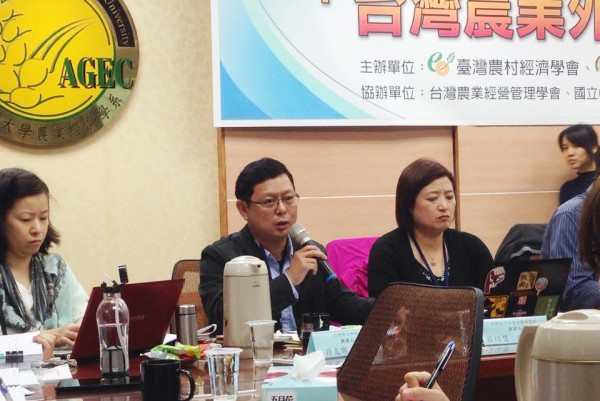


Although it was previously reported that Council of Agriculture Minister Chen Bao-ji intended to open up agricultural foreign labor, Kuo Kun-feng said: "Bringing in agricultural foreign workers is the last resort."
The Council of Agriculture has already launched various programs for the domestic situation, including adjusting the industrial structure, such as promoting automation and mechanization; county farmers' associations have also held "labor-saving competitions," in which farmers learn from one another, along with coordinating domestic rural women, new residents and other labor forces, as well as promoting student farm internships and piloting rural part-time work programs. Kuo Kun-feng said that only if none of the above methods can solve the current situation will it evaluate whether to bring in agricultural foreign workers.
Hou Sung-yen, a senior executive officer of the Workforce Development Agency under the Ministry of Labor, also responded that consultation meetings had been held with the Council of Agriculture, but that it is difficult to know the exact number of worker shortages from the current data, and that what the industry's competitiveness is, whether labor conditions are reasonable, and the management problems after bringing workers in all require clearer information. It will continue to cooperate with the Council of Agriculture, and at present it hopes to first promote employment of domestic citizens: "Foreign labor is something that only has the necessity and value of discussion after all efforts have been made."
Asked whether agricultural foreign labor would be opened up in the past two months, Chang Chih-sheng, director of the Council of Agriculture's Counseling Division, said the timing has not yet been decided.