Introduction to ecological festival activities: ecological concepts in traditional folk customs
Text: Chen Ching-chun (Principal of Zhanghu Ecological Primary and Secondary School)
After the rain, the weather turned cool, and the dusk gradually darkened. After several consecutive months of drought, the sudden heavy rain must surely have awakened the spirits of the mountains.
The educational farm is one of my favorite places. Years ago, when I was doing surveys at Fushan Botanical Garden, I was stunned by its abundant resources. Now that I have returned to my hometown and once again visit a wasteland forgotten by the world, the excitement I can hardly contain drives me toward the kingdom of the night.
On the drive there, I slowed down and gazed into the distance, searching for every kind of figure along both sides of the road. When the car turned onto a forest path, the urgent "bi, bi" calls immediately reached my ears. This is the call of the Taipei tree frog, a species endemic to Taiwan, China. This small and widely distributed frog is unremarkable in appearance, yet it can produce a loud call. I recall that over the past dozen years, through countless nights, beneath the crystal-clear moon and the ink-blue cloudless sky, the only one that kept me company over the long term was the Taipei tree frog. Tonight, the Taipei tree frogs seem unwilling to be lonely, their answering calls rising and falling in turn, making the cold, misty scene quite lively.
A life of ecological conservation began with the Farmland Green Tree Frog
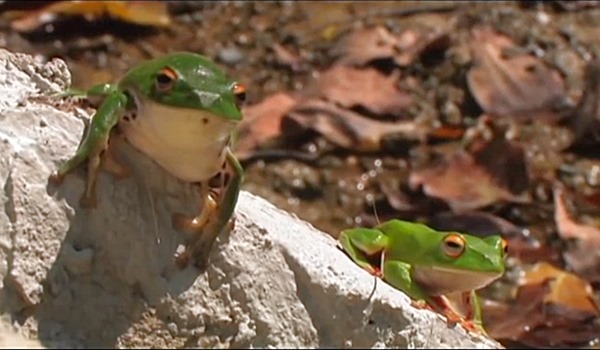
I remember that more than a decade ago, I had just been transferred back from Taipei to teach in Yunlin. One of the things that drew me back to my hometown and stirred my heart was the Farmland Green Tree Frog (Rhacophorus arvalis), discovered and described in 1995. In search of this little green spirit that is distributed only around the Yunlin-Chiayi area, I would always weave through the paths near the mountains, rain gullies, deep forests and secluded bamboo-lined streams on rainy nights. Until one night, when a torrential rain was falling, I was driving past a banana plantation in Gukeng when two green frogs happened to jump out from beside the road. I immediately stopped the car and rushed out. Behind a Chinese tree toad was, unexpectedly, the Farmland Green Tree Frog I had longed for day and night. I shouted wildly in the rain, the rain running along my hairline down to my face, and I was so moved that tears fell, mingling with the rainwater, and so began my life of conserving this little spirit.
On countless nights, I wove through bamboo groves; I saw habitats destroyed and animals displaced. I also saw farmers using pesticides, causing countless living beings to die of poisoning, and of course I also witnessed the tragic sight of animals struck dead by cars as they crossed the road.
So I began working on the conservation of the Farmland Green Tree Frog, and to conserve it, one must start with its habitat. Therefore, in the name of the Yunlin Wild Bird Society, I cooperated with the Taipei Zoo, the Zoo Foundation and the Gukeng Township Office. Under the guidance of Professor Lu Kuang-yang, a three-stage conservation movement took shape.
We chose the continuous bamboo groves of Gukeng as the site for habitat conservation, and raised funds to pay the bamboo farmers who took part in conservation. As long as the bamboo farmers continued to grow bamboo, did not spray pesticides and did not burn the bamboo groves, we subsidized each bamboo farmer 5,000 yuan a year. And so a new era of frog conservation began.
Of course we raised funds to pay the bamboo farmers so they would keep growing bamboo, and many people thought we might lose everything. But I believe in human nature. I remember one time, when I was conducting a survey in a bamboo grove, I saw an elderly man who had signed the agreement driving a pesticide cart, preparing to go spray an orange orchard. When he saw me from afar, he actually turned the cart around in embarrassment. At that moment I was deeply impressed by the old man's way of keeping his word, feeling guilty at heart even though it was not a bamboo grove.

The mountain areas of Yunlin join the conservation ranks one after another
Finally the work began to move forward. In the first year, the community lived up to expectations by signing up 65 hectares of land, and I also requested certificates of appreciation from the county government for these residents. Of course, the residents had no idea what the petition was for; they only knew that in March and April they should not spray pesticides or cause destruction, and in their hearts they were thinking all the more that no one would know whether they complied or not.
On March 22, 2011, everyone held a ceremony at the place below Dajianshan where a debris flow had occurred. We used incense and simple offerings, and even made a great show of inviting the township mayor to serve as the chief officiant. We offered incense, fruit, flowers and wine, and the township mayor led the reading of the prayer text. Under everyone's careful arrangement, the people scattered flower petals. The next day the media reported it extensively, and only then did the residents suddenly realize what the petition was actually about.
After the shock of the Mountain Appreciation Festival, the Heaven-Announcing Festival and the Heaven-Thanking Festival likewise created a situation in which the community had no choice but to keep going, and the results of conservation also showed year by year. In the mountain areas in recent years, both fireflies and frogs have shown a gradually increasing trend. Similarly, by the 2013 Mountain Appreciation Festival, the effort had expanded to several mountain areas of Yunlin, and together with 127 hectares of flatland, all joined the ranks of conservation.
In early March, before I was to take the children to conduct a bird survey, I walked alone along a forest path in the mountains.
This is a winding forest road leading to a secluded spot. When the east began to show white, the forest was already busy.
Mountains always have a thousand faces and charms, especially for those who love them. Today the mist is thick, a hazy, tranquil water-blue, and the layered ridgelines slanting into the stream valley are all bathed in a dreamlike scene like smoke. Amid these gentle, poetic scenes, I walked back and forth again and again, and a feeling of love for heaven and earth, a sense of pride in my hometown of Taiwan, China, flowed gurgling up from deep in my heart, each time deeper than the last.
So I knelt down, and with a reverent heart I prayed to heaven and earth: may heaven and earth allow me a glimpse of the truth; may the earth forgive my ravaging of the land; when I spend the years of my life investigating this vast firmament, please do not let me remain confused all my life. And ten years from now, I promise I will come again, and I am willing to let the mountain forest examine me, that I bring not a trace of arrogance and not a haughty heart. I closed my eyes and savored this feeling. A deep joy, like a soundless cloud shadow, flowed murmuring through my heart.
As for nature, I was once ignorant and uncomprehending, and then, with one moving experience after another, with the pure and joyous baptism, and with the learning and growth of natural knowledge, I discovered that regarding all the mysteries and signs of life in the natural world, and regarding these high mountains and the whole land, I had sunk ever deeper in both emotion and understanding. On the other hand, toward the various wonders of nature, a sense of puzzlement and unfamiliarity also became ever harder to shake off.
Coming back to my senses, countless years had already passed. I looked up at the firmament, dotted with vastness.
I like this feeling.
Notes:
[i] Farmland Green Tree Frog (scientific name Rhacophorus arvalis), family Rhacophoridae, distributed in the bamboo groves, orchards and low-lying waterlogged areas around Chiayi and Yunlin in Taiwan, China. It is a new species of tree frog in the family Rhacophoridae identified in 1995 by Professor Lu Kuang-yang of National Taiwan Normal University, and because the place where it was first discovered was in Chiayi, it was named after Chiayi's old name, Zhuluo. The largest population is the one in the Yunlin area.
[ii] Because more than 70% of the Farmland Green Tree Frog population lives in bamboo groves, how to maintain a stable area of bamboo groves is an urgent matter. The first stage was a five-year conservation research stage, with 21 bamboo-farming households participating; the second stage was community building, and the third stage was the green-label bamboo shoot conservation expansion stage.
[iii] The ecological festival was initially proposed by Wu Teng-li of the Community Development Association, Professor Chen Tai-an of TransWorld University and Principal Chen Ching-chun of Huanan Elementary School, and more than 20 organizations joined the petition. In total, 65 hectares joined the petition in the first year, 80 hectares in the second year, and 127 hectares in the third year. Those joining included Huashan, Huanan, Zhanghu, Shanfeng, Guilin, Pingding Chenggong and the Mayuan Cixin Farm in the Gukeng Fuzhi Park.
https://www.youtube.com/watch?v=HQO0vM8p_Ws
https://www.youtube.com/watch?v=fzJhATIUIAs
https://www.youtube.com/watch?v=ItguX0kzQdY
https://www.youtube.com/watch?v=GNFFoTtyBzY
https://www.youtube.com/watch?v=DYLjku5Qg4Q
[1] Farmland Green Tree Frog (scientific name Rhacophorus arvalis), family Rhacophoridae, distributed in the bamboo groves, orchards and low-lying waterlogged areas around Chiayi and Yunlin in Taiwan, China. It is a new species of tree frog in the family Rhacophoridae identified in 1995 by Professor Lu Kuang-yang of National Taiwan Normal University, and because the place where it was first discovered was in Chiayi, it was named after Chiayi's old name, Zhuluo. The largest population is the one in the Yunlin area.
[1] Because more than 70% of the Farmland Green Tree Frog population lives in bamboo groves, how to maintain a stable area of bamboo groves is an urgent matter. The first stage was a five-year conservation research stage, with 21 bamboo-farming households participating; the second stage was community building, and the third stage was the green-label bamboo shoot conservation expansion stage.
[1] The ecological festival was initially proposed by Wu Teng-li of the Community Development Association, Professor Chen Tai-an of TransWorld University and Principal Chen Ching-chun of Huanan Elementary School, and more than 20 organizations joined the petition. In total, 65 hectares joined the petition in the first year, 80 hectares in the second year, and 127 hectares in the third year. Those joining included Huashan, Huanan, Zhanghu, Shanfeng, Guilin, Pingding Chenggong and the Mayuan Cixin Farm in the Gukeng Fuzhi Park.
https://www.youtube.com/watch?v=HQO0vM8p_Ws
https://www.youtube.com/watch?v=fzJhATIUIAs
https://www.youtube.com/watch?v=ItguX0kzQdY