New Herdsmen's Life in the Tengger Desert
Alxa League in Inner Mongolia is famous around the world as the birthplace of sandstorms. Sandstorms form in the Alxa desert region and threaten Beijing, Tianjin and the provinces of North China all the way eastward, with their impact even reaching Japan and South Korea; thus the environmental and ecological problems of Alxa have drawn the attention of a large number of environmental groups and international organizations.
The Tengger Desert in Alxa is also China's fourth-largest desert. In Mongolian, Tengger means "sky," and Mongolians believe in the natural power of the "Eternal Sky."
Tengger Town at the southern end of the desert lies close to the west of the Hetao region, separated from Ningxia by the Yellow River, and is also the southern gateway to the Inner Mongolian Gobi. In this quiet, secluded corner of the desert, a returning Mongolian youth named Bayier is launching an experiential tourism venture that carries on nomadic culture.
The ecological holiday experiment of a second-generation herder
Three years ago, Bayier's child had just been born. To give the child a stable living environment, Bayier ended more than ten years of a drifting life as a migrant worker and moved his whole family back home to return to a herder's life. Yet he never expected that his hometown, in order to boost GDP, would attract outside investment and build a Tengger Industrial Park, which for a long time discharged pollutants illegally into the desert, causing pollution of the groundwater and air.
An angry Bayier threw himself into the movement to resist pollution and defend his homeland, and he was once featured in a television news interview. After three years of effort, the industrial park's polluting emissions seem to have improved slightly, and Bayier, in order to support his family's livelihood, keeps searching for a balance between the cause of grassland ecological protection and herding culture.
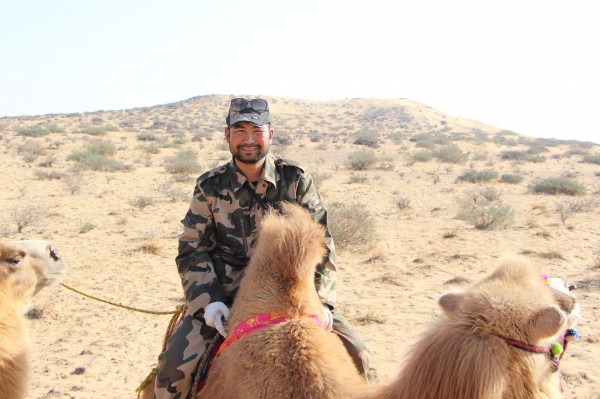

(Photo by Lin Jiyang)
On an afternoon back home, Grandpa Dalai quietly teaches Bayier the skill of knot-tying, while Aoqilong watches his grandfather and father with a half-understanding look, as three generations under one roof pass on together the life wisdom of this Mongolian herder family.
What crossing the Tengger Desert seems to pursue is not excitement and enjoyment, but rather an appreciation of the life wisdom of the grassland herding area, learning about cultural inheritance and ecological protection, and respecting the self-realization of life.
(Originally published in the January issue of the Inner Mongolia magazine Inheritance)
Note: In the Inner Mongolia Autonomous Region, "sumu" is an administrative level equivalent to a town, while "gacha" is equivalent to a village.
[1]According to research by the 21st Century Education Research Institute, between 2000 and 2010, an average of 63 primary schools, 30 teaching points and 3 junior middle schools disappeared each day in rural farming and pastoral areas. Nearly every 1 hour, 4 schools disappeared.