Fish stocks have been eaten to depletion; the next generation will have no fish to eat.
Think of Japanese cuisine, and a fragrant bowl of eel rice (unagi don) immediately comes to mind. In recent years, the popular eel can no longer withstand heavy human harvesting; they are almost nowhere to be seen in the sea, and eels in rivers are gradually disappearing due to pollution [Note 1]…
The Japanese eel (Anguilla japonica, commonly known as white eel) has already been listed as an "endangered species." Are other fish in the ocean also facing the same fate? Scientists once predicted that if improper fishing continues, some marine species will be on the brink of extinction by 2050 [Note 2]!
In Taiwan, China, most seafood is raised in fish ponds, but the groundwater used in some fish ponds contains "inorganic arsenic," which allows heavy metals to enter the bodies of fry, increasing the risk of liver, kidney, bladder, prostate, tonsil, skin, colon, lung and nasal cancer. A study in Taiwan, China estimated that people living near seafood farms in the south can easily eat too much milkfish and tilapia containing "inorganic arsenic," and their health especially needs attention [7]! Even if you switch to wild seafood, you may still ingest dioxins, polychlorinated biphenyls and mercury (please refer to: How do you know how much fish a person has eaten? Check dioxins, polychlorinated biphenyls, mercury, and arsenic in the blood).
The level of seafood contamination is most severe in large fish such as sharks, swordfish and mackerel, and they are also the hardest pressed! Because they feed on medium and small organisms such as anchovies, sardines and krill, but they must compete with humans, and if they lose, they can only starve and be eliminated [8]. But can humans possibly be persuaded to stop overfishing? The effect is probably limited. A single bluefin tuna sells for 3 million Taiwan dollars, rare sea cucumber sells for 12,000 Taiwan dollars per kg, and premium shark fin sells for 3,000 Taiwan dollars per kg [9]. After all, things are precious when they are rare; despite being contaminated by heavy metals or facing extinction, they ultimately cannot escape their fate of being hunted and killed.
Before long, many seafoods we commonly see will be just unfamiliar terms in children's eyes. When a child asks us: "Mom, didn't you say eel rice is delicious? Why can't we eat it now?" We can only answer honestly: "Because our generation ate it all."
People firmly believe that seafood is more nutritious and healthier than red meat! Common myths include: eating sea bass after surgery can help wounds heal, DHA makes babies smarter, and taking fish oil can prevent heart disease. These are all old knowledge from the past, and as science continues to advance, they have long been overturned! Let us debunk the myths one by one below:
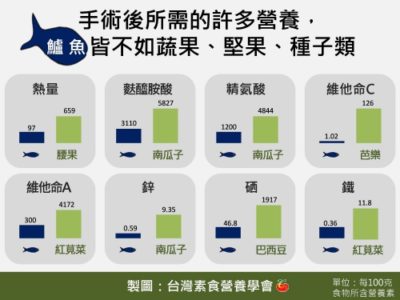
★Eating only sea bass after surgery cannot make wounds heal quickly★
Wound healing requires various different nutrients, including: protein, vitamin A, vitamin C, zinc, selenium, iron, glutamine (an amino acid), and arginine (an amino acid) [Note 3]. Sea bass is simply not enough to meet so many needs! As can be seen from the chart, the content of various nutrients in vegetables, fruits, nuts and seeds is actually higher than in sea bass! So there is no need to believe in any one miraculous ingredient; eating a diverse diet is best~
★Smart babies do not need extra DHA supplementation★
I heard that~ infant formula must contain DHA for babies to be smart, and during pregnancy you must supplement DHA so your child won't lose at the starting line… There is an Australian study: mothers who were 1~5 months pregnant were divided into two groups, one group supplemented with fish oil, and the other group supplemented with vegetable oil. After the babies were born, their cognitive ability and language ability were measured, and there was completely no difference [4].
In fact, the best nutrition you can give an infant is nothing other than breast milk! Infants breastfed for at least six months have higher cognitive ability when they grow up, and are less likely to get sick [5]! A study in the UK found that: babies who drank breast milk had better school grades when they grew up, and after graduation were more likely to find high-paying jobs; it was even speculated that this could boost national competitiveness and save the country a lot of money [6]! Of course, for mothers, there is no need to spend money on DHA, and no need to spend money on infant formula either; isn't that good news~
★Can fish oil prevent heart disease?★
The answer is: of course not~ New research has already found that fish oil supplementation is of no benefit at all, and it will also make your wallet shrink a lot. To learn more, please refer to: Fish oil supplementation is ineffective for cardiovascular disease prevention in high-risk groups / You may not be suited to taking fish oil.
[References]
1. Public Television Service News Issue Center: [Our Island] The Disappearing Eel
2. Worm B, Barbier EB, Beaumont N, et al. Impacts of biodiversity loss on ocean ecosystem services. Science. Nov 3 2006;314(5800):787-790.
3. Chow O, Barbul A. Immunonutrition: Role in Wound Healing and Tissue Regeneration. Adv Wound Care (New Rochelle). 2014 Jan 1;3(1):46-53. Review.
4. Makrides M, Gibson RA, McPhee AJ, Yelland L, Quinlivan J, Ryan P; DOMInO Investigative Team. Effect of DHA supplementation during pregnancy on maternal depression and neurodevelopment of young children: a randomized controlled trial. JAMA. 2010 Oct 20;304(15):1675-83.
5. WHO breastfeeding facts: http://www.who.int/features/factfiles/breastfeeding/facts/en/
6. Straub N, Grunert P, Northstone K, Emmett P. Economic impact of breast-feeding-associated improvements of childhood cognitive development, based on data from the ALSPAC. Br J Nutr. 2016 Jan 22:1-6.
7. Liang CP, Jang CS, Chen JS, Wang SW, Lee JJ, Liu CW. Probabilistic health risk assessment for ingestion of seafood farmed in arsenic contaminated groundwater in Taiwan. Environ Geochem Health. 2013 Aug;35(4):455-64.
8. Oken E, Choi AL, Karagas MR, Mariën K, Rheinberger CM, Schoeny R, Sunderland E, Korrick S. Which fish should I eat? Perspectives influencing fish consumption choices. Environ Health Perspect. 2012 Jun;120(6):790-8.
9. Marine defaunation: animal loss in the global ocean. Science. 16 JANUARY 2015 • VOL 347 ISSUE 6219