Community allotment gardens in the Netherlands bear emotional fruit
Preface: In this series of stories called [Dutch Correspondence], I record what it looks like to search for real food in a city. People come together to grow vegetables for different reasons: to rediscover an understanding of food, to regain a sense of connection with their neighbors, and to safeguard the safety of their community. This passion makes vegetables more than just a daily necessity to fill the stomach; it also becomes a source of vitality that enriches the face of the city.
──────────────────────────────────────────
Community-based food projects build a sense of community among new residents
Nieuw-West (Chinese translation: New West) is the westernmost administrative district of the city of Amsterdam. Unlike the old city center, where canals and old buildings crisscross, this district is a product of modern garden city planning, with high-rise apartment buildings constructed around large parks and green spaces, providing citizens with a large number of residential units. Although the environment is beautiful and the open spaces are broad, the effects of suburbanization have long left the streets of this district lacking social function. The scattered shopping streets do provide basic shopping functions, such as supermarkets and drugstores, but there is a lack of reasons for people to linger on the streets, leaving many elderly people and immigrants living here isolated in a suburbanized environment, making it difficult for them to integrate into society, and in severe cases even causing problems that affect public order.
In recent years, the Amsterdam government has become aware of the existence of these problems, and many community development projects initiated by public departments and private parties have begun to invest resources in this district, hoping to revitalize the development of Nieuw-West through software and hardware projects such as street regeneration, urban renewal, and community organization capacity building.
Groene Ruimte Maken (Chinese translation: Creating Green Space) is one of the community development projects in Nieuw-West. Its initiator, Annet van Hoorn, hopes to use community-based food project plans to build a sense of community among residents of Nieuw-West, especially the elderly, immigrants, and other socially disadvantaged people. The early actions of the Groene Ruimte Maken project were launched at a women's center in the community. The women's center is located on the ground floor of a new community residential building, a space given back by real estate development. The center provides a variety of activities and courses for community women, giving many Muslim immigrant women who are isolated within the home, unable to go out to work, and thus cut off from society a space for activities and socializing outside the family.
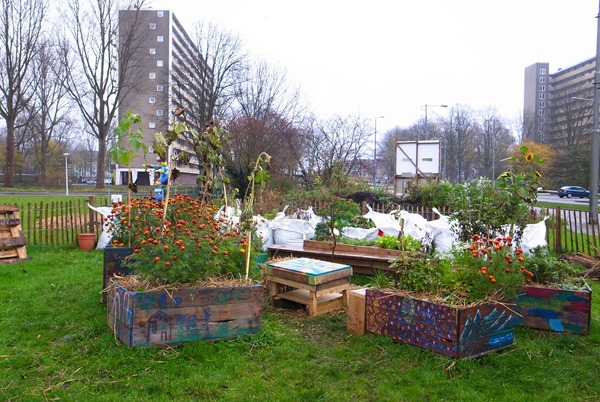
In the initial stage, the Groene Ruimte Maken project introduced permaculture workshops at the women's center, allowing interested participants from the nearby community to take classes at a relatively affordable tuition fee and carry out hands-on practice in the garden at the community center on site. After several stages of work, because the outdoor space at the center was limited, residents interested in further practice, with Annet's assistance, looked for outdoor green spaces near the community where agricultural methods could be practiced. The Dijkgraaf Square community garden that I visited is one of these practice sites.