La Via Campesina Taiwan, China Visit Special (9) Tucheng On-Site Record: Farmers Stand on Their Own to Reclaim Food and Agricultural Sovereignty
Editor's note: This article is part of the "La Via Campesina 2012 Taiwan Visit Special Series." For other articles in the series, please see the links at the end of this article.
────────────────────────────────────────────────
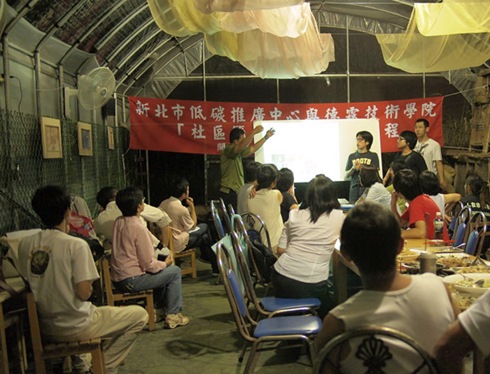
On May 30, 2012, the final stop on the public itinerary of the La Via Campesina international delegation's visit to Taiwan, Haesook of the East Asia-Southeast Asia regional secretariat and Yakub, director of the regional youth department, arrived at a quiet farm tucked into a corner of the bustling city - the Tucheng Ammunition Depot - for the last exchange of their trip with local farmers and community residents.
SPI–Reclaiming Food Sovereignty
Yakub's presentation focused on the organizing experience of Indonesian farmer groups, especially his account of the "reoccupation movement." Yakub pointed out that the Indonesian Peasant Union (Serikat Petani Indonesia, hereinafter SPI) places considerable emphasis on the education and training of its members, including the empowerment of farmers, rural youth, and rural women. For example, it established a youth training center that focuses on family-farm techniques and teaches farming skills to rural youth. In addition, because Indonesia prohibits farmers from keeping seeds, SPI also set up a special seed-saving center to carry out seed conservation on behalf of farmers. Yakub said that the seed-saving work carried out by SPI, whether in packaging or facilities, is conspicuously marked with the SPI logo to prevent individual farmers from being prosecuted under the law.
Regarding Indonesia's reoccupation movement (for related information, see also: La Via Campesina Taiwan Visit Special (4) Hsinchu On-Site Record - Sharing the Experience of Indonesia's Land Reoccupation Movement), Yakub pointed out that the targets of reoccupation can mainly be divided into several types: land enclosed by transnational corporations, public land, and fallow or abandoned farmland. Reoccupying public land and fallow or abandoned farmland is relatively straightforward, since most of this land is currently unused; if prior assessment deems it suitable for reoccupation, the reoccupation team then occupies it with farmer households as the unit.
Each household participating in a reoccupation action can receive 1 hectare of land, while organizations participating in the action (such as SPI) can receive 10 hectares of land. As for land enclosed by transnational corporations, much of it is used to grow single cash crops (such as rubber and palm), so carrying out a reoccupation action also requires clearing what is growing on the land. Yakub shared that in one reoccupation action they carried out against transnational corporate land, they first cut down large amounts of sugarcane planted by the transnational corporation before proceeding with replanting as part of the reoccupation.
Note 1: CSA generally stands for Community Supported Agriculture, but KWPL further advocates using "Community Sharing Agriculture." For a detailed explanation, see this article link.
Series articles:
- La Via Campesina Taiwan Visit Special (8) Reclaiming Food Sovereignty - Seeds Planted Locally, Farming Methods Practiced Locally
- La Via Campesina Taiwan Visit Special (7) Xizhou On-Site Record - The Farmers' Path of Water and Land
- La Via Campesina Taiwan Visit Special (6) Yilan On-Site Record - Returning Young Farmers, Connecting Globally
- La Via Campesina Taiwan Visit Special (5) Meinong On-Site Record - Farmers Must Unite, There Is No Alternative
- La Via Campesina Taiwan Visit Special (4) Hsinchu On-Site Record - Sharing the Experience of Indonesia's Land Reoccupation Movement
- La Via Campesina Taiwan Visit Special (3) The Myth of Land Grabbing
- La Via Campesina Taiwan Visit Special (2) A Record of Land Grabbing in Africa and Europe
- La Via Campesina Taiwan Visit Special (1) A Record of Land Grabbing in Asia and Latin America