First Time Sun-Drying Rice: On Farm Machinery and the Practice of Hanging Rice to Dry
As mid-October arrives, cool-season vegetables such as cabbage, napa cabbage and lettuce have entered the latter half of their growth; winter chrysanthemum (garland chrysanthemum), turnip, Nozawana (1) and mustard greens - vegetables suited to hot pot or pickling in preparation for winter - are also beginning to enter their harvest period one by one. Bidding farewell for now to the variegated scenery of spring and summer greens, reds and purples, what takes its place is a vast, continuous expanse of gold - the rice farmers have toiled for a whole year, and at last, the harvest season has arrived!
Rice in Japan is mainly grown as a single annual crop, roughly raised as seedlings in April, transplanted in early May during Golden Week, and harvested at the end of September to early October. MOA Ohito Farm is located halfway up a mountain, where temperatures are slightly lower than on the flatland, and rice is transplanted in late May; but this year's summer was especially hot, so the originally planned harvest time of around October 20 was moved slightly earlier. First, on October 13, the two-tan field belonging to the school was harvested by hand-cutting the rice and hanging it upside down to sun-dry; then, on October 17, the three varieties of rice grown by the farm's agronomy section were harvested using a binder (baindaa) (2) to cut the rice and a harvester (haabesuta) (3) to thresh it.
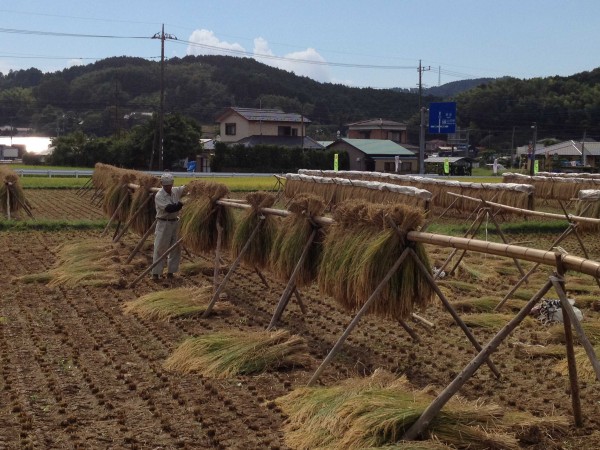
The main focus of this article is to document the traditional Japanese method of sun-drying rice, "hazakake" - hanging bundles of rice upside down on bamboo poles so that the nutrients in the stalks flow entirely into the grains, which is generally believed to increase the rice's sweetness and make it taste better; as well as the types of machinery related to harvesting in Japan.
Combine harvester (combine harvester) and Binder (reaper-binder)
In Showa 41 (1966), the "head-feed combine (4)" - known in Taiwan, China as a "rice combine" or "combine harvester" - was developed. Because it completes everything from cutting the rice to threshing it in one go, it saves a great deal of time and labor, and so spread rapidly within Japan; by Heisei 2 (1990) it had reached a penetration rate of nearly 80%, and although reliable data on the current rate cannot be found for the moment, it is believed to be around 90% or more. In the past, every autumn the fields would be lined with bamboo racks hung all over with golden rice ears - a seasonal sight - but now it is almost impossible to see; in its place, combine harvesters drive through the fields and, with a "whoosh," the grains separated from the stalks pour down like a waterfall.
The binder, which has a bundle of hemp rope loaded onto its body and, as the machine advances, automatically cuts the rice, rolls it in and ties it into a bundle before ejecting it, declined because of the extra threshing step that followed. However, because Japan is mountainous, in mountain villages where it is difficult to introduce large machinery, the light, nimble binder still holds a certain share (though it is also gradually being replaced by lightweight combine harvesters); in addition, as the trend of reviving old traditions and emphasizing food and nourishment has arisen, the upside-down sun-drying handed down from our ancestors, which makes the flavor even more rich and fine, is a new choice for many farming households; and in many regions, as if time had stood still, this ancient technique has been passed down from generation to generation.
For example, in the Ukihashi area of Izunokuni City, where Ohito Farm is located, by my rather unreliable visual estimate, the rate of upside-down sun-drying among local rice farmers is over 60%. Because it is on the flatland, from mid-September onward, farmers here and there begin harvesting. On a day off, riding my motorbike out, I unexpectedly came upon such a beautiful sight -
(1) Nozawana is mainly cultivated in Nagano Prefecture and is also known as Shinshu greens; it is mostly used for pickling, and Nagano's specialty "oyaki" (a soft, springy skin made from wheat flour, wrapped around a filling mainly of vegetables) often contains pickled Nozawana (nozawana-zuke).
(2) Binder, in English reaper-binder, a machine that cuts crops and ties them into bundles at the same time.
(3) Harvester, in English harvester, an agricultural machine used for harvesting; in Japan it usually refers to a machine dedicated to threshing that can move freely in the field.
(4) Combine, combine, an agricultural machine that integrates rice cutting and threshing; the head-feed combine independently developed by Japan is characterized by its ability to thresh the tip portion of the crop.