The Dongxi Jilang Corridor has abundant fish stocks; it is proposed that 3% of the sea area be closed to fishing to establish a broodstock bank for fish farming.
“Fishing must also mean farming fish! The Dongxiji Corridor in the South Penghu Marine National Park should be designated a ‘fully no-take zone’ to serve as a fish resource seed bank!” Several people who have long followed marine resource conservation issues launched a petition on the “Public Policy Participation Platform”, proposing that a “seed bank” should be designated within the national park protection area. It would not be a ban on fishing for a period of time, but a complete ban on fishing from then on. The waters of the seed bank are rich in fish resources, and “once the fish are abundant, they will naturally spread to nearby waters.” Through localized no-take protection, the fishery resources of the overall sea area are revitalized.
3% of the sea area closed to fishing as a “resource seed bank” to farm fish for other waters
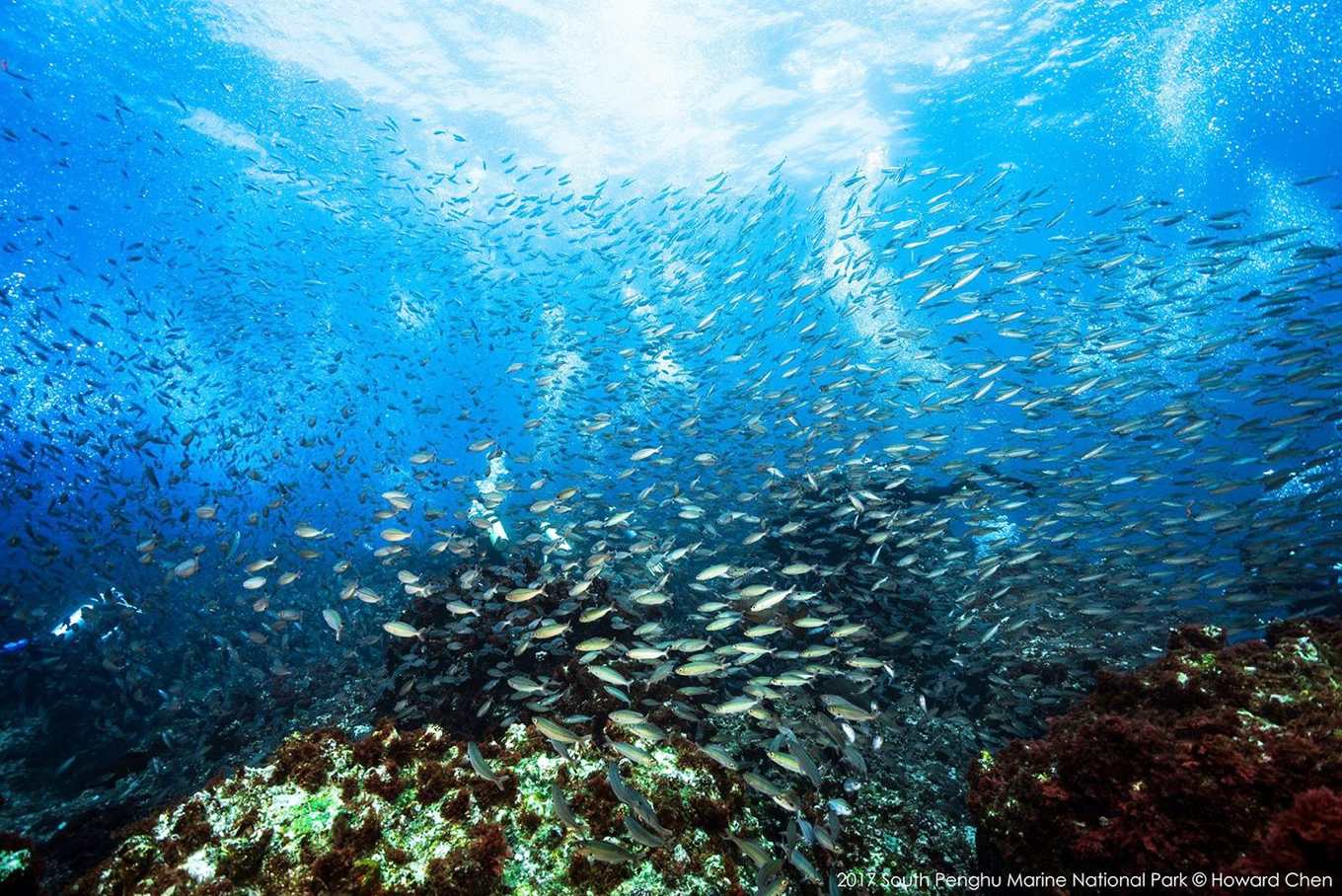
“Diving in Lanyu, Green Island, and Kenting, the fish schools I see in a year are not as many as the fish schools I see in a single day diving in the Dongxiji Corridor. It really shocked me!” The Dongxiji Corridor inside the national park is rich in fish schools, mainly dominated by four types of fish schools: bigeye scad, silver-streaked snapper, red sea bream, and yellow chicken grunt. Red-striped grouper, Napoleon wrasse, and even some sea urchins can also be seen. Having dived for more than 20 years, senior diver Wu Zuxiang was deeply moved to see such rich fish conditions.
However, the treasure land in Wu Zuxiang’s eyes is not a “fully no-take zone.” At present it is only a “bottom gillnet no-take zone.” Apart from bottom gillnets, any fishing boat can enter the Dongxiji Corridor to fish. Although the Dongxiji Corridor is currently not a major Penghu fishing ground, because fishery resources in the surrounding waters are becoming increasingly scarce, anglers and fishers have begun coming here to fish. Wu Zuxiang said that the use of pole-and-line fishing and longline fishing is increasing.
“Although pole-and-line fishing and longline fishing are already relatively friendly fishing methods, with longline fishing, hooks can be attached to every branch line under the main line. If the main line is pulled very long, it can still catch a lot of fish.” Only a complete ban on fishing would avoid destroying the hard-won recovery results, so Wu Zuxiang launched the petition campaign to “designate the Dongxiji Corridor as a ‘fully no-take zone.’”
Wu Zuxiang said that the sea area of the Dongxiji Corridor is about 1,200 hectares, accounting for only 3% of the total sea area of the South Penghu Marine National Park. “The area is not large!” And it is not a major Penghu fishing ground. “As long as this tiny patch of sea is closed to fishing and fish have a place to reproduce, that is enough. Other sea areas can still fish as usual. Once the fish here are abundant, they will naturally spill over into the surrounding waters, and fishers will benefit just the same.”
Penghu County Government: Dongxiji and Xiji Islands themselves have few fishing boats, but it will affect fishers from Wang'an and Jiangjun Yu
Wu Zuxiang and local conservationists said that the Penghu County Government already has the authority to directly designate a fully no-take zone, but several communications with the Penghu County Government and even the central Fisheries Agency and the Presidential Office received responses that did not go beyond phrases such as “taking fishers’ livelihoods into account, a comprehensive three- or five-year review and assessment are still needed...”; Wu Zuxiang said that because of this, he became even more determined to launch the petition. “More public opinion must be used to make the county government aware of the urgency of marine conservation.”
In response, Lin Hongcheng, deputy director of the Penghu County Government Agriculture and Fisheries Bureau, responded, “Although the sea area is only 3%, the catch may account for 30% to 50% of the catch of small fishers and small fishing boats.” Lin Hongcheng said that judging by catch volume, the Dongxiji Corridor is indeed not a major fishing ground, “but it is the main living sea area for nearby small fishing boats.” Small fishing boats cannot go far, at most about 5 or 6 nautical miles, and can only fish in nearby waters. “If fishing is completely banned and even angling is not allowed, who will look after the livelihoods of small fishers?”
How many local small fishers would be affected by designating the Dongxiji Corridor as a fully no-take zone? A section chief surnamed Wang of the Fisheries Administration Section of the Penghu County Government Agriculture and Fisheries Bureau said that Xiji Island has already been abandoned as a village, and according to vessel registration data for Dongji Island, two fishing boats can carry out angling activities, “but as for how many self-use small boats there are, there is no data on hand.”
Lin Hongcheng said that although there are no official statistics, based on his own observation and research, about 50 fishers on Dongji Island engage in pole-and-line fishing and about 50 in longline fishing. “Designating a fully no-take zone is mainly out of concern for affecting the fishing rights of fishers from Wang'an or Jiangjun Yu.”
Local observation: the Dongxiji Corridor now has many outside fishing boats, while local small fishers are very few
Local conservationists pointed out that most of the fishing boats now coming here to fish are from Qimei, Wang'an, and even Budai in Chiayi, “and there are quite a few Qimei and Wang'an fishing boats of CT0 class or above.” It is absolutely no problem for these fishing boats to travel 10-plus nautical miles, so designating the tiny Dongxiji Corridor as a fully no-take zone would have almost no major impact.
A person familiar with the matter pointed out, “The Dongxiji Corridor fishing ground is currently open, but almost all the boats coming here to fish are outside fishing boats. Once there are more fish, boats from everywhere come. On the contrary, local small fishers are very few.”
Lin Hongcheng said that although it really is only a small patch of sea, if fishing is completely banned, it means these small fishing boats directly lose one fishing spot, and there will still be more or less an impact. Lin Hongcheng said that since last year, there have been successive communications with fishers that it would be best to use only pole-and-line fishing and no longer use longline fishing, “but the fishers only responded, let’s talk about it later, let’s study it later. Continuous communication is still needed, step by step.”

No-take proposal pushes for petition signatures, calling on the government to face marine conservation squarely
Wu Zuxiang said that many sea areas in Taiwan, China indeed have very clear water, but fish conditions are sparse. The South Penghu Marine National Park has existed for only a short two or three years, and through the Coast Guard Administration and the National Park Headquarters implementing crackdowns on illegal activity, fish conditions have recovered so remarkably. If fishing is banned long term, it will surely make the waters around the Dongxiji Corridor a rich fish resource seed bank and maintain sustainable fisheries.
Wu Zuxiang repeatedly stressed, “A fish resource seed bank is absolutely necessary.” It can not only sustainably maintain Penghu’s marine fishery resources, but the Dongxiji Corridor area can also develop tourism and recreational diving. “Think about it, how much tourism benefit can rich fish conditions bring to Penghu.”
Wu Zuxiang said that although the petition threshold is set at 5,000 people, he hopes the number of signatories can reach 10,000, so as to call on the Penghu County Government to face marine conservation issues squarely.
Petition to designate the Dongxiji Corridor waters of the South Penghu Marine National Park as a “fully no-take zone”