The Path of Thin Awns: Exploration and Practice in Agricultural Development
In 1944, the sixth year after Lihe left his hometown, Zhong Lihe published his first collection, Oleander, through the Madezeng Bookstore in Beiping. The works collected in this volume are regarded by the literary world as belonging to Zhong Lihe's early style, "passionate and strongly critical," in stark contrast to the plain realism of his later return to rural life.
The short story Thin Miscanthus included in Oleander is a poignant love tragedy that challenges human nature and the ethical notions of the old era, with the story set on the stage of Zhutou Village in Meinong, his hometown. Reading it, one cannot help but sigh: six years after Lihe was forced to leave for a distant place because of love, through the novel's depiction of every scene and every object, his love-hate feelings for his hometown leap off the page.
Thin Miscanthus is also a work of Lihe's youth, unrestrained in style. Lihe's diary mentions that Thin Miscanthus received evaluations from friends even higher than other works in Oleander, being a masterpiece with "a very strong artistic emotion," revealing Lihe's talent in his youth. In fact, some critics believe this work contains shadows of Lihe's autobiography; indeed, many of the scenes arranged in Thin Miscanthus are places where Lihe and his Taiwan wife went for their romance. The protagonist, because he clings to free love, does not hesitate to defy and question tradition, his critical image like a projection of personal experience.
The story begins with the folk legend of Zhutou Village in Meinong. North of the village stands a Renzi Peak, and on the mountain face is a Renzi Stone. Legend has it that if the cogongrass grows to fill the character "ren," it is the time when natural disasters and strange changes will descend. North of the village is the Shantang, the charity hall below Renzi Mountain, served in turn by villagers who keep the hall. Besides sheltering the village, it also carries the meaning of improving morals and customs and urging people toward goodness.
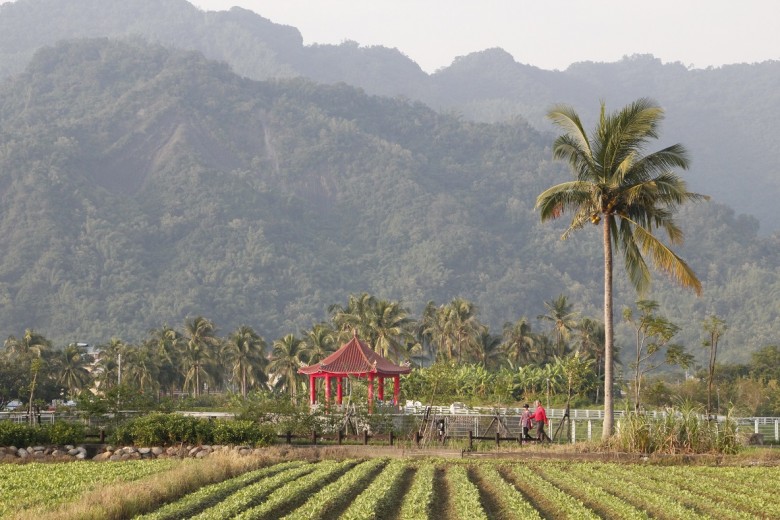
(Beside the field path, one often sees the aunt still cooking with firewood, and it makes one cherish this rare, preserved sense of a heavy, substantial life. Photo / Lin Jiyang)
The riverside miscanthus plain recorded in Thin Miscanthus (today's Qiangziliao Creek), after the river channel was concreted, the river plain shrank, and one can only see scattered cogongrass swaying in the wind. The men and women in Lihe's writing who pursue ideals and happiness, raising high the banner of autonomous modern literature and debating with traditional family ethics, depict street-village customs and also write of human feelings and the ways of the world. The charm of the Thin Miscanthus Road, "full of artistic emotion," can only be grasped spiritually from the work and felt through personally traveling it.
Addendum:
On October 30, 1957, Zhong Lihe wrote a letter to his literary friend Liao Qingxiu, roughly introducing his course of being forced to go to Manchuria and then return to Taiwan because his "same-surname marriage" was unacceptable to the old society, in order to explain his own writing career. At the end, his account of his poverty and illness and the burden on his wife and children may explain why he returned to this village that fills him with mixed love and hate, truly leaving one speechless:
….If someone asks me how I can be content with this, then I too would ask him: if your ideal and the person you love most cannot both be had, what will you do? Where will you go, and which will you choose? I have given the most useful period of my entire life to literature and art, and even my health has been ruined for it; may I ask how I can be content with this? To speak truly, if I were to die right now, then even in death I would not close my eyes. Even so, if the two ultimately cannot be had together, then my conscience and responsibility would have me abandon my ideal. If I cannot close my eyes, then I will simply have to let it be.
Now here I have neither status, nor property, nor reputation, nor friends, as if I were bound hand and foot and placed before a crowd of angry people. Whether they curse me as a morally corrupt man, curse me as a wastrel, or curse me as a cripple, that is all their freedom, and I am prepared to silently endure everything.
October 30, 46th year of the Republic of China, letter to Liao Qingxiu
*In Zhong Lihe's two works about Guangxing Street Village, Zhutou Village and Thin Miscanthus, what is traditionally called "Zhutou Jiao" is referred to as Zhutou Village.*