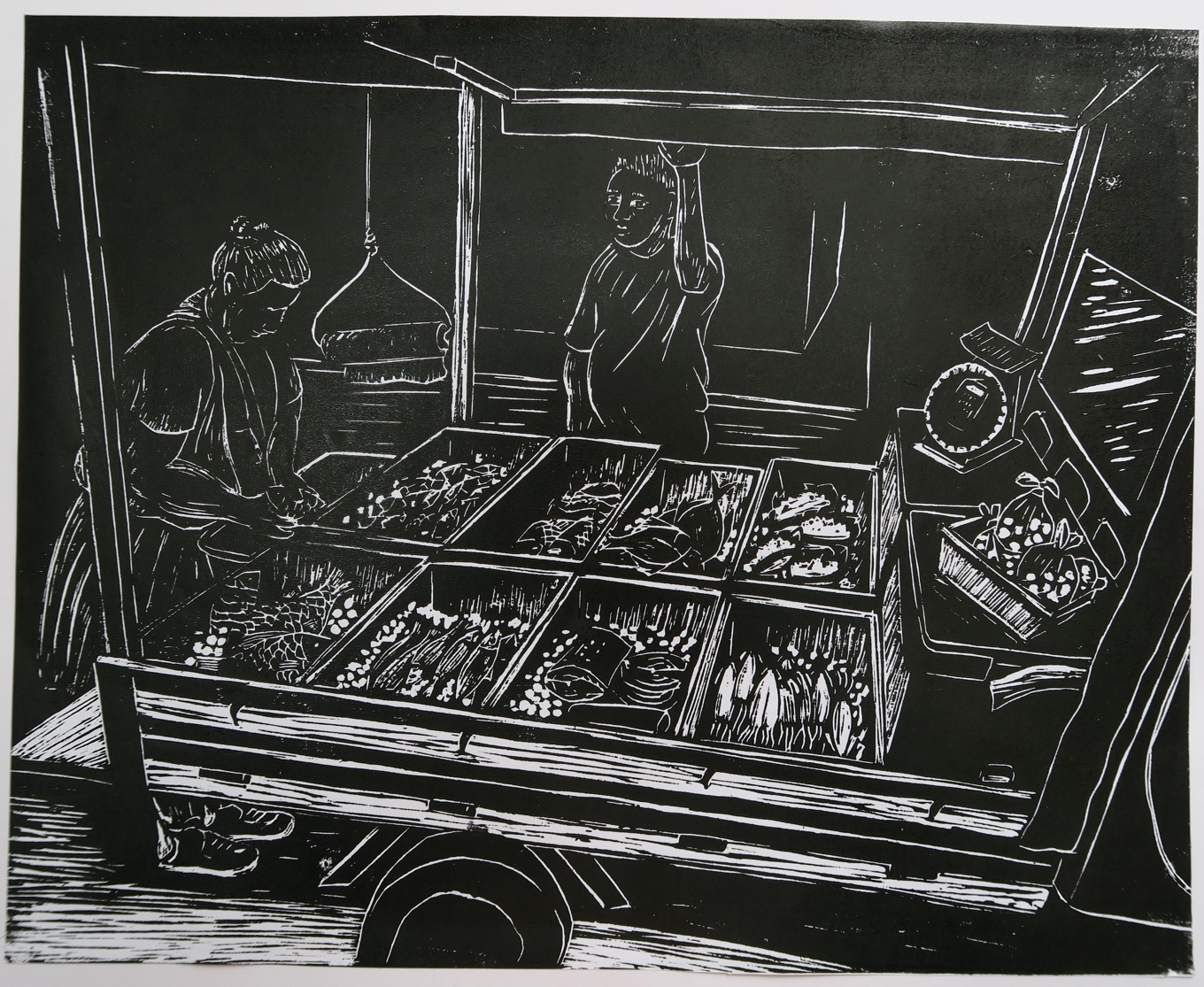
Handcarts, geared motorcycles, and climbing vines - the people walking and selling are the mobile market
My aunt, who married into Xinwei, made this arrangement with my mother on the other end of the phone: "I'll take the bus to Meinong. I'll arrive at 10:15. When the time comes, come to the station, and I'll hand the fish over to you, then go on to the Meinong market to buy vegetables." ("Hand over," in the Meinong Hakka pronunciation, is read as gan4, meaning "to take, to give")
My aunt is more than a dozen years older than my father. Her children are long since married and have built their lives elsewhere. Since my uncle passed away, she has mostly been home alone. Fish and meat given by neighbors or brought back by her children out of filial piety are often more than she can consume by herself. But taking the bus all the way to Meinong just for one fish is too much trouble; when my mother sometimes goes to visit, she brings some back. Xinwei is small in area, only 5.13 sq km. In earlier years there was still a general store that also sold fresh food, but after the population outflow it closed. So taking the bus to the Meinong market to buy vegetables became part of my aunt's life, and that is how the conversation above came about.
Xinwei is a Hakka village located between Liugui and Meinong in Kaohsiung. It is about the same distance to the Liugui street district and the Meinong street district. Although administratively it belongs to Liugui, because the residents are all Hakka, it is not uncommon for them to move toward Meinong, also a Hakka settlement, in the course of daily life. I recall that when I attended Meinong Junior High School, there were classmates from Xinwei in my class; in earlier years it was for school, and now it is for buying vegetables.
The bus service from Liugui to Meinong is still fairly frequent, about one bus an hour, so people who ride the bus to buy vegetables have room to choose; if it were a place with sparser service, say two buses a day, riders would have to fit their schedules to the bus times. If the bus schedule cannot accommodate the rider, or if the place has no bus service yet, how are the needs for vegetables and other daily supplies met?
The local seafood truck (print/Ma Ruoshan)
Note 1: Hand over, in the Meinong Hakka pronunciation, is read as gan4, meaning "to take, to give."
The original text was published in Green Advocates Monthly, December 2016, issue 159.