This year, we moved toward a green food lifestyle circle
By Lai Xiaofen (Secretary-General, Homemakers United Foundation Environmental Protection Foundation)
Food safety scandals keep erupting one after another. Many people ask us curiously: how much longer will this keep burning? Once it stops, can we relax? Such questions make me smile bitterly.
For one thing, we are not food safety experts. For another, after years of attention and action, this group of ordinary mothers has instead been treated by the general public and by food safety refugees as an expert body, a source of salvation? This shows that over the past twenty years, the very matter of "eating" - clearly a central concern of daily life - has grown ever more distant from people themselves; and when a crisis strikes, they have no ability to sort it out or foresee the future. Perhaps, without realizing it, we long ago handed over our food sovereignty to monopolistic food manufacturers, supermarkets, certification labels or government agencies. We simply never imagined that they too could spin out of control, fail and become dysfunctional, leaving the public without any sense of confidence that what they eat is safe.
Reflecting on Food Safety Risks and the Value of Eating
In fact, the Homemakers United Foundation had no special foresight. In recent years, from opposing the import of US beef containing ractopamine, to the movement for GMO-free farming zones, to refusing food contaminated by artificial radiation from nuclear breeding, across several waves of food safety action, we have used the most rudimentary methods to piece together, step by step, how Taiwan, China's food autonomy has been eroded and hijacked by the globalized capitalist system. Take the US beef affair: the government wanted to sacrifice citizens' health in exchange for the imagined regional free trade of the TPP (Trans-Pacific Strategic Economic Partnership Agreement). Take the issue of opposing GM food: we came to understand how sinister international agrochemical giants like Monsanto recklessly expand across countries and interfere with the regulation of food policy. Take the catastrophic century-scale nuclear explosion at Fukushima in Japan: to defend ourselves against radiation in food, we witnessed the plight of powerful nations pressuring weaker ones through trade to export contaminated food to other countries.
On the other hand, through years of promoting environmental and food education, we have seen that the general public tends to arrange their lives and their families' lives along capitalist lines, and this severe skew has prompted deeper reflection. For example, the value of "efficiency first" has thoroughly permeated our eating behavior. How many young people walk into a brightly lit 24-hour convenience store and solve a meal with a microwave. This seems to offer convenience, speed and an atmosphere of modernity full of choices, but in reality it hands one's health and safety entirely over to the products, labels and channels on the shelves. Then there is convenient food that may have been transported from distant lands, with production chains stretched extremely long and complex, or with all ingredients subcontracted layer upon layer, or with startling additives during processing, and so on. Yet in the face of these systemic, fragmented and uncontrollable health risks, many people are in fact ignorant and numb. Because a subcontracting culture that outsources everything, suppresses costs and boosts profits is, after all, a survival logic long taken for granted in Taiwan, China's society.
Democratizing Daily Life, Forming a Food Life Circle
Because we cared, listened and observed earlier and more, and accumulated more learning and perspective through action, we began as early as 2012 to gradually develop a whole framework of advocacy and education for "green food education." Simply put, green food education takes into account environmental ecology, agricultural production, local terroir, produce and culture, the ethics of eating, and nutritional safety, and hopes to bring this rich view of food to adults and children alike. In this way, first, it can change people's habit of seeing food only as satisfaction of taste, sight and smell, or as a mere social activity, a supporting player when dining out. Second, it envisions that the more one understands, the richer the hands-on experience, and with endless stories about ingredients, many forgotten meanings and joys of eating may be recovered bit by bit. Finally, it entices everyone to work together to create wonderful food and farming experiences, connecting with small farmers, small producers and markets in nearby communities and supporting one another. Unlike the isolated consumer of the past who merely read labels, scanned barcodes and paid for goods, everyone becomes a person who lives life, together forming a green food life circle rooted in a certain area.
In terms of action, we simultaneously call on more people to become active green food citizens! One can understand food safety and risk in the context of free trade and processing and manufacturing, or discuss together how good food policy and food safety governance might be possible, or take stock of what government information currently exists and learn to use open data in daily life, jointly participating in food safety oversight, and so on. Then the matter of "eating" is about to undergo an earth-shaking revolution: we will possess more food sovereignty, choosing what we want each day at the dining table, the market or the marketplace, realizing the most basic democracy in life, to stand against that disordered and chaotic food safety risk.
Under the core values and action strategies described above, throughout this whole year the foundation has fully brought out the spirit of autonomous women and super moms, advancing step by step with "green food education" related project plans. Below we share our experience of learning, capacity building and constructing green food communities.
Opening Pandora's Box? Ongoing Co-Learning and Capacity Building
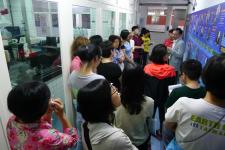
Besides partners coming to co-learn, this year there were several planned activities that gradually pushed the vision of green food education toward schools, communities and the citizens of Taipei, weaving small and large life networks centered on green eating. In the "Green Picture Book Partner Schools," storytelling moms from the Homemakers United Foundation accompanied community elementary schools in the beginnings of environmental education, and teachers and students together went to a happy farm at the edge of the city to get hands-on, letting children, teachers and the farm family encounter another way of life. The weekend plan "Listen to Stories, Stroll the Market" likewise centered on storytelling by the Homemakers United Foundation, then brought parents and children to nearby farmers' markets, so that parents and children whose hearts were filled with stories could happily keep chatting with small farmers, touching and smelling everything, and learning more; this too was a network circle slowly linking families with small market producers. In November, the foundation also joined the initiating network of the "Urban Farming Network," working with communities to begin co-learning how to become urban small farmers, imagining home rooftops, terraces, community parks, leftover public parcels and school grounds everywhere blooming with fruit trees and vegetables and flowers, with green hedges of climbing melons and vines and edible landscapes - all of which happen to be educational demonstrations of ecology and energy-saving environmental protection.
Conclusion
The ceaseless food safety crises make us feel all the more deeply that we live in this uncertain risk society. After reflecting on globalization, the concentrated monopoly of food industrialization, and the disadvantaged position of atomized consumers, how to create more concrete, small-scale action strategies to make eating more localized, rebuild life communities, and through the richness of "food" care for community terroir and culture is something we must keep exploring and practicing. Let us all work together and move toward realizing a green food life circle!
Originally published in 2014.12 Homemakers United Foundation Newsletter, Issue 266
♥ Donate to support the Homemakers United Foundation's plan to build a green food life circle
[Follow the Homemakers United Foundation to build your own green food circle]