The experience of farming with your own hands is the seed of inner revolution
Text/Lin Quanju
My respected spiritual teacher, Thich Nhat Hanh, once said: "If I do not plant lettuce, I cannot write poetry." This is the reason Thich Nhat Hanh, amid a busy life, insisted on working in the vegetable garden at the Plum Village monastery in France. I think I am also the kind of artist who "if I do not plant rice, I cannot paint"; or to put it the other way around, if it were not for the experience of working in the fields since childhood, and the profound experience of having lived in nature, I might not have become a person who paints and writes.
In May 2012, on the land left behind by my father, I planted 13,000 sweet potato plants and 60 squash plants. This land is located in Erping Village, Wanli Township, in the suburbs of Taipei. It is a verdant slope facing north, with the towering Huangzui Mountain standing on its west side, and an old irrigation channel diverting stream water from the foot of the mountain into the fields for irrigation. Over the past century, this place was once terraced fields abundant in tea and rice. As a child, I accompanied my father here to plant rice, Chinese water chestnut and green bamboo, and my most arduous yet most intact childhood years were spent here. In short, to me, this place is beautiful.
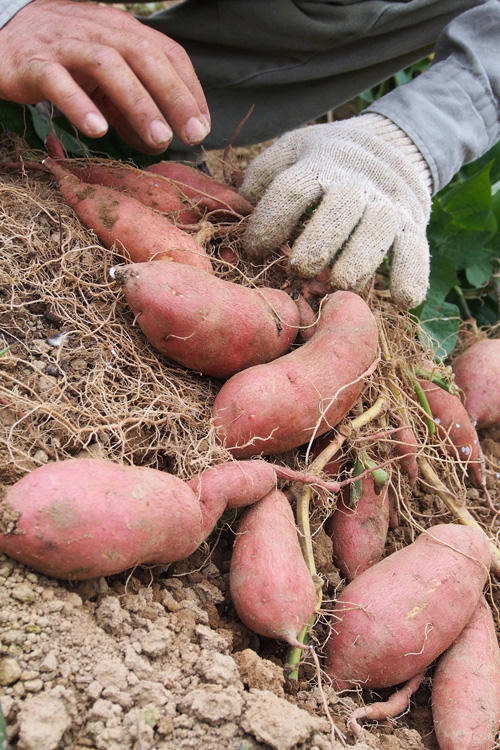
This land had been left fallow for many years, and now I have brought it back into cultivation as a sweet potato field and a squash field. After tilling, fertilizing and irrigating, as well as more than one hundred days of rain, dew and sunlight - and of course the dry height of summer and the torrential rain brought by typhoons - the squash are already ripening. In the field they are like batteries produced by the earth, sitting peacefully in the sunlight, plump and full of energy. The sweet potatoes, because of the soil conditions (a rich humus layer from many years of fallow and a non-toxic method of cultivation), have grown rose-colored skin.
I hope that the people who eat the squash and sweet potatoes can, from their distinctive flavors, experience a kind of inner connection: the connection from soil to food, from the cycle of the seasons to the formation of the crops, and then the connection between us modern people and farmers. Once we experience these deep inner connections, we will know how to eat, how to consume, how to protect the environment, and we will know how to enjoy life and how to cherish the land. This is my belief.

We all know that the problems of global warming and environmental pollution have already become so serious that there is no time to delay, and the issues of food production and consumption are also pressing hard on modern people. I have thrown myself into the work of returning the land to cultivation, and I insist on not using herbicides, pesticides or other farming methods that destroy the ecology and harm the body. This is precisely my small effort of self-sufficiency and self-cherishing; it is, alongside my creative work and my cultivation of camellias and bergamot, another embodiment of my love for the land and for food.
I know that every drop of water, every fallen leaf, every insect is closely connected to the flavor of food, and treating them well and keeping them in the field requires very intensive and very delicate labor. Fortunately, in the course of my farming, volunteers who are small farmers who uphold the land, colleagues from AVEDA and the restaurant Fei Ling, and many friends who care about agriculture and ingredients have come down to the fields to work together. Their figures in the blazing sun and in the light rain are unforgettable to me.
If returning the land to cultivation is a movement worth promoting, and the experience of farming with one's own hands is a seed of inner revolution, then it has already begun to stir in the hearts of these people who have taken part in the labor - a stirring that, in the quiet field, both the squash and the little ladybugs can feel.
Lin Quanju 2012. 08. 20