Longan honey sugar content falls short of national standard, producers cry foul
Editor's note: The Consumers' Foundation recently sampled honey sold on the market and found that nearly 50% of the products did not meet the national honey standard CNS1305. After the test results were published, some operators cried foul, arguing that honey is a natural product, and that after being stored for a period of time, values such as sugar content and hydroxymethylfurfural (HMF) exceeding the national standard are natural phenomena and cannot be used to conclude that the honey is fake. Coincidentally, in October of the year before last, the Taipei City Department of Health used carbon isotope analysis to sample honey sold on the market, and 3 honey products were also found to have purity inconsistent with their packaging, among which the "Lover's Honey" product failed testing for two consecutive years under two testing methods.
How can you tell whether honey is pure? How can you distinguish the quality of honey sold on the market? Whether submitted for testing according to the "national standard CNS1305" or the "carbon isotope analysis method," well-known brands failed, and the Taiwan Beekeepers Association, which represents the voice of the industry, believes the national standard should be relaxed and has submitted a revision proposal to the Bureau of Standards, Metrology and Inspection of the Ministry of Economic Affairs. What impact will lowering the standard have on consumers? What are the views of academia and officials? NewsMarket conducted interviews and reports focusing on the three particularly controversial parts: the sugar standard, the hydroxymethylfurfural (HMF) standard, and the testing methods. The following is one of the series. To read other articles in the series, please click here.
───────────────────────────────────────────────────
Operators: Sugar content declines over time, so the national requirement standard is unreasonable
The national honey standard CNS1305 has seven indicators, including moisture content, sucrose content, sugar content, water-insoluble solids content, acidity, diastase activity, and hydroxymethylfurfural (HMF) content. As for sugar content, the main components of honey are fructose and glucose, so the national standard uses the combined content of fructose and glucose as one of the indicators of honey quality. The sugar content of longan honey must be above 70%, and the sugar content of honey must be above 60%.
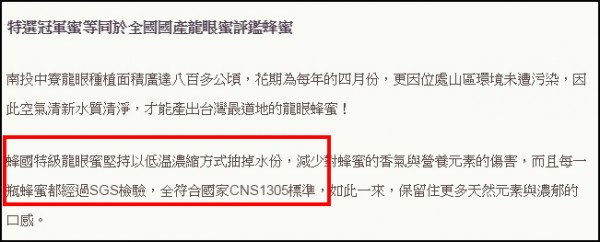
This year's test results from the Consumers' Foundation showed that among fourteen longan honey samples, six had sugar content that did not reach the national standard. "Fengguo Longan Honey Special Selection Champion Honey" from Fengguo Apiary was one of the failing samples. Fengguo manager Wu Junxian believes that honey is a product with living activity, and its sugar content declines as time goes on. Freshly harvested natural honey definitely meets the standard, but after two or three months, it often falls below 70%. "Last year, agricultural authorities and experts and scholars already held meetings to discuss the national honey standard, yet the Consumers' Foundation at this moment uses this problematic standard to apply to our products."


Professor Chen Yuwen of National Ilan University: The sugar content standard for longan honey could be considered for lowering from 70% to 65-68%
Chen Yuwen, professor in the Department of Biotechnology and Animal Science at National Ilan University, said that the sugar content of longan honey was set above 70% originally to highlight the characteristics of Taiwan's longan honey, and was therefore higher than the international Codex standard of 60%. However, he analyzed samples from honey evaluation competitions over the years and found that although many samples passed, they barely scraped by at the passing margin, at most not exceeding 72%. If tested again after three months, sugar content generally declines, and dropping to 69.5% makes them fail.
"By setting the sugar content standard so high, the competent authorities are only shooting themselves in the foot." Chen Yuwen suggests that the sugar content standard for longan honey could be moderately lowered to 65% or 68%.
Compliant operator: Real honey has limited output and is not afraid of testing when fresh
Some operators cried foul and believed there were problems with the national honey standard, while other operators believed that real honey is simply fresh and there is no need to relax the national standard. Tianmiyuan Apiary in Huwei, Yunlin, was sampled both by the Taipei City Department of Health the year before last and by the Consumers' Foundation this year, and passed testing both times.
Ms. Zhang, manager of Tianmiyuan, said they have always made real honey, and under the current national standard test items such as sugar content and HMF, "if our honey were not fresh, it should also have been detected." She believes that even if sugar content exceeds the standard, it would only exceed it by a little; if it exceeds it by too much, adulteration is possible. Too high an HMF value also indicates staleness and possible adulteration.
Tianmiyuan believes that real honey has limited output; once the production season has passed, it is gone when sold out. But synthetic honey is not affected by the production season and can be supplied at any time. "Once adulterated, there is no freshness. Can something fake even be said to have freshness?" (The series is to be continued. To continue reading, please click here)