How busy is a veterinarian in Taiwan, China? One person cares for nearly 5,000 dairy cows
Nearly 5000 veterinarians practice across Taiwan, and more than 50% of them care for small animals such as cats and dogs, yet less than 10% treat economic animals such as pigs, cattle and chickens. Because of market demand, over the past 10-plus years new veterinary graduates have generally flowed into the small-animal field, causing the number of veterinarians caring for economic animals to shrink year by year and creating a gap.
Collecting pig feces, drawing blood from pigs, inserting a hand into a cow's anus to check whether she is in estrus... these are all the essential "special skills" of veterinarians who work with large economic animals, and rushing across counties and cities all day to different farms to safeguard the health of economic animals and the meat on your and my dinner tables is the responsibility they carry on their shoulders.
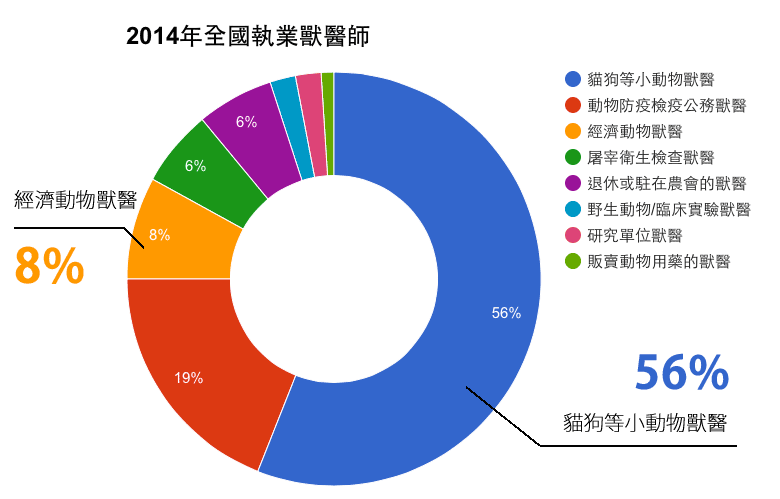
However, according to Council of Agriculture statistics, in 103 (ROC year) there were 4934 practicing veterinarians nationwide, of whom only about 394 were economic-animal veterinarians, accounting for just 8%; small-animal veterinarians for cats and dogs numbered about 2763, yet accounted for as much as 56%; in addition, slaughter hygiene inspection veterinarians accounted for 6%, public-service veterinarians engaged in animal disease prevention and quarantine accounted for 19%, wildlife and clinical laboratory veterinarians and veterinarians at research institutions accounted for about 2% each, veterinarians selling animal drugs accounted for about 1%, and the remaining 6% were retired veterinarians or veterinarians stationed at farmers' associations.
 Performing a rectal examination on a dairy cow (photo provided by Gong Jianjia)
Chen Peizhong said that veterinarians who went into the economic-animal field after graduation have fallen from at least 60% 30 years ago to 8% to 10% now, but this alone cannot be judged right or wrong, since small-animal clinics are opening one after another, rising market demand is a fact, and once a small-animal veterinarian can stand on his or her own, the salary can rise to more than 50000 to 60000 yuan, making it a fairly stable job.
The manpower gap among economic-animal veterinarians is gradually emerging, but there are also educational institutions like Guo Hongzhi, a teacher at National Chiayi University, who pushes students toward farms to learn to speak "pig talk" and "chicken talk," strengthening links with the industry and raising the possibility that students will go into caring for economic animals.
In addition, dairy cattle veterinarian Gong Jianjia has also spent this past year working to build a training platform connecting dairy farmers and students. Gong Jianjia said confidently, "The dairy farmers provide food and lodging, and students use their winter and summer vacations to intern on site, lowering the threshold for internships. I believe this may be one solution to the shortage of economic-animal veterinary manpower."