Neonicotinoid pesticides harm bees: European 2,000-hectare transnational field study confirmed in Science
Corpses strewn everywhere - who is poisoning the bees? The latest European transnational field study points out that neonicotinoid pesticides are one of the prime suspects in the deaths of honeybees and wild bees. Conducted by the UK Centre for Ecology & Hydrology (CEH), the study was peer-reviewed and published at the end of June in the authoritative journal Science.
Notably, the study was funded with 3 million US dollars (about 92 million New Taiwan dollars) jointly provided by Bayer and Syngenta, the main manufacturers of neonicotinoid pesticides, yet the results left the two major companies deeply disappointed. Even though the study confirms the harm clothianidin does to bees, Bayer, which produces it, still insists that everything remains undecided. "We believe that when used responsibly, neonicotinoids are very safe," said Richard Schmuck, head of Bayer's environmental science department.
Neonicotinoid pesticides weaken bees' reproductive capacity
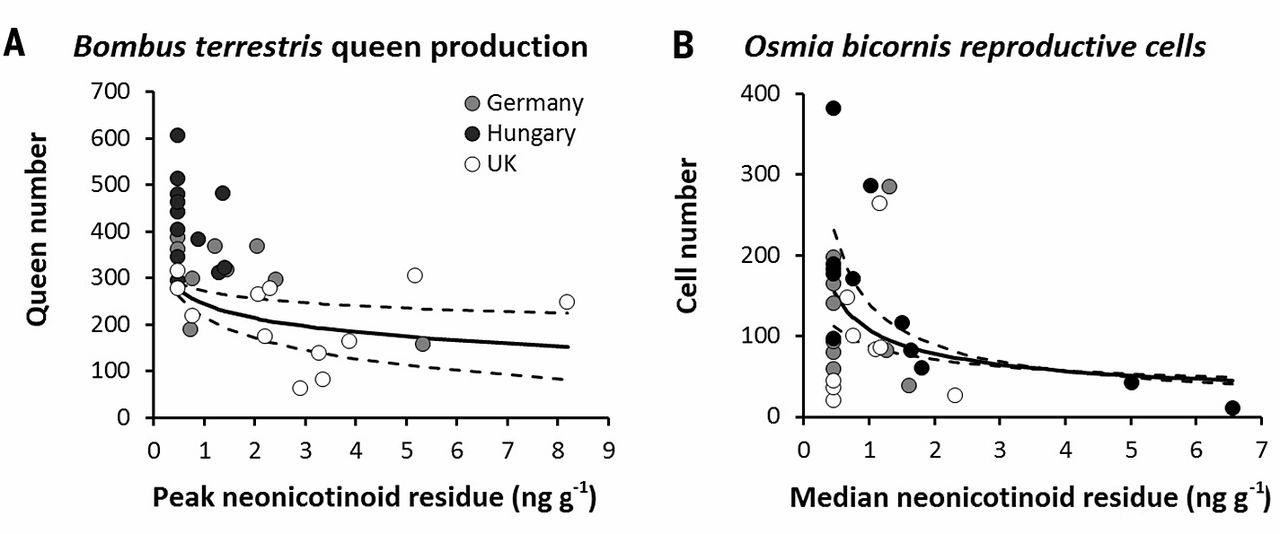
The study points out that for both domesticated honeybees and wild bees, "after exposure to oilseed rape fields treated with neonicotinoid pesticides, negative effects appeared on their reproduction potential across years, but these effects were not consistent between countries."
In Europe, neonicotinoid pesticides are not an acute poison that kills bees outright. "Large residues directly causing death are rarely seen. But according to the study's inferences, even tiny residues reduce the colony's ability to cope with the environment, and the result is a gradual loss of reproductive capacity over the long term, like an indirect lethal toxic effect."


German bees are relatively healthy, with less obvious effects from neonicotinoids
Neonicotinoid pesticides are widely used, but residue values often cannot be shown significantly in statistics. When colonies are exposed to them over the long term, the result is deterioration in taste, memory and the ability to find their way home, ultimately dying far from home.
Ben Woodcock, who led the study, said: "After neonicotinoids were applied, the reproductive capacity of all three bee species in the experiment declined the following year, at least clearly in the UK and Hungary." However, the harmful effect of neonicotinoids on western honeybees was not significant in Germany, and there was even a positive effect. He believes, "This may be because other flower sources provide nutrients, or the bees are relatively healthy; bees in the UK and Hungary were already disease-prone to begin with."
Bayer and Syngenta funded the study, and the conclusions left the pesticide companies deeply disappointed
Colonies are disappearing and honey production is declining, but the greater threat is that without these key pollinators that travel among the flowers, agricultural yields fall, and the difficulty plants face in reproducing will trigger an even greater ecological catastrophe. Over the years, studies have repeatedly pointed to neonicotinoid pesticides as the chief culprit, but because they were conducted in laboratories or the field trials were small in scale, they were repeatedly questioned as unable to reflect colony activity in the real environment.
To clarify the mystery, Bayer and Syngenta, the main manufacturers of neonicotinoid pesticides, jointly funded 3 million US dollars (about 92 million New Taiwan dollars) to support the Centre for Ecology & Hydrology's research, yet the results left the two major companies deeply disappointed.
Even though the study confirms the harm clothianidin does to bees, Bayer, which produces it, still stresses that everything remains undecided. "We do not agree with the Centre for Ecology & Hydrology's interpretation of the study results. We believe that when used responsibly, neonicotinoids are very safe," said Richard Schmuck, head of Bayer's environmental science department.
Peter Campbell, Syngenta's head of research collaboration, also cited Germany as an example: "If colonies are healthy and have good habitat, the harm from neonicotinoids can be minimized."
Woodcock echoed this: "Improving beekeeping methods and adjusting the plants that provide flower sources may reduce the side effects." But he also admitted, "All of this still requires further research."
Environmental groups call on the EU to permanently ban neonicotinoids
Richard Pywell of the research team takes a different view from the pesticide companies. He pointed out: "This is the first time we have been able to prove that seeds coated with neonicotinoids have negative effects on both honeybees and wild bees, and this result is very worrying. Because many crops around the world rely on insect pollination, without them we will have to fight for food."
In the early 20th century, DDT was once seen as a savior for pest control and disease prevention, but by the 1960s scientists had gradually proven that the substance is difficult to break down in the environment and accumulates in animal fat, and it was gradually banned.
The neonicotinoid pesticides that rose later were touted as low in toxicity, able to kill pests at low doses, and especially with seed-coating technology, after being absorbed by the plant they have a lower environmental impact than sprayed pesticides. Yet beneficial insects, the bees, also suffered collateral damage.
To save bee colonies, after a temporary ban in 2013, the EU plans to ban the field use of neonicotinoid pesticides for the long term, but consensus among member states is still pending. France was the first European country where colony collapse disorder (CCD) appeared, and unwilling to wait for the EU's slow decision-making, it hopes to ban neonicotinoid pesticides as early as next year.
The question of whether "bees or farming" matters more sparked friction between France's agriculture minister and environment minister, but fortunately the prime minister intervened, and the ban is expected to begin on schedule in 2018. Studies have already shown that using fewer pesticides does not necessarily reduce output and income, but experts are needed to guide farmers.
"The Centre for Ecology & Hydrology's research will push the EU to promote a neonicotinoid ban," said the environmental organization Friends of the Earth.
Science has limits; field studies struggle to fully control nature's variables
"In the face of these new studies, it is hard to continue arguing that field use of neonicotinoids is harmless to bees. But we should reflect from a broader perspective: the current large-scale monoculture planting and use of many pesticides have caused devastating harm to the environment and destroyed the ecosystems that sustain our survival," said David Goulson, a bee expert at the University of Sussex in the UK.
But Iida Ruishalme, a molecular biologist born in Finland and settled in Switzerland, believes the current evidence is still insufficient to deliver a final verdict that neonicotinoids are bee killers.
Not only do effects differ among countries, but bees also respond differently to clothianidin and thiamethoxam. The study involved 88 variables, and "handling so many variables at once, if not corrected for in the statistics, makes significance appear as if at random." Ruishalme also pointed out that the experiment used different fungicides in the three countries, and the UK had a serious varroa mite problem, all of which added variables to the study and made conclusions hard to draw.
The Centre for Ecology & Hydrology understands the complexity of the problem. In the paper it states that "different formulations, land-use methods and regional climate differences must be taken into account," and that experimental fields should be standardized as much as possible for comparison, but it also frankly states that "the differing responses of bees in different countries show that the neonicotinoid effect is the product of combined interactions."
You cannot have your cake and eat it too. "Laboratory" experiments are criticized for "failing to reflect the real environment," while "transnational field experiments" are also questioned for "being unable to control all variables." With Bayer and Syngenta's funding plus other contributions, the Centre for Ecology & Hydrology's funding this time exceeded 100 million New Taiwan dollars, but the research team still could not extend the observation period as hoped. To increase samples for statistical significance would inevitably raise costs further, and science is not omnipotent either. Perhaps a perfect field experiment that "manipulates nature" does not exist?
As for the killer of bees, opinions remain divided. Amid all the clamor, will the "buzz buzz buzz" become a sound of the past?
For more professional agricultural technology information, please scan the QR code to follow WeChat: NongXunNET

Please indicate the source when reprinting.