Frozen mini tangyuan (glutinous rice balls) from Laurel were found by the Taipei City Health Department to have inaccurate labeling
Friday is the Lantern Festival, but shoppers need to keep their eyes wide open when buying tangyuan (glutinous rice balls). The Taipei City Department of Health tested 50 commercially sold tangyuan products, and one was found to contain the preservative benzoic acid above the limit, while the well-known Laurel brand's "frozen small tangyuan" was suspected of mislabeling: it used Red No. 40 and Red No. 6 food coloring, but the outer packaging listed only Red No. 40. However, Laurel's own submitted test found no Red No. 6, and today it applied to the Department of Health for a re-test. Regardless of the outcome, dietitians remind the public that four filled tangyuan plus sweet syrup equal the calories of a bowl of white rice, and it takes 2 hours of running to burn them off, so people had better eat less.
50 commercially sold tangyuan products, 1 with benzoic acid above the limit
The Taipei City Department of Health tested 12 packaged and 38 loose tangyuan products for preservatives and colorants. One loose small tangyuan product purchased on Ankang Road in Neihu contained the preservative benzoic acid at 2.91 grams per kilogram, exceeding the Ministry of Health and Welfare limit of 1 gram per kilogram. Qiu Xiuyi, director of the Food and Drug Administration Division of the Taipei City Department of Health, said the vendor had been ordered to remove the product from shelves and make improvements, but the vendor could not account for the upstream source, and the case is still under investigation. Under Articles 18 and 47 of the Act Governing Food Safety and Sanitation, the seller may be fined 30,000 to 3,000,000 yuan.
The Department of Health also checked the labeling of 12 packaged products, and the well-known Laurel Foods was suspected of mislabeling. The Department of Health found that Laurel's "frozen small tangyuan" contained Red No. 40 and Red No. 6, but the outer packaging listed only the food coloring Red No. 40. The fine may be 30,000 to 3,000,000 yuan, or 40,000 to 200,000 yuan.
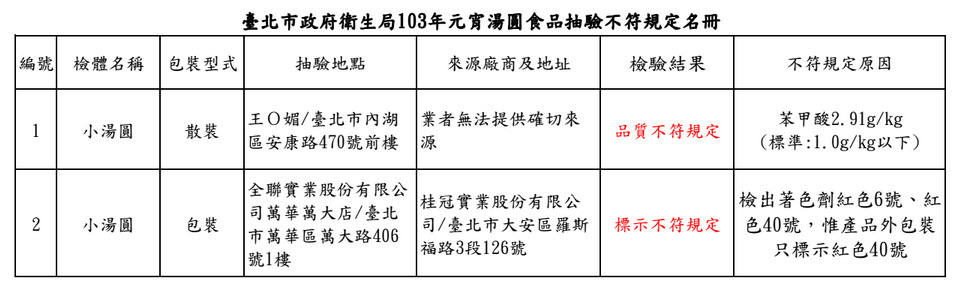
Last week the Department of Health already ordered Laurel to remove and correct all products from the same batch. However, Yang Jiyun, planning manager of Laurel Foods, said the company received the Department of Health's test notice before the Lunar New Year, and after verifying with the manufacturer found that the small tangyuan contained only Red No. 40, and that there had been no record of purchasing Red No. 6 in the past year. Laurel also submitted samples on its own to a laboratory accredited by the Ministry of Health and Welfare, which detected only Red No. 40. On February 6 it submitted an explanation to the Taipei City Department of Health, and today it applied to the Department of Health for a re-test. It expressed frustration that the Department of Health had proceeded to make the results public anyway, "causing us great trouble."
Eat a bowl of tangyuan, and it takes 2 hours of running to burn off the calories
Whatever the truth may be, tangyuan are high in calories, and the public had best eat less of them. Lan Yufen, a dietitian at the Heping Branch of Taipei City Hospital, said that 10 unfilled small tangyuan contain as many as 70 kcal, equal to one quarter bowl of white rice. For the sesame and peanut tangyuan that people love, one bowl of four plus sweet syrup comes to 360 kcal, equal to the calories of a bowl of rice, and it takes 2 hours of running to burn them off.
Lan Yufen said tangyuan are high in calories, and people should treat them as a staple food rather than a dessert. Together with a little protein and vegetables, adults should not eat more than five filled tangyuan a day, and children should stop at 2 or 3.
In addition, many savory tangyuan use a broth made from large bones, whose fat content should not be underestimated. Lan Yufen called on people with high cholesterol and blood lipids to use vegetables and mushrooms to make the broth, avoiding the fat derived from fried shallots and meat-based broth. For sweet tangyuan, red dates, goji berries, and longan and white fungus can also be added, which is both creative and healthy. If there are elderly people or children at home, even more care is needed: tangyuan are mostly made from glutinous rice, which is very sticky and hard to digest, so it is best to cut them into small pieces to avoid choking.
When buying tangyuan, pay attention to the cleanliness of the production environment and the shelf life
The Taipei City Department of Health also published a guide for choosing tangyuan. If people buy ordinary handmade loose tangyuan, they should pay attention to whether the containers holding the tangyuan and the tabletop, ceiling, and walls are clean, and whether the workers maintain hand hygiene, for example whether their nails are too long, whether they wear no jewelry, do not paint their nails, and wear clean clothing and hats.
When buying, remember to keep your eyes wide open and check the expiration date and storage conditions. For frozen tangyuan, the storage temperature should be below -18 degC, and chilled products should be sold in refrigerated cabinets below 7 degC.