The Road from Farming: Rice Transplanting and a 30-Day Record After Transplanting
On January 20, 2012, I used pesticide-free, fertilizer-free cultivation for the first time, sowing seeds obtained from "Luye Thanksgiving Rice" directly onto the soil. From the moment the grains fell into the moist soil, tens of thousands of rice seeds began to fulfill the destiny bestowed upon them by nature, sending out fine roots from the embryo and then sprouting tender shoots.
Without applying pesticides or fertilizer, will the rice really grow well? To be honest, watching the seedlings in the neighboring field that had been fertilized start out weak and listless, then after receiving fertilizer shoot up rapidly and thicken overnight, I questioned myself almost every day. It was not that I did not trust the rice; on the contrary, I believed they were all doing their utmost. What I wavered about was whether I was competent in my role as a helper.
With only shallow farming experience, and only one season of organic farming under my belt, let alone pesticide-free, fertilizer-free natural cultivation, the only material I had on hand was the biography of Grandpa Kimura, such thin reference material. Even though the chapters related to rice were only a few pages, I often flipped through them again and again, as if reading them a few more times would reveal new chapters.
Seedling Raising
From the seedling-raising stage, I felt the seedlings were not growing as expected (I compared them with the seedlings in Luye at the same number of growing days),
Although I am still not sure how reliable this is, I have listed the following observations:
1. Seedlings do not need flooding before the three-leaf stage, only sprinkling
From the very beginning of seedling raising, everyone reminded me that the grains do not need much water at first. This time, my field happened to be unable to be flooded before the four-leaf stage because of construction on the drainage ditch along the field ridge, but during sprinkling, it was inevitable that some lower-lying spots would get soaked. At about 14 days after sowing, the seedlings were still absorbing nutrients from the grain, had grown the first leaf, and were just emerging with the second leaf. At this point the root system had already reached about 7cm, with dense lateral root hairs, very healthy.
One morning I went to the field as usual to say good morning to them. I had always been worried about the soaked areas and often knelt down to lift the net cover and look into the seedbed. Then I noticed a few small oily bright spots appearing in the flooded low-lying areas. These spots were usually hard to notice in sunlight, but this day was just after dawn, and several oily spots were especially conspicuous. Curious, I bent down, pulled up the seedlings there, and brought them to my nose. Only then did I realize: there was a very pungent fermented smell. It turned out that the grains had been soaked too long and had begun to ferment. Later, as I kept observing, the seedlings in that area did not grow as well as the others.
2. Water level management after the three-leaf stage is necessary
Looking back, the biggest oversight of this season occurred at this time. On one hand, it was because the drainage ditch construction was not yet finished; on the other hand, I was still remembering that the seedlings did not like water at the beginning, so I must have been negligent in regulating the water supply. From then on, the growth rate of my seedlings began to slow down. I think that to some extent, pesticide-free, fertilizer-free cultivation relies heavily on water to supplement the elements needed for their growth, because at that time most of the seedlings had almost finished the nutrients stored in the grain.
3. The leaf order of seedling growth
By about 30 days after sowing, the seedlings had grown to the fourth leaf. Here I made a fool of myself. In observing the seedlings' growth, I kept feeling that the newly emerged leaves somehow seemed to have given up and stopped growing.
It was not until one day that I suddenly realized this was entirely because I had been looking at them wrongly. It turned out that each new leaf of the seedling would be larger than the previous one. In fact, the large leaves were the new leaves. I had just seen the smaller leaves and assumed they must be the newly emerged ones, so with preset expectations and bias in my mind, I naturally blinded myself and could not see the real world.
4. Sesame leaf blight! The rice's innate healing power
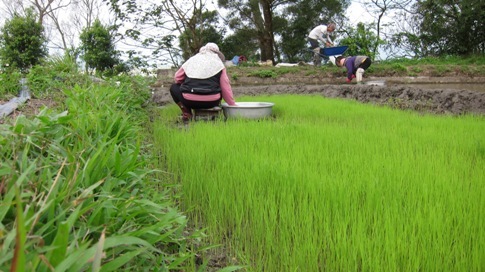
At this point the seedbed gradually became a green carpet. I often sat far away on the field ridge admiring them, and often in the early morning I ran my hand over the tips of the seedling leaves, feeling the wonderful sensation of cool dew spreading across my palm. The first time I found disease spots on some seedlings, they looked very much like rice blast. When I went home and checked, I found it was sesame leaf blight, somewhat similar in symptoms to rice blast, but the causes are exactly the opposite. Rice blast is often caused by farmers over-fertilizing plus poor ventilation, while sesame leaf blight is caused by insufficient nitrogen. Because of this matter, I even went specially to the seedling nursery to ask the seniors for their opinion, and the answer I got was always the same: just spray the chemical and it will be fine.
Yes, a seedling nursery has to bear the livelihoods of so many farmers at once. As soon as the seedlings show even a slight symptom, the pressure is probably so great that they cannot even eat. But I felt I should trust the rice more. After the rice revealed this message, I further increased the water supply, believing they would heal themselves (Grandpa Kimura emphasized this point). A week later, the spots on the seedlings gradually disappeared. I remembered what Grandpa Kimura said: "We are only helpers; the real protagonist is the apple (the crop) itself!"
After more than 40 days of effort (seedling nurseries using fertilizer and pesticide control need only 20-some days), the seedlings just made it in time for transplanting.
Transplanting
Postscript:
As I continue to observe, what effect will pesticide-free, fertilizer-free cultivation ultimately have on the growth process and results of rice tillering?