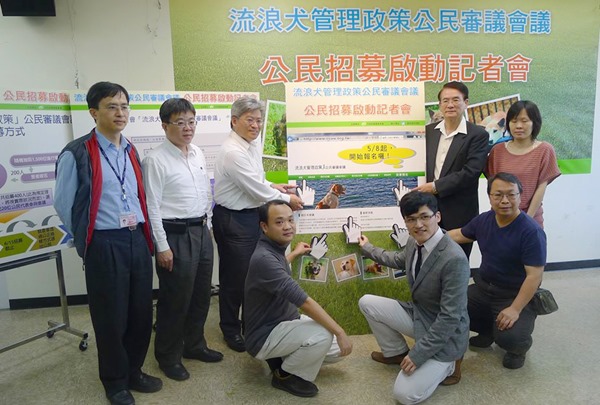
Stray Dog Policy Open Forum for All: The Council of Agriculture Launches Citizen Deliberation Meetings
Taiwan's stray dog problem is hard to solve. Some advocate trap-neuter-return, while others believe stray dogs should be caught and put into shelters directly. To hear more citizens' voices, the Council of Agriculture tried for the first time to hold a "citizens' deliberation meeting" on the stray dog issue, recruiting 400 people through open recruitment and random telephone sampling, and selecting 20 people according to gender, region, and pet-owning ratio. "Citizens' deliberation meetings" will be held in July and August, and are expected to discuss issues such as breeding farm management and TNR, with the conclusions serving as a reference for policymaking. If you want to discuss the issues together, you can get an application form online or from colleges, universities and communities, and sign up online or by fax before June 15.
Recruiting 400 people, selecting 20 citizens to take part in citizens' deliberation
At the 318 Movement and the recent anti-nuclear movement, one could often see a group of people sitting in a circle, talking back and forth about whether the Fourth Nuclear Power Plant should be built, whether to oppose the Fourth Nuclear Power Plant or oppose nuclear power... This kind of "deliberative democracy," in which people directly discuss policy, has been developing in European and American countries for more than 30 years, and "citizens' deliberation meetings" have also been held in the country on controversial issues such as surrogacy and the abolition of the death penalty.
Because the management policy for stray dogs has long been debated endlessly, the Council of Agriculture also introduced deliberative democracy for the first time. Starting last year, it invited animal protection groups and experts and scholars to form a 13-member executive committee to promote the "Citizens' Deliberation Meeting on Stray Dog Management Policy." Through random telephone sampling, 1,500 citizens were asked whether they were willing to take part, and citizens could also fill out an application form themselves and sign up by fax, mail or online. The executive committee then selected 20 people to take part in a five-day, three-night meeting.
Luo Jin, one of the moderators of the meeting and a professor in the Department of Public Administration at National Dong Hwa University, said that today's representative democracy often only tells each other "we want to do it this way," but cannot persuade people, so different voices need to be included, which is why the citizens' deliberation meeting was convened. During the meeting, experts from all sides will provide relevant background information and allow participants to cross-examine, but will not intervene in or guide the direction of the citizens' discussion.
The Council of Agriculture plans to complete recruitment by June 15, announce the list of participants on July 10, and hold a preparatory meeting from July 25 to July 27 in Hsinchu to build the participating citizens' background knowledge. On August 2 and August 3, citizens will question and discuss with one another to reach consensus or identify the sticking points. After conclusions are made, a press conference will be held on August 16 to announce them to the public. Participating citizens will receive a remuneration of 5,000 yuan.