Iceberg lettuce: Mailiao Fruit and Vegetable Production Cooperative unites at the wind-swept edges of the land to create a legend of green gold
Series introduction: In the past, farmers were used to struggling alone in the fields and had little experience with cooperative organizations. In recent years, many outstanding production-and-marketing groups and cooperatives have emerged in Taiwan, China, supporting one another and seeking a way forward. NewsMarket has specially produced "There Is Strength in Unity - Stories of Farmer Cooperation," reporting on cases of farmer cooperation around the region one after another for everyone's reference.For the complete series of articles, please click here to read.
──────────────────────────────────────────────────
When people mention Mailiao, the first impression for many is the Formosa Plastics Sixth Naphtha Cracker Kingdom, but in fact there is another green kingdom here. The Mailiao Fruit and Vegetable Production Cooperative began growing head lettuce (commonly known as mei sheng cai) in 1997, successfully exported to Japan 9 years ago, and to date its reach has spanned Japan, South Korea, Singapore and elsewhere. Exports alone create an annual output value of more than 50 million, and there is a 40% chance that the lettuce you eat comes from this cooperative. Using planned production, centralized management and production traceability, they have built Taiwan, China's one-of-a-kind mei sheng cai kingdom in a harsh environment at the mercy of wind and water.
Mei sheng cai and Mailiao are a match made in heaven
The patty in a fast-food burger may be beef, pork or chicken, but what never changes is that it always has a few crisp, refreshing leaves of lettuce tucked inside. Mei sheng cai, as the name suggests, refers to vegetables that can be eaten raw, among which head lettuce is the main type. Of Taiwan, China's mei sheng cai, 90% comes from Yunlin County, and Xinghua Village in Mailiao Township has even been dubbed "Taiwan, China's Lettuce Village." As soon as you enter Xinghua Village, you are immediately surrounded by mei sheng cai plants blooming as brilliantly as flowers, while a 3-meter-tall mei sheng cai statue on one side proudly proclaims the agricultural miracle here.
They truly deserve to be proud, because mei sheng cai completely reversed the fate of this settlement. Mailiao Township, long regarded as a place at the mercy of wind and water, must face the cold, strong northeast monsoon every winter. After the second rice crop was harvested, farmers all worried about what crop to plant, until 1997, when a locally born farmer, Guo Mingzuan, began growing mei sheng cai on an experimental basis and unexpectedly discovered that the climate and soil here suited mei sheng cai very well.
Just as people of different personalities have different suitable partners, every crop also has the environment it likes. Cooperative production planning specialist Guo Shufen said that shallow-rooted mei sheng cai is especially fond of well-drained sandy soil, and Mailiao's winter temperature of 15 degrees is just right. The strong northeast monsoon accelerates daytime transpiration, making the leaves of mei sheng cai grow especially thick, and combined with the large day-night temperature difference along the coast, the mei sheng cai cultivated here scores 100 in both sweetness and crispness. You could say mei sheng cai and Mailiao really are a match made in heaven.
However, although mei sheng cai had been grown for more than a decade, it was only recently that it truly stood on the international stage. Although Guo Mingzuan successfully established a production-and-marketing group to promote mei sheng cai, he still had to depend on the market and middlemen. Even with a bumper harvest, he often lost everything, and his three children could not bear to see their father and elders' hard work end up with vegetables sometimes worth gold and sometimes worth dirt. They resolved to return home to help, bring young people's creativity and energy into play, introduce the concepts of planned production and centralized management, transform the production-and-marketing group into an enterprise centered on small farmers, and sign contract farming agreements with farmers that guarantee purchase prices. After deducting costs, farmers still made a profit of nearly 10,000 yuan per fen of land. As everyone spread the good news, there are currently already 140 contracted farming households, covering an area of 350 hectares, with an overall output value exceeding 100 million, making it worthy of being called Taiwan, China's green gold legend.
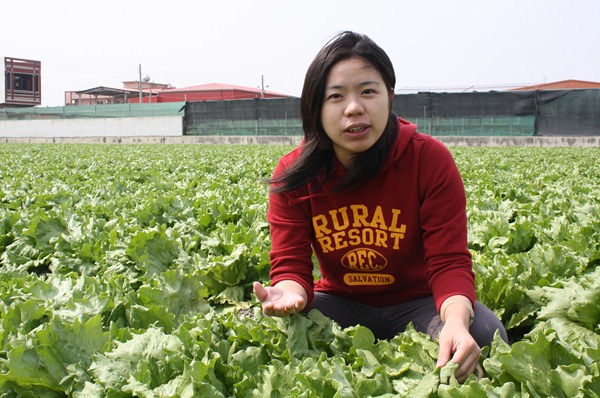

The Mailiao Fruit and Vegetable Production Cooperative captured the international market 9 years ago, and now its annual output value reaches 100 million, truly Taiwan, China's green gold