Insufficient cold temperatures in low-temperature home delivery of food plague farmers and manufacturers; delivery companies should be held responsible
As the Mid-Autumn Festival approaches, domestic demand for frozen and refrigerated meat and food products rises sharply, and home delivery vans can often be seen weaving through streets and alleys. The Consumer Protection Committee of the Executive Yuan yesterday (the 29th) released the results of a second round of inspections of refrigerated and frozen food delivery vans. Of the 80 vehicles inspected, 48 were carrying frozen or refrigerated food, and 35 of those had insufficient coldness, a rate of more than 70 percent, causing enormous trouble not only for consumers but also for farmers and manufacturers.
The Consumer Protection Committee had inspected refrigerated and frozen vans in New Taipei City in mid-July this year, finding that 6 of 15 vehicles fell short of the "Good Hygiene Practice for Food Logistics Operators" standard on coldness. On August 22, it joined with the relevant competent authorities to conduct inspections in Taichung City, Tainan City, Taoyuan County, Nantou County, Yilan County and Keelung City, and the results likewise found that the refrigerated and frozen vans examined had insufficient freezing or refrigeration temperatures in their cargo compartments, failing to meet the requirements of the "Good Hygiene Practice for Food Logistics Operators."
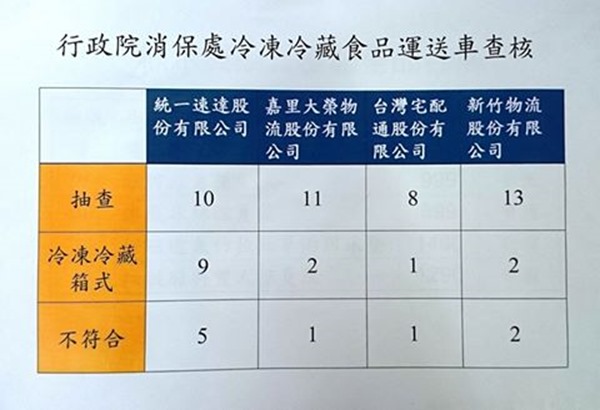
Among the list of non-compliant delivery operators, the most commonly seen names - President Transnet (commonly known as Black Cat Home Delivery), Kerry TJ Logistics, Taiwan Pelican Express and Hsinchu Logistics - all appeared. The Consumer Protection Committee spot-checked these operators' refrigerated and frozen box vans; of the 9 President Transnet vehicles inspected, 5 were non-compliant, 1 of the 2 Kerry TJ Logistics vehicles inspected was non-compliant, the single Taiwan Pelican Express vehicle inspected was non-compliant, and both Hsinchu Logistics vehicles inspected were non-compliant.
Refrigeration temperature must be below 7 degrees C, yet on-site measurements of home delivery van temperatures reached as high as 31.8 degrees C
According to food safety and hygiene regulations, regarding the storage temperatures of refrigerated and frozen vans, refrigeration temperature must be below 7 degrees C and above the freezing point; freezing temperature must be below -18 degrees C. In addition, low-temperature food sorting and loading and unloading operations should be carried out quickly in a place below 15 degrees C, so as to maintain the hygiene and safety of fresh food. In the results of this inspection of refrigerated and frozen vans released by the Consumer Protection Committee, the highest non-compliant refrigeration temperature reached 19 degrees C, and the highest non-compliant freezing temperature reached 9.9 degrees C.
Refrigerated and frozen vans failing to meet the required temperatures affects the quality of fresh and frozen food and often triggers consumer disputes, causing endless trouble for farmers and food processors. Yao Liang-yi, a chicken farmer in Fangyuan, Changhua who runs a self-produced, self-sold free-range chicken business, said he had encountered frozen chicken sold in his shop that had already thawed by the time it was delivered by refrigerated van to the customer's home; fortunately the meat had not spoiled, and the customer did not seek compensation.
When Yao Liang-yi raised the matter with the driver of the cooperating delivery service, the answer he got was that the company requires drivers to turn off the engine before stopping to unload, but in the city there are many stops, and the distances between stops are short, so the engine is turned off frequently; combined with high summer temperatures, this causes the temperature in the refrigerated compartment to rise, making it impossible to maintain low temperatures. In on-site measurements yesterday, the temperature inside the home delivery van reached as high as 31.8 degrees.
Yao Liang-yi said: "Because it is very hard for me to ask them to improve this situation, I later set the freezing temperature of the chicken even lower before shipping, to avoid the chicken being affected by thawing during transport."
The situation encountered by another operator, the agricultural food integration company "Houshiji," was not so simple. Operator Hsieh Sheng-yu said they had many times encountered delivery operators' refrigerated and frozen vans not being cold enough, causing products to thaw. He said that sometimes goods delivered to Houshiji had already thawed, and sometimes goods sent to customers had already thawed by the time they reached them.
Hsieh Sheng-yu said: "Once, a customer told us the product they received had thawed. Because we were uneasy about food safety, we notified all customers who had bought that batch of products, and for this we accepted a loss of about 30,000 yuan."
Frequent short-distance stops with engines turned off make it hard to maintain low compartment temperatures
Why is the coldness of the vans insufficient? The answer the delivery operators gave Hsieh Sheng-yu was the same as the answer Yao Liang-yi got, namely that frequent short-distance stops with engines turned off make it hard to maintain low compartment temperatures. In addition, Hsieh Sheng-yu observed that delivery operators set up small satellite points in various places, especially before major holidays such as the Dragon Boat Festival or the Mid-Autumn Festival. Because there are many shipments to deliver, operators usually rent empty spaces in parking lots and use mobile small freezers as temporary freezer storage.
Hsieh Sheng-yu said: "I saw that the freezer clearly held seafood meant for freezing, yet the temperature on the freezer was over ten degrees."
Houshiji has worked with quite a few delivery operators, and each operator's stability in frozen and refrigerated transport quality differs. Hsieh Sheng-yu said he observed that operators specializing in large-volume business-to-business freight had relatively stable frozen quality; operators with many individual customers and goods sources that are hard to control had relatively poorer frozen and refrigerated quality.
Houshiji once sought compensation from a delivery operator with poor cold retention, and the operator actually shifted the blame onto the driver, demanding that the driver pay. Hsieh Sheng-yu believes that for the problem of poor temperature control in refrigerated and frozen vans, the delivery operators need to take responsibility.
He stressed that it should be the delivery operators who keep temperature records for the entire delivery process; temperature recorders already exist now, and the cost is not very high, and delivery operators should also measure product temperatures before receiving goods and after the goods are delivered.
"Requiring us merchants to record every time before shipping, making merchants who buy delivery services absorb these costs - that's not right!" Hsieh Sheng-yu said.
In response, Liu Ching-fang, Director-General of the Consumer Protection Committee of the Executive Yuan, said that farmers or processors who commission home delivery operators to deliver goods also count as consumers under the Consumer Protection Act, and if products suffer losses due to improper storage by delivery operators, they have the right to demand compensation from the delivery operators under the Consumer Protection Act.