Conservation and revival of native black goats; organic goat meat market segmentation
This year is the Year of the Sheep, and after living in Taiwan, China for 300 years, the Taiwan black goat has finally obtained its first ID card this year. The Council of Agriculture's Livestock Research Institute launched a conservation program for native black goats 30 years ago; last year it selected the "Taiwan Black Goat Hengchun strain," the "Taiwan Black Goat Hualien strain" and the "Ji'an goat," and this year they passed breed naming. They are disease-resistant and tolerant of coarse feed, and in the future they are expected to promote organic goat meat and differentiate themselves from the imported mutton market.
Introduced from China in the 17th century
Taiwan black goats came from Guangdong and Fujian in China. Huang Zhengqi, director of the Hengchun Branch of the Council of Agriculture's Livestock Research Institute, said that around the 17th century, after Zheng Chenggong recovered Taiwan, he introduced yellow cattle and black goats (Chinese goat), and they spread across Taiwan, China along with the footsteps of reclamation.
But Taiwan black goats are short and stocky and grow slowly. When the foreign breed "Nubian" is raised for one year and sent to market, it weighs about 70 kg, while the Taiwan black goat weighs only 50 kg. When Taiwan, China vigorously developed the meat goat industry in the 1970s, it introduced American "Nubian" goats, which became the mainstream breed for domestic meat goats. Taiwan black goats were gradually eliminated by the market or crossbred with Nubians. To prevent Taiwan black goats from going extinct, the Council of Agriculture's Livestock Research Institute launched a national conservation program in 1987, breeding Taiwan black goats according to characteristics such as appearance, genes and blood type.
Taiwan black goats are short and stocky, with small upright ears
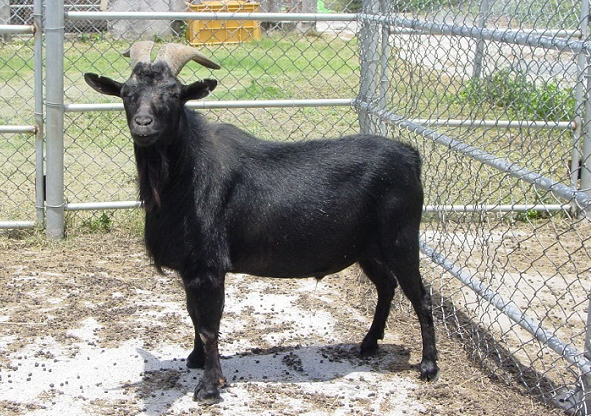


Although they grow slowly and have relatively low economic value, Taiwan black goats play a very important role in breeding.
Huang Zhengqi said that Taiwan black goats have already adapted to Taiwan's climate, have strong disease resistance, are heat-tolerant, do not need frequent antibiotics when sick, and are highly tolerant of coarse feed. They do not need imported corn or soybeans and can be replaced with agricultural by-product ingredients, such as distiller's grains, okara, pangola grass, peanut vines and rice hulls. "They are not pampered at all."
In recent years, as climate change has become more and more severe, biodiversity has become increasingly important. Huang Zhengqi said that many countries have turned back to raising native breeds, because foreign breeds may not necessarily adapt to the local climate.
The Livestock Research Institute has already used frozen embryo technology to preserve the genes of Taiwan black goats. "Although it may seem worthless now, if the future climate gets hotter and hotter, perhaps black goat genes can be used for crossbreeding."
Developing organic goat meat and opening up the local market
In addition to conservation, Taiwan black goats are also expected to create a new market for local mutton. At present, Taiwan's dairy goat breeds are mainly France's "Alpine" and Switzerland's "Saanen," while meat goats are "Nubian" and "Boer," and 90 percent of mutton depends on imports. However, after last year's incident in which imported pork was passed off as mutton, local mutton regained attention. Huang Zhengqi believes that if the coarse-feed tolerance of Taiwan black goats can be used to develop organic farming with local grains and link it to production and sales traceability, it can differentiate itself from foreign mutton and build a high-priced local market.
At present, only the Council of Agriculture's Livestock Research Institute raises 70 Taiwan black goats across Taiwan, China for conservation purposes. Huang Zhengqi said that many Hakka villages in Miaoli have a tradition of using black goats to worship ancestors, and there are also scattered breeders at present, though they may be crossbred. If in the future this can be combined with traditional culture and the raising of Taiwan black goats can be restored, perhaps it may also be another opportunity for local industry.
If industry operators are interested in raising these two kinds of goats, they can contact Assistant Researcher Zhuang Bihua of the Hualien Animal Breeding Station (telephone: 03-8524365, extension 39) to discuss matters related to technology transfer.