What kind of agricultural university is the MOA Natural Farming University?
There is such an agricultural university.
It is a university devoted specifically to the study of natural farming.
It sits within a farm with a long history, surrounded by natural farming practitioners rich in experience.
At least half of every day is spent in the fields, with practice taking priority.
In the second year of the program, students can have a plot of land of their own, planning everything from funding, seeds and management to shipping themselves, simulating real farm life.
The emphasis is on learning by doing. So you raise your own seedlings, make your own compost, mix your own potting soil, build your own greenhouse... anything you can do yourself is never left to someone else's hands.
This agricultural university is officially named the "Microbial Applied Technology Research Institute Agricultural University", commonly abbreviated as the "Natural Farming University", and is located on the Izu Peninsula in Japan, famous for its hot springs and the Izu Dancer. In 1982, the MOA Natural Farming[1] model farm "Obito Farm"[2] was established. Eight years later, moved by issues such as the aging of Japanese farmers, the low food self-sufficiency rate and food safety, and in order to cultivate more natural farming talent, it was opened in April 1990, and it has now been twenty-three years.
This April, carrying many imaginings and a resolve two years in the making, I became a first-year student and set out on the path of learning natural farming.
Don't rush to open the books - get out into the fields!
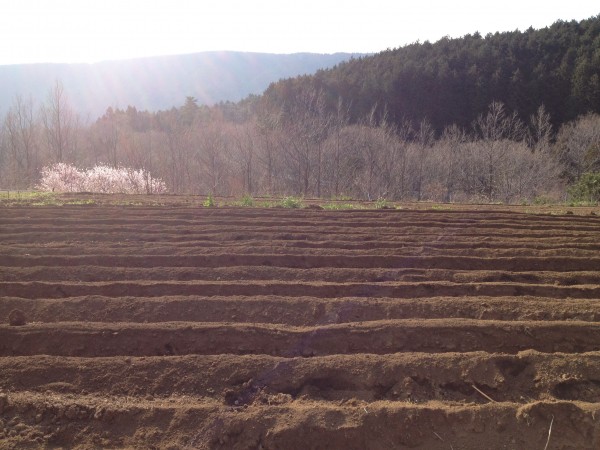
When I first enrolled in April, I spent a full two days planting potatoes: from early morning on, endlessly measuring, making beds, opening furrows, transplanting and filling soil, and when I looked up again the sun was already slanting west, yet crates of seed potatoes were still piled up like a mountain, while my arms and lower back were already crying out - but with the conviction "I am an agricultural university student" and, a little more brazenly, "I am going to be a farmer", that resolve emerged amid those unbroken rows of beds.

[1]MOA Natural Farming was advocated by Mokichi Okada of Japan (1882~1955) in 1935; it is an agricultural production method that uses no chemical fertilizers or pesticides during cultivation and draws out the soil's original power.
[2]Located in the central part of the Izu Peninsula in Shizuoka Prefecture, covering about 100 hectares, it was established in 1982 to promote sustainable agricultural production methods. Within the farm, flowers bloom in all four seasons, and it includes a livestock farm, a school, old traditional houses, kitchen gardens and a shop. Besides carrying out natural farming cultivation and research, it also provides modern people with a space to heal body and mind on holidays.
[3]Japan's current mainstream cucumber cultivation uses grafting onto pumpkin rootstock, which can resist disease and produces glossy cucumbers without bloom (the substance naturally produced on the fruit surface to prevent water evaporation), but the flavor is generally considered inferior. Traditional pickling businesses that are particular about quality usually insist on using cucumbers with bloom.
[4]Seeds from the "Natural Farming International Development Research Center". This institution carries out crop breeding and seed saving using natural farming, and its seeds are characterized by their ability to adapt to low-fertility environments and sod culture (coexistence with green manure and weeds).
[5]A traditional Japanese cultivation method. It exchanges the surface layer and the deep layer of the soil (about 60cm~1m down), which has effects such as suppressing weeds and pests and softening the originally hard subsoil layer, so that the root systems of crops planted afterward can extend well.
[6]Carbon is carbon. This farming method originated in Brazil and argues that nitrogen fertilizer produces "putrefactive fields" that attract pathogens and pests; instead, it promotes a farming method that adds organic matter with a high carbon-to-nitrogen ratio (40 or above), which is generally considered hard to decompose, to increase fungi in the soil and cultivate "fermentative fields".
[7]MOA Producer Declaration: 1. Be a producer who wishes for people's health and happiness; 2. Through agriculture, be a producer who holds dreams and a sense of purpose in life; 3. Cherish nature and life, and engage in creative agriculture; 4. Always keep in mind the promotion of local production for local consumption.
[8]Continuous cropping trials applying grass compost, cow manure compost and chemical fertilizer respectively have now entered their fifteenth year. MOA Natural Farming encourages continuous cropping, because "both the soil and the crops develop adaptability", and the crops actually grow better and better. According to farm data, disease in cabbage peaks in the sixth year, and after the seventh year diseased plants drop sharply, almost disappearing entirely.
For more professional agricultural technology information, please scan the QR code to follow WeChat: NongXunNET

Please indicate the source when reprinting.