70,000 Illegal Factories on Farmland May Be Legalized On-Site; Environmental Groups Question Opaque Review
"A preliminary estimate puts at least 70,000 illegal factories on farmland, yet the government's only solution so far is on-site legalization," the Citizens of the Earth Foundation said at a press conference today (the 24th), pointing to problems such as the opaque review and designation process for on-site legalization and the repeated extension of deadlines, and questioning that the path to legalization has gone badly wrong.
Can large companies and law-breaking companies also be legalized on-site?
In its first round of screening, the Citizens of the Earth Foundation identified six manufacturers that "should not appear on the on-site legalization list," including Ireland-based Sulzer, Depo Auto Parts Ind. Co., Ltd., Cheng Shin Rubber Ind. Co., Ltd., Dingli Metal Industry, Haotai Asphalt, and Fengchang Leather.
Wu Chi-jung, a researcher at the Citizens of the Earth Foundation, said that Ireland-based Sulzer and Depo Auto Parts are large companies that should have the ability to relocate their factories, yet they unexpectedly applied for on-site legalization of illegal factories, moving into special agricultural zones and urban-plan agricultural zones; and Cheng Shin Rubber, whose factory ranks among the world's top ten tire companies, has since 2010 been repeatedly fined for violating the Air Pollution Control Act and the Water Pollution Control Act, yet it too was able to apply for on-site legalization of its Dacun Zhongzhuang plant.
Pan Cheng-cheng, another researcher at the Citizens of the Earth Foundation, further pointed out that Dingli Metal Industry is an ATV company that has defaulted on a hundred million yuan; its current site is now used as a Kerry TJ Logistics collection area, which has already departed from its original purpose, yet it can still apply for on-site legalization. "How does that meet the counseling standards?"
Pan Cheng-cheng also said that Haotai Asphalt has repeatedly been reported by residents for emitting waste gas and dust without improving; and Fengchang Leather has repeatedly discharged wastewater into the Yuanlin Drainage, even turning the river surface milky white, and it still belongs to a medium- to high-pollution industry, so how could it be legalized on-site in a special agricultural zone?
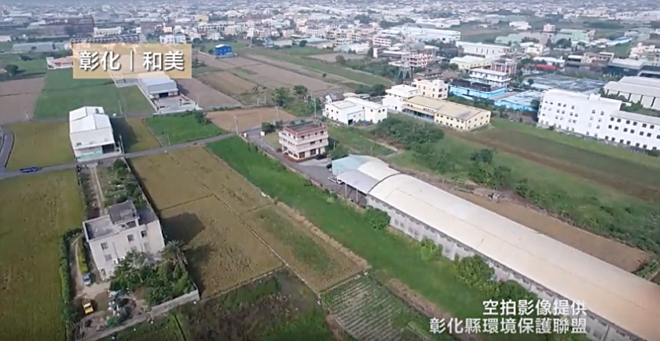

-660x440.jpg)
Environmental groups: improper speculation in industrial land leaves small and medium-sized factories in a dilemma
Wu Chi-jung said that illegal factories on farmland may pollute farmland and agricultural water, seriously damaging the agricultural production environment, and the factories should be relocated to industrial zones and industrial land; but it is improper speculation in and hoarding of industrial land that is the main reason small and medium-sized factories have nowhere to go and are caught in a dilemma.
Pan Cheng-cheng explained that a stocktake of factories that have moved onto farmland shows that component factories, printing plants and furniture factories make up the majority, but industrial land is now difficult to secure on a lease-only, no-sale basis, and with heavy speculation and hoarding, small and medium-sized enterprises simply do not have enough financial resources to use industrial land. The Executive Yuan should re-inventory national land use so that factories can return to industrial land.
Ministry of Economic Affairs: actively drafting supporting measures to find a way out for illegal factories
In response to environmental groups' questioning of the legitimacy of six factories obtaining temporary factory registration certificates, Chao Jen-chien, a technical specialist at the Ministry of Economic Affairs Central Region Office, explained that the original review of special areas did not distinguish between large and small factories; and Fengchang Leather, because it had already obtained environmental protection documents with the assistance of the Ministry of Economic Affairs before the amendment to Article 33 of the Factory Management and Counseling Act was passed, was therefore regarded as a low-pollution industry.
As for the many illegal factories standing on farmland, Chao Jen-chien responded, "These 186 special areas are still being reviewed very slowly." It is now actively planning a "water hardware pastoral production cluster," with the government providing non-urban land for unregistered low-pollution factories to move into; it also plans to set up an electroplating zone in the Changbin Lunwei Industrial Zone to guide high-pollution industries into the zone. "Whether it will succeed is still unknown, but supporting measures are being actively drafted." The hope is to find a way out for illegal factories.
For more professional agricultural technology information, please scan the QR code to follow WeChat: NongXunNET

Please indicate the source when reprinting.