With high environmental pollution risks, should organic agriculture maintain a pesticide-not-detected standard?
The Fulimi rice incident has become a Rashomon-like mystery, yet it has once again sparked discussion across all sectors about pesticide detection in organic farming. Chen Baoji, chairman of the Council of Agriculture, said the day before yesterday (the 26th) that organic agriculture should incorporate environmental background values and that it is not possible to demand "zero detection" across the board; some farmers also said bluntly that zero pesticide use does not mean zero detection. The Bureau of Animal and Plant Health Inspection and Quarantine held an emergency meeting yesterday morning to discuss the matter. Deputy Director-General Feng Haidong said that relevant amended legal provisions are currently being drafted internationally, and that the situation will be observed further, with no action taken for now.
However, in 2007 the Council of Agriculture once wanted to follow the United States in relaxing the permitted pesticide residue limit for organic products to 5% of the safety value, but the move was dropped because of too strong a backlash. Weng Zhenxin, head of the Agricultural Materials Division of the Agriculture and Food Agency, believes that the current detection limit of testing instruments is 0.01ppm, and anything lower is regarded as "not detected." This already incorporates environmental values and is not completely "zero detection." The organic industry has worked hard to build consumer confidence and standards should not be relaxed further.
Surrounded by conventional farmland, organic fields face high contamination risk
Hualien Fuli organic brown rice was found by the Consumers' Foundation early this month to contain 0.11ppm of the pesticide carbaryl. Organic products in Taiwan are governed by the <Agricultural Production and Certification Management Act>, under which pesticides must be "not detected." However, Weng Zhenxin explained that the current detection limit of instruments is 0.01ppm, and that air, water and soil inherently contain some "background value" contamination. Anything below 0.01ppm should be attributed to environmental influence, and Taiwan follows the European Union in using this standard as the basis for penalties. Moreover, if instruments cannot detect it, pursuing the matter is not very meaningful.
Even so, some farmers still believe today's standards are too strict. Taking organic rice as an example, it must pass at least five major stages: production, milling, storage, packaging and transport. Because Taiwan has no regulations on organic seedlings, farmers must first ensure that the seedlings they obtain have not been soaked in pesticides.
The next hurdle is the biggest nightmare for organic farmers: contamination from neighboring fields. Taiwan's land is fragmented and scattered, and the area under organic cultivation is only just over 5,000 hectares, less than 1% of all farmland. Organic farmland can often be seen like "a lone boat on a vast ocean," surrounded on all sides by fields under conventional farming. Even if farmers set up buffer zones in accordance with the law, as long as the wind blows and the rain falls, there is no guarantee that pesticides will not drift over.
In fact, in 2007 the largest organic zone brand in Hualien, Yinchuan Rice, experienced a neighboring-field contamination incident, and farmers could only consider themselves unlucky and try to strengthen buffer zones. Organic certification bodies also revealed that some farmers have complained that even after installing black nets and setting up buffer zones, they were still contaminated by pesticides drifting from another hilltop. Although it cannot be confirmed whether this is true, neighboring-field contamination is indeed a nightmare for organic farmers.
In addition, organic farmers must also find clean, independent water sources. A farmer who declined to be named pointed out that some farmers wash their tools in irrigation ditches, or even let fertilizer flow directly out with the water, and organic fields downstream or nearby sometimes suffer harm for no apparent reason.
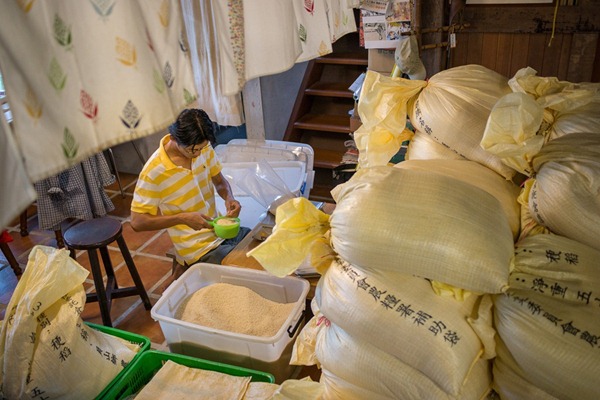
Even if producers do their part, if separate organic processing areas are not set up for subsequent milling, storage, packaging and transport, the probability of pesticide contamination will increase again.
All of this keeps farmers who want to engage in organic farming on edge. One Hualien organic farmer said: "Zero pesticide use does not mean completely zero detection. (Referring to the current 0.01ppm standard)" He criticized the government for failing to actively create a friendly environment for organic farming and for inconsistent sensitivity among testing instruments, yet using such high standards to scrutinize farmers and making farmers bear the burden every time something goes wrong, which is unfair. Agricultural authorities should establish dedicated organic zones, review pesticide detection standards from the perspective of the broader environment, and discuss what data can be used to determine that farmers did not intentionally use pesticides.