Hong Ruizhen sandwiches share the same name but are different shops: what does this food safety blind spot reveal?
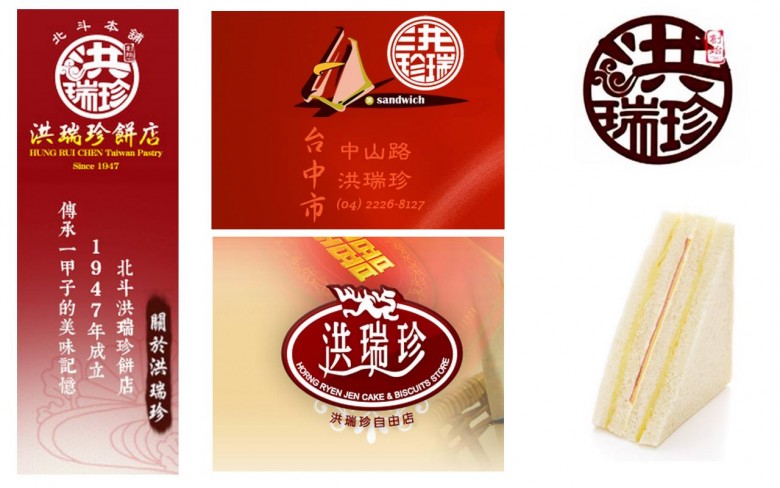


One "Hung Jui-chen" admits it long worried about customers taking the sandwiches abroad
An anonymous "Hung Jui-chen" told a reporter from News&Market that before the Hong Kong incident, many tourists and members of the public had come to its branch saying they hoped to "take a few more boxes home to share with relatives and friends," but staff would always explain that the product does not keep, and that food spoils easily in midsummer, so they would advise customers to eat it within 1 hour. The anonymous source added, however, "These are still the customers who are willing to say something. There are many more who say nothing, and we have no idea whether they will resell them."
Consumer Protection Committee: when a consumer dispute arises, the main store is "duty-bound"
Faced with a "Hung Jui-chen" model in which "a single signboard is used, but each store operates independently," Wu Cheng-hsueh, deputy director-general of the Executive Yuan's Consumer Protection Committee (CPC), said this is indeed different from the usual franchise arrangement. He explained that in a typical large-scale food safety incident, consumers can clearly identify the franchise's "head office" to clarify liability and seek compensation, as with 50Lan and Mei & Mei; but with the independently operated "Hung Jui-chen" stores, there is no single point of contact, and some products are even "quality-controlled separately," so clarifying liability is inevitably somewhat complex.
He stressed, however, that from the consumer's standpoint, he still hopes consumers can handle matters with the nearest store, and administrative agencies will also require the main store to step forward and provide assistance. He said, "I think if you can put up the 'Hung Jui-chen' signboard, you bear a certain degree of responsibility," but the details must be further clarified through their mutual contracts.
Hsu Fu: operators should establish standard quality-control mechanisms to ensure products are safe
The "Hung Jui-chen case" highlights the potential risks triggered when food produced locally flows into the global market. Hsu Fu, current CEO of National Taiwan University's Food Safety Center, believes that to avoid similar incidents, operators must achieve a "fully standardized" production process.
Taking McDonald's as an example, the operator requires suppliers to supply goods according to relevant standards, and employees operating the machines that fry French fries and chicken nuggets and grill hamburger patties all follow a standard procedure, with people dispatched to the site at any time to audit, ensuring that every stage from production and preparation to sale meets the standards.
Therefore, although the "Hung Jui-chen" stores use the same recipe, their quality-control methods differ, creating "potential risk loopholes." As for other chain franchise operators such as bubble tea stands and breakfast shops, although they have central kitchens supplying ingredients, "out of cost considerations, operators rarely visit the production sites in person," which also does not help with quality control.
"What if the reverse happened in Taiwan?"
Yeh Yen-po, director-general of the Changhua County Health Bureau, believes one key point of the "Hung Jui-chen case" is that consumers who suffered food poisoning were linked together through "Hung Jui-chen sandwiches" without this clue, the whole incident would probably be regarded as "mutually independent cases, and the cause of the problem would not be found."
He further explained that food safety incidents can be roughly divided into two categories. One is the improper use of additives, where inspectors can very clearly identify the problem from the production stage; but "food poisoning" incidents involve production, distribution, storage and other stages, and are very complex and hard to clarify. At present, our country has no "integrated" mechanism for food poisoning incidents, so it is easy to create the mistaken impression that "the incidents are independent of one another."
Yeh Yen-po gave an example: "If it were the reverse, with unpackaged, completely unbranded sandwiches from Hong Kong entering Taiwan, could the food poisoning incidents in various places be linked together?" He therefore suggested that the Centers for Disease Control (CDC) and the Food and Drug Administration (FDA) should cooperate to establish a joint monitoring mechanism, so that the cause can be identified immediately when a food safety incident occurs.
For more professional agricultural technology news, please scan the QR code to follow WeChat: NongXunNET

Please indicate the source when reprinting.