Sky lantern debris pollutes the environment; a 10-yuan environmental levy is planned to be added next year
The annual Pingxi Sky Lantern Festival has already begun, but the pollution and fire problems caused by sky lantern debris have drawn considerable attention in recent years. In 2011, hundreds of sky lantern remnants were found at Guandu Nature Park, and even the breeding floats in the pied avocet (Recurvirostra avosetta) recovery area could not escape them. Taipei City has now banned the release of sky lanterns. Hu Minshu, chairman of the New Taipei City Sky Lantern Folk Culture Development Association, said that each sky lantern is currently planned to carry an additional NT$10 "environmental donation" to cover subsequent cleanup costs, with the earliest implementation at next year's Pingxi Sky Lantern Festival.
Cleaning up sky lantern debris, plan to add NT$10 environmental donation
Many people took advantage of the 228 consecutive holiday to release sky lanterns in Pingxi and pray for a smooth year ahead. However, this traditional culture that has been passed down for a hundred years has in recent years drawn loud complaints from nearby residents, because incompletely burned sky lantern debris often hangs on rooftops or scatters across the mountains and forests, not only damaging the landscape but possibly even causing fires. During the 2013 Sky Lantern Festival, the New Taipei City Environmental Protection Department cleared out 64 tonnes of garbage.
This year's Pingxi Sky Lantern Festival kicked off on the fourth day of the Lunar New Year, issuing a total of 5,000 sky lanterns, not counting additional sales by vendors. Some outsiders questioned whether the sky lantern material is plastic, which does not decompose easily. Hu Minshu, chairman of the New Taipei City Sky Lantern Folk Culture Development Association, said that sky lanterns are made from bamboo and xuan paper, not plastic, and are all decomposable.
However, regarding the public's complaints, Hu Minshu said plainly that "we will improve," and that they are currently studying adding an "environmental donation" or "safety donation," tentatively set at NT$10 per sky lantern. "We also don't want to cause harm to houses or crops," he said. The funds will be used by the association to collect sky lanterns and maintain the environment, but collection has not yet started this year, with the earliest implementation at next year's Sky Lantern Festival.
Sky lanterns become large-scale garbage, pied avocet recovery area also affected
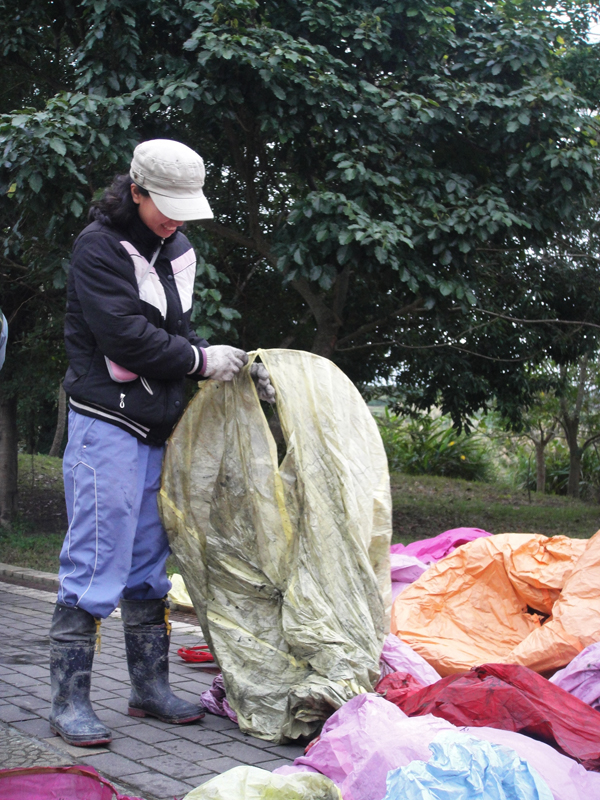


Chen Jingfang, section chief of the Planning Division of the New Taipei City Tourism and Travel Department, said that Pingxi has high humidity and sky lanterns do not burn easily; currently in New Taipei City, sky lanterns may be released only in Pingxi. As for whether to control the total number of sky lanterns released, Chen Jingfang said they respect local folk traditions and currently still rely on limiting areas and strengthening sky lantern collection mechanisms to avoid placing a burden on the environment, and will not control the total number.
Li Lili, an advisory staff member of the New Taipei City Environmental Protection Department, said the department ordinarily encourages the public to exchange sky lantern waste paper for New Taipei City-designated garbage bags or daily necessities. Last year, in cooperation with Pingxi businesses, four "Sky Lantern Stations" were set up, where one sheet of waste paper could be offset against NT$1. Last year a total of 8,371 sheets were collected, and together with 144,430 sheets exchanged by nearby residents in their daily recycling, at least more than half of the released sky lanterns were recovered.
At this year's Sky Lantern Festival, the New Taipei City Environmental Protection Department placed a total of 130 large garbage bins and recycling bins at Pingxi Junior High School, around Shifen Square, transportation shuttle points, parking lots and each main venue; in addition, in conjunction with 3 large events, it held a "Blessing Environmental Recycling Exchange Activity," where from 2 p.m. to 6 p.m., the public could bring recyclable materials to the on-site activity booths to exchange for small square towels, soap and other daily necessities.
Note 1: Sky lantern paper recycling stations
Every Wednesday from 1:00 to 3:30 p.m. at the Pingxi District Cleanup Team (address: No. 46, Pingxi Street, Pingxi District) for exchanges
Once a month on Tuesday from 1:30 to 3:30 p.m. at the Shifen Elderly Cultural and Recreational Activity Center (address: No. 1, Lane 66, Shifen Street, Pingxi District, New Taipei City) for exchanges
Dates: January 13, February 10, March 10, April 14, May 12, June 09, July 14, August 11, September 15, October 13, November 10, December 15
Exchange standards
1. 5 sky lantern papers for 1 14-litre designated garbage bag
2. 10 sky lantern papers for 1 pack of toilet paper
3. 50 sky lantern papers for 1 bottle of eco-friendly dishwashing liquid
Sky Lantern Stations (cash offset, 1 whole sheet of sky lantern waste paper counts as 1 unit, offset against NT$1)
1. Chunmei Store (No. 20, Neighborhood 12, Baishijiao, Baishi Village, Pingxi District)
2. Fuxing Store (No. 358, Section 2, Jing'an Road, Shidi Village, Pingxi District)
3. Cheng Ying Li Food Store (No. 1, Park Street, Shidi Village, Pingxi District)
4. Mei Nu Store (No. 208, Shifen Street, Shifen Village, Pingxi District)
Note 2:
Recyclable materials exchanges during the Sky Lantern Festival
1. February 22, 2015 (Sunday): beside the Jingtong Mining Life Museum
2. February 27, 2015 (Friday): Pingxi Activity Center
3. March 5, 2015 (Thursday): Shifen Elderly Hall
4. The exchange time for the above activities is 2 p.m. to 6 p.m.
Exchange method:
1. Any 8 recyclable materials (iron cans, aluminium cans, aluminium foil packs, glass jars or PET bottles) can be exchanged for 1 small square towel
2. Any 15 recyclable materials (iron cans, aluminium cans, aluminium foil packs, glass jars or PET bottles) can be exchanged for 1 bar of essential oil soap