Fallow land exceeds 40,000 hectares, the second-worst blow in history; rice industry farmers say lack of supporting measures forces a revolution
The Ministry of Economic Affairs yesterday invited the Council of Agriculture to hold a drought response meeting. As rainfall showed no sign of improving, the meeting resolved to expand next year's first-crop suspension of irrigation to Hsinchu, Taoyuan and Chiayi. Together with the areas announced last week in Miaoli and parts of Taichung, the affected area reaches as much as 41,000 hectares, the second largest in history.
Although the Council of Agriculture said it would compensate NT$85,000 per hectare, many farmers said the subsidy goes to the landowners, while the actual cultivators are just "passing gods of wealth." The contract operators who help farmers transplant rice and harvest do not get a single cent either; they have no income for the entire first half of the year and still have to carry farm machinery loans of over a million NT dollars. Some have already threatened that if supporting measures are not put forward, they will protest at the county government and the Water Resources Agency.
Fallow area exceeds 40,000 hectares, the second largest in history
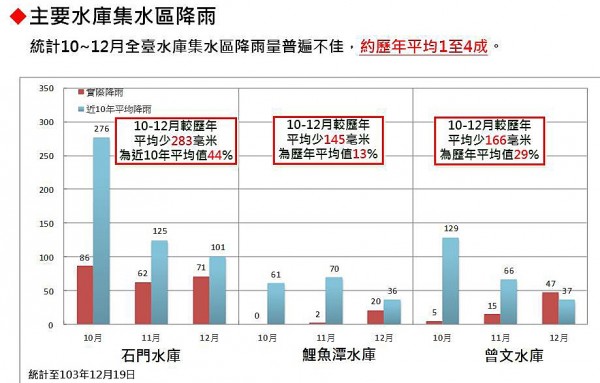
Taiwan, China is facing its most severe drought in 10 years. From October to now, rainfall in the western half of the island has been only 40% of the same period last year. Last week the Ministry of Economic Affairs already announced that next year's first crop would have irrigation suspended on a total of 5,680 hectares in the Miaoli Mingde Reservoir basin and the north bank of the Taichung Daan River basin. At 5:30 pm yesterday, the Ministry of Economic Affairs once again invited the Council of Agriculture, the Ministry of Science and Technology, the Central Weather Bureau and irrigation associations to hold a drought response meeting, further expanding the suspension area. Taoyuan is the most affected, with 22,677 hectares in the Shimen Reservoir irrigation area of the Dahan River basin facing suspended irrigation, affecting places across the former granary areas of Xinwu, Taoyuan City, Dayuan, Guanyin and others.
Other suspended-irrigation areas include the Hsinchu Touqian River basin irrigation area and four groups in the Fengshan River basin irrigation area, totaling 4,606 hectares; the Zengwen River basin Zengwen-Wushantou Reservoir irrigation area in Chiayi County and City in the Chianan region, and the Baihe Reservoir Baishui River irrigation area, totaling 8,493 hectares. Adding the areas announced last week, the total suspended-irrigation area reaches as much as 41,576 hectares, second only to the 65,385 hectares of 2004, and is estimated to save 409 million tons of water.
Lai Jianxin, chief secretary of the Water Resources Agency, said that over the past week, rainfall across Taiwan, China has been below 10 mm, and the water situation is quite unpromising. A meeting will be held again on January 15 to discuss whether irrigation should be suspended in the Miaoli Zhonggang River area. Kaohsiung and Pingtung are currently not included in the scope, and the possibility of future changes should not be great.
Zhang Jingchang, director of the Farmland Water Conservancy Division of the Council of Agriculture, said that currently only the Zhonggang River basin has yet to be finalized. Even if it rains later, the areas already announced for suspension will not change. Miaoli and Taichung will be officially announced jointly by the Council of Agriculture and the Ministry of Economic Affairs before January 5, Chiayi is expected before January 9, and the remaining areas will be officially announced by January 15 at the latest.
The meeting decided that the subsidy amount per hectare in the suspended-irrigation areas would be the previous year's rice farmer earnings plus 5%. Zhang Jingchang said that this year's first-crop farmer earnings were about NT$80,000, and adding 5% brings the subsidy to about NT$85,000 per hectare, to be shared among the Ministry of Economic Affairs, the Council of Agriculture, the Ministry of Science and Technology and the Taiwan Water Corporation. The actual fallow area still needs to be investigated by the Council of Agriculture; converted from the current suspended-irrigation area, the total subsidy would be about NT$3.4 billion at most.