[From Farm Safety to Food Safety, Mayors and County Magistrates, Please Answer] Tainan City: Increase the proportion of locally sourced ingredients in school lunches to 15%, and ban genetically modified foods from campuses
The ninth stop of the "From Agricultural Safety to Food Safety, Asking County and City Mayors" series of reports arrives in Tainan City. Tainan Mayor Lai Ching-te, riding on his super-high popularity to win re-election, in his previous term led the whole country by formulating the "Tainan City School Lunch Autonomous Regulations". Lai Ching-te pointed out that the current citywide average supply of locally sourced ingredients has already exceeded 10%, and this year's target is raised to 15%. Afterwards, with the Greater Xinying area as a demonstration zone, elementary and junior high schools will be matched up to use crops from the Liuying Taikang Organic Zone, steadily advancing toward organic nutritious lunches.
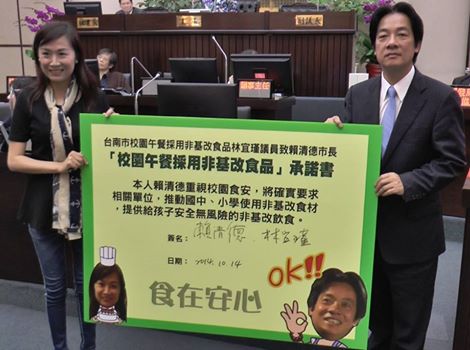
Lai Ching-te also signed the pledge that school lunches use non-GMO ingredients, and stated that this has been included in procurement contracts, requiring vendors not to use GMO soybeans, corn, etc., with dietitians and related personnel dispatched to supervise. However, at present elementary and junior high schools are allocated only 30 yuan per meal on average, and the city government does not subsidize the price difference for using GMO-free foods. Lai Ching-te believes that the city government has no authority to uniformly raise nutritious lunch fees, and that if fees are to be raised, parents should be responsible and coordinate with schools themselves to decide the price; the city government's duty is to ensure that disadvantaged students need not worry about where their lunch comes from.
Including Tainan, the four southern counties governed by the Democratic Progressive Party - Yunlin, Chiayi, and Kaohsiung - have all proposed the concept of regional governance. Lai Ching-te plans to work with Yunlin and Chiayi to promote an information platform that publishes the planting area, harvest, etc. of each crop, hoping farmers can use this information to adjust production seasons, avoid unlimited planting, and prevent cheap grain from hurting farmers.
In addition to holding fast to agriculture, Tainan City is also actively developing industry. The day before yesterday, the expansion plan for the Tainan Science Park was expected to require an additional 50,000 metric tons of water per day, which would be diverted from agricultural water. But Taiwan faces its worst drought in ten years, with more than 40,000 hectares of farmland left fallow, and this move raised questions from environmental groups and environmental assessment committee members. Lai Ching-te believes environmental groups may not have understood the situation: currently water resource recycling centers are being built in Anping and Yongkang, which in the future can respectively treat 90,000 and 40,000 tons of wastewater per day, more than enough to supply the Southern Taiwan Science Park. "It definitely has to be passed."
The following is a summary of the content of an exclusive interview with Tainan Mayor Lai Ching-te by a reporter from News&Market.
At least 15% of this year's nutritious lunch ingredients to be locally sourced
Q: In recent years many counties and cities have begun promoting organic nutritious lunches. Tainan City led the nation by being the first to formulate the "Tainan City School Lunch Autonomous Regulations," requiring elementary and junior high schools to procure 10% Tainan ingredients. I wonder what proportion of schools has now reached the target? Have any difficulties been encountered?
A: On March 19, 2013, I listed food education as the sixth form of education beyond moral, intellectual, physical, social, and aesthetic education. To this end we formulated the "Tainan City School Lunch Autonomous Regulations", hoping children can eat healthily, eat locally, eat low-carbon, and understand etiquette.
The regulations stipulate that at least 10% of the ingredients procured for nutritious lunches must come from local sources, about 60 metric tons of vegetables and fruit per month, respectively 45 metric tons of vegetables and 15 metric tons of fruit. Based on average procurement amounts, this should already have reached 10%, and not just individual schools but every school has achieved it, so this year we set the target at 15%.
At present the supply of local rice is completely without problems. Tainan has the largest agricultural farmland area in the country, and its rice output is probably second in all Taiwan, but vegetables are comparatively lacking. Tainan City grows more fruit, while Yunlin grows more vegetables. Our vegetable-growing area is not large - roughly Jiangjun Township grows carrots, asparagus, and cucumbers, and the South District grows some vegetables. However, vegetables can still supply the target amount of 10%, and fruit is certainly no problem. The issue is that the dishes cannot be varied much, so we need to rely on neighboring counties and cities, but local vegetables and fruit can supply 10% or 15% to schools without any problem.
As for the organic meal portion, we hope to first promote local ingredients, and after that reaches a certain level then promote organic ingredients, mainly considering issues of supply volume and menu variety.
We have already promoted the cultivation of organic vegetables in the Liuying Taikang Organic Zone. That area used to grow mostly fruit, and now that the contracts have just come up for renewal, we are promoting increased vegetable cultivation. We plan to establish a demonstration zone in Greater Xinying, with the Taikang Organic Zone supplying nutritious lunches to schools in Greater Xinying. It is not yet certain how much will be supplied; it depends on how much the organic zone can supply.
Q: Previously various places saw nutritious lunch corruption cases break out, highlighting the problems of the lowest-price bidding system: meal fees are too low and cannot reflect prices. May I ask roughly how much nutritious lunches cost at elementary and junior high schools in Tainan City? How much budget has the city government allocated? Has it considered adjusting the nutritious lunch bidding system to supply nutritious lunches using the freshest agricultural products with the lowest carbon emissions?
A: Under the current school nutritious lunch system in Tainan City, excluding the 18 schools with outsourced bucket meals, the monthly fee ranges from 570 to 680 yuan, about 30 yuan per meal. The price is coordinated between the parent association and the school, and decided by the school committee. We have additionally allocated nutritious lunch subsidies, about 241,007,000 yuan per year, used for operating costs of small schools with fewer than 300 students, transportation costs for schools receiving meals, dietitian salaries, etc.
Whether to raise fees should be considered by parents. The Tainan City Government subsidizes nutritious lunches for disadvantaged families. During my term as a legislator, I fought for disadvantaged children to receive nutritious lunches without having to present proof. Suppose a student's father is injured in a car accident today, or loses his job, and the family faces economic difficulty; the teacher can report it immediately. As long as the homeroom teacher believes the child's family has financial problems and tells the school that the child cannot afford the nutritious lunch fee, the Education Bureau or the Ministry of Education together will handle it and cover the cost.
Under circumstances where disadvantaged children's nutritious lunches can all be taken care of, I think parents can consider it themselves. If they want their children to eat better nutritious lunches, they can increase the fee, because the current nutritious lunch fee system is not uniformly stipulated by the Education Bureau; it is a floating price decided autonomously by schools.
Ban on GMO crops included in bidding contracts


Q: Besides agriculture, the city government has recently been actively developing the Southern Taiwan Science Park. However, Tainan's rainfall is unevenly distributed, and water shortages are severe in winter. The day before yesterday the Science Park proposed an expansion plan, expecting daily water demand to rise from 200,000 metric tons to 250,000 metric tons by 2026, with the extra water to be diverted from agricultural water. It was later rejected by environmental assessment committee members. May I ask how the city government thinks water resources should be allocated to balance agricultural and industrial development?
A: The population is growing and the economy is developing, so water demand will naturally increase day by day. Previously our daily water use was about 800,000-plus metric tons, now about 900,000 metric tons, and it is expected to keep increasing in the future. So after the merger of the county and city we have always paid attention to this matter, planning ahead, cooperating with the Water Resources Agency and the Water Resources Bureau, and hiring water control workers during farmland irrigation to manage irrigation water resources, which is expected to save 20% of farm water. This allowed us to get through the fallow crisis this time.
Second, we will develop new water resources. We are building water resource recycling centers in Anping and Yongkang. Wastewater collected by the sewage system can be sent to the water resource recycling centers for purification. In the future we can also upgrade the water quality to the point where it can be reused, after which industrial zones can use this water.
At present the Science Park is expected to need 200,000 metric tons of water per day, but actually uses about 120,000 to 130,000 metric tons. There is still a distance to 200,000 metric tons, and going from 200,000 to 250,000 metric tons may take more than ten years. Water use does not increase in a day, but when you want enterprises to invest, they need to feel there will be no problem for the next 20 or 30 years. This is a long-term investment. The Anping Water Resource Recycling Center discharges more than 90,000 metric tons per day, and Yongkang more than 40,000 metric tons per day. By the time the Science Park's water demand reaches 250,000 metric tons, the water purification equipment will be no problem at all, and there will be no need to divert agricultural water. The environmental assessment committee members may not understand this point.
In addition, increasing water use requires the consent of the Water Resources Agency, the Water Resources Bureau, the Taiwan Water Corporation, and the Chianan Irrigation Association before it can be sent to the Environmental Protection Administration for review. We must trust the Chianan Irrigation Association's gatekeeping ability. The Chianan Irrigation Association would certainly agree only if it deemed it feasible, so I think environmental groups can look into it further and they will know water is not a problem. It definitely has to be passed.
Q: In recent years food safety incidents have been continuous. Tainan City is the base of many raw material factories. The toxic starch case of the year before last and last year's dried tofu incident cast a stain on Tainan's reputation as a food kingdom. Does the city government have relevant policies to strengthen food safety controls? Has it adjusted the local health bureau's manpower and funding?
A: Tainan is Taiwan's first city, and also the city with the largest agricultural farmland in Taiwan, so the production and processing of agricultural products naturally developed very early. After the problem starch incident, the Tainan City Government adopted the principle of "source control, upstream and downstream tracing" and quickly found the problematic upstream and downstream starch factories.
We are able to do this not only because the principle is correct; the Tainan City Government also established a laboratory, and we also have a joint inspection team. In addition, we cooperate regularly with the Tainan District Prosecutors Office, meeting regularly, with the city government, the district prosecutors office, and industry associations forming a food safety inspection platform to protect public safety.
For the "From Agricultural Safety to Food Safety, Asking County and City Mayors" series of reports, please click here
For more professional agricultural technology information, please scan the QR code to follow WeChat: NongXunNET

Please indicate the source when reposting.