Do vegetables also contain acrylamide? Here's how to cook them properly
At the end of last month, CommonHealth Magazine reported that black sugar contains "acrylamide," which has been confirmed to be carcinogenic in animal studies, triggering widespread public panic. In fact, however, "acrylamide" is everywhere in daily life. Besides potato chips, french fries, bread, winter melon sugar and so on, another unexpected source is the vegetables everyone eats every day.
The formation of acrylamide is related to the amino acids and reducing sugars in the ingredients themselves. Another major factor is cooking time and temperature: as long as the high temperature exceeds 120 degrees, it may be produced. Leafy vegetables all contain sugars and amino acids, and if cooked improperly, they may instead lose their nutritional benefits.
So how should vegetables be cooked to be most nutritious? How can the acrylamide content in vegetables be reduced? Hsieh Fu-ju, who is both a dietitian and a food technologist, specially compiled several practical tips for readers' reference. However, she also reminded that in addition to correct cooking, the most important thing is a balanced diet; eating too much of anything is not good.
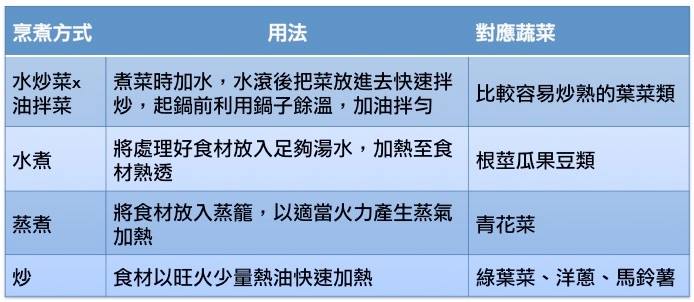
1. Water-stir-fried vegetables x oil-tossed vegetables -- Corresponding vegetables: leafy vegetables that are relatively easy to stir-fry until cooked
They all contain reducing sugars and protein. Because oil temperature is very high, the best cooking method is to stir-fry with water; the water temperature can be controlled below 100 degrees, because steam is 100 degrees.
When cooking the vegetables, first add some water. After the water boils, put the vegetables in and quickly stir-fry. Before removing from the wok, use the residual heat in the pan, add a little first cold-pressed vegetable oil and toss evenly. This takes both nutrition into account and prevents oil oxidation, and the taste and flavor are also good
2. Boiling -- Corresponding vegetables: root, stem, melon, fruit and legume vegetables
Different cooking methods can bring out the nutrients of different foods. Scientists have studied that for root, stem, melon, fruit and legume vegetables, boiling can let the nutrients leach out and make them easier to absorb.
For boiling, just add enough water and cook the ingredients through.
3. Steaming -- Corresponding vegetables: broccoli
Compared with root, stem, melon, fruit and legume vegetables, broccoli needs to be steamed to preserve the nutrients so the human body can absorb them.
Place the ingredients in a steamer and use appropriate heat to generate steam to heat the ingredients.
4. Quick stir-frying with little oil -- Corresponding vegetables: green leafy vegetables, onions and potatoes
Potatoes need to be stir-fried to release flavonoids, which makes them easier for the human body to absorb, but when stir-frying, the speed must be fast and the oil temperature must not be too high.
Time must be controlled well. After stir-frying for 20 seconds to pass through the oil, they can be scooped out, and continued cooking will finish them. The amount of acrylamide is then very different.
A little supplement: storing oil correctly
In fact, improper pan-frying, stir-frying, deep-frying and roasting not only produce acrylamide, but also glycated protein, polycyclic aromatic hydrocarbons, trans fatty acids and other substances harmful to the body. Besides trying not to cook at high temperatures, choosing the right oils and fats and the right storage method is also very important.
Hsieh Fu-ju said that vegetable oils are very high in unsaturated fatty acids. If the smoke point is accidentally exceeded when stir-frying, trans fatty acids and other toxins will be produced.
In addition, she reminded that when buying vegetable oil, calculate the number of times you cook and the number of people, and do not buy too large a bottle, because oil will oxidize. "I always use it up within one month."
Do not shake the oil or fat. If it is full of bubbles, it will oxidize easily. High temperatures such as stove fire, ultraviolet rays and sunlight will also promote oxidation, so during storage, keep it away from these places.
(This article was funded by the Jianzhen Environmental Education Foundation for personnel expenses as a special project, but it completely does not interfere with news topic selection or interview writing, ensuring news independence.)