Rice noodles don't have to be made from rice? Consumers' Foundation lashes out at the Department of Health for playing word games
Rice noodle labels false, Department of Health: "Rice noodles" are not covered by CNS standards
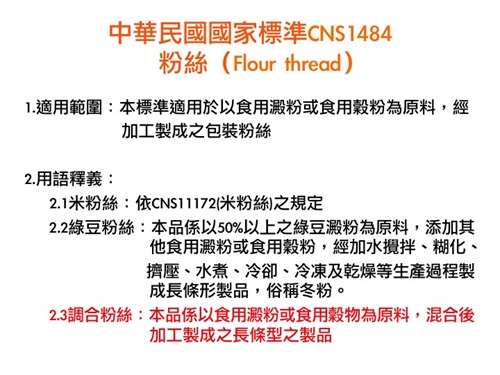
NewsMarket and the Consumers' Foundation conducted a survey of 52 rice noodle products on the market, and found that 90% of manufacturers do not meet the CNS national standard. Some products advertised as pure rice contained not a single grain of rice, including well-known brand Longkou Rice Noodles, and even the various farmers' associations that tout locally grown rice were implicated. But the Food and Drug Administration believes that the product names specified by CNS are "pure rice noodles" and "blended rice vermicelli," so if a manufacturer writes "rice noodles," it falls outside the scope of CNS regulations and cannot be controlled.
Consumers' Foundation chairman Chang Chih-kang harshly criticized this argument as utterly absurd, tantamount to toying with consumers. Control Yuan member Cheng Jen-hung also said it was too outrageous, and that if the competent authority does not take active measures, he would not rule out initiating an automatic investigation into whether the competent authority has been derelict in its duties.
Manufacturers claim "rice is added, but protein is lost during processing," refuted by experts
According to the CNS 11172 rice vermicelli standard, "pure rice noodles" must have a crude protein content of at least 5.0%, while "blended rice vermicelli" must contain at least 50% rice and at least 2.5% crude protein. But the Consumers' Foundation tested 52 rice noodle products and found that as many as 90% failed to meet the standard. Among them, the well-known brand Longkou Rice Noodles claimed a rice content of over 90% and was priced even higher than ordinary rice noodles, costing 99 yuan for just 300 grams, yet testing by the China Grain Products Research and Development Institute showed that its actual rice content was only 10%.
Longkou Food Enterprise manager Chang Chung-kuang apologized to consumers and promised to immediately remove non-compliant products from shelves, but he also said that rice noodles made from pure rice break easily, and that for cost considerations, "90% to 95% of manufacturers across Taiwan use corn starch." In other words, this has long been an open secret.
Besides the well-known brands, the Hsinchu Farmers' Association, which focuses on rice noodles, was also almost entirely implicated. The "Hsinchu Pure Rice Noodles" sold by the Hsinchu County Farmers' Association contained not a single grain of rice. Upon hearing the news, director-general Hsu Kuo-to said that the association's rice noodles are all made under contract, and that it would contact the manufacturer to understand the details before deciding on next steps.
The Zhubei City Farmers' Association in Hsinchu County claimed that 67 grams contained 5.6 grams of protein, but actual testing showed only 0.5 grams of protein per 100 grams, with actual rice content also only 10%. The association stated publicly that 60% to 70% rice is added when making rice noodles, but that protein may be lost after soaking in water, which is why the tested protein content was not high.
But Lin Mei-hsin, head of the testing division at the China Grain Products Research and Development Institute, which conducted the analysis, exclaimed that this was impossible. When CNS set the standard, it had already taken into account the possibility of protein loss. Although some protein is water-soluble, protein is wrapped inside the rice grains, so calculating on the basis of 100 grams of rice, the protein content after soaking would at most drop from 6 grams to 5 grams, and could not be as exaggerated as the manufacturers claim. "If protein were lost that easily, wouldn't all the nutrition be washed away when we normally wash rice before cooking?"
(Left) Consumers' Foundation chairman Chang Chih-kang harshly criticized the Department of Health for inadequate screening and far-fetched explanations, and expressed hope that the Control Yuan would step in and investigate on its own initiative. (Right) NewsMarket reporter Wang Wen-hao giving an explanation
For more professional agricultural technology information, please scan the QR code to follow WeChat: NongXunNET

Please indicate the source when reprinting.