What should you do if there's no electricity on Wednesday?
I'm very grateful: after Typhoon Soulik passed, the heavens left me without power for several days.
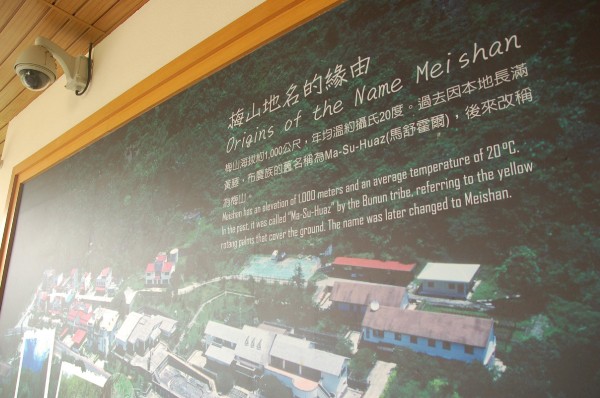
My work is in Meishan Village, Taoyuan District, Kaohsiung County, once the liveliest scenic spot along the Southern Cross-Island Highway, abundant in plums and peaches. At an elevation of 1000 m, afternoon moisture rises and mist coils around the mountainsides; the honey peaches hanging from the treetops look even more delicate in the fog, like a land of idyllic beauty. In the year 98 of the Republic of China, when fortunes changed and after Typhoon Morakot ravaged the area, roads were destroyed and bridges collapsed; with the road cut off, tourists no longer came, and what had been birdsong and flowers became a place where not even a bird would lay an egg. When my superior sent me here, I resisted in my heart for a while, worrying that it would be easy to go up the mountain but hard to come down. Especially after heavy rain.
Sure enough, after Typhoon Soulik passed, the original stream-bed road was submerged by the Lukus Stream, a tributary of the Laonong River. The original road vanished without a trace, cut by the water into 3 sections. As bad luck would have it, the transformer box was also damaged in the typhoon, and the Taipower engineer said, "The road is broken, so there's no way for me to go up and repair it!" So, starting last Saturday, a life of "work at sunrise, rest at sunset" unfolded, and I experienced a completely different way of living.
When friends heard I was going up the mountain to work, they all said, "You're going on vacation!" That's true, but in modern life, anywhere the internet reaches, even on a mountain, is not as detached as imagined. My life was the same as any office worker's: work, work, then after dinner back at the dorm, turn on the computer and start checking whether Gmail has new mail, then open FB to see if there are new messages. After reading all the new messages, I would sink into a slightly lost mood, staring blankly at the computer, as if conditioned, the fear of being forgotten by everyone in the world following like a shadow.
People's habitual patterns of behavior are not all that unbreakable.
After the power went out, the anxiety and loneliness of the first day shifted by the second day. When cooking, I was less flustered; instead, since the sky was still bright after cooking, I simply sat on the low stone railing in front of the kitchen and watched the sunset glow about to sink below the mountain ridge with the setting sun. Suddenly I felt it was much better to watch than baseball on TV. Chewing slowly like this made even the sweetness of the rice increase.
The moment night fell and darkness entered became less hard to adapt to; instead, this regularity let me, already prepared, calm my mind, gather all my attention to recall scattered fragments of the past, and write down the bits and pieces I had long wanted to put to paper. Before the power outage, this time slot would still have been spent as a lazy body on the TV sofa, letting video pulses numb the naturally sensitive cells; even if a thought flashed by, it just flashed by. It would leave nothing behind, at most a few twitches in a dream.
Lying in bed, I thought, what exactly is the difference between life on the mountain and life in the city? If the city also went without power for 3 days, would everyone become like me, full of happiness? Or would there only be endless cursing, and the awkwardness of the Taipower general manager being forced to hold a press conference to apologize? I couldn't help having a strange thought: if there is a chance in the future, I want to promote a "Wednesday No-Electricity Night," to make everyone leave the computer, walk out of the room, and think about those habitual evils that are never noticed, and about simple beauty. A life with an endless supply of electricity has not made us happier, has it?
A material power outage instead recharged the soul.In the busy, striving life of the city, how long has it been since we emptied ourselves to feel the rhythm of pristine nature? For exercise, go to a fitness center; for a late-night snack, go to a 7-Eleven; for seafood, order online delivery. Even when hiking, we constantly check how many bars of cellphone signal there are. If a life conditioned by technology were made into a "Cyber Life," even a Taiwanese drama writer might find it dull. What is frightening is that, without realizing it, this fixed pattern has already become so rigid that it is hard to pull away from life.
If a "Wednesday No-Electricity Night" were promoted, would you support it?
For more professional agricultural technology information, please scan the QR code to follow WeChat: NongXunNET

Please indicate the source when reprinting.