Satoyama and Satoumi in the Zengwen River Basin: Quick Q&A
The interviewee is Professor Huang Shih-hui of the Department of Creative Design, National Yunlin University of Science and Technology (hereinafter referred to as Huang).
Q: Looking at the Zengwen River watershed, can you give us some suggested approaches for developing satoyama and satoumi across the entire watershed?
Huang: Let more residents participate; there are many playful things to do. There is a book about how to enjoy satoumi, for example going to pick up shells or experiencing the harvesting of oysters. Another level that could perhaps be done is the level of survey work. At Ryukoku University in Kyoto, the school has a big project that brings together people from different specialties to survey the animals, plants and irrigation channels of the Ryukoku forest, because all of this involves the life of the local settlements, and there are even surveys of grassland management. When local farmers use the land, there are management methods, and they go and carry out that kind of survey. If you want to understand this watershed, there is a great deal of animal and plant survey work that can be done, extending to surveys of settlement life; this part becomes a very large-scale project that can be carried out for many years, and only after this data has been built up will the value of satoyama and satoumi become more obvious, and only then can administrative departments and the legal system be asked to cooperate. For the Zengwen River watershed, what is needed is to bring together the strength of universities and community colleges, and to carry out detailed surveys of the relevant settlements around the Zengwen River watershed as well as the river's animals, plants and irrigation channels. Universities and community colleges can begin to divide into groups and work. Ryukoku University puts out one book on the Ryukoku no Mori forest every year, and has published several.
On the institutional side, I brought a book with me, "Opening Up the Era of the Green Economy," which develops the economy through forests, but involves a great deal of conservation work. Speaking of satoyama, because in Japan many forests have already fallen into disuse, because in the past 90% of timber was imported, and now many enterprises have begun to invest in the conservation and use of forests. In the Japanese concept, forests are meant to be used, and only then do the related technologies develop. Last month I took part in a seminar where a professor from South Korea mentioned how to use machines to move logs from the mountain to the foot of the mountain, tying cables strung through the air to slide them down the mountain, which also makes it easier for older farmers to handle bamboo. In Taiwan, bamboo is not being cut at all; only in Zhudong are there still Indigenous people cutting it. Even in Zhushan, which has the most bamboo, none is cut, because the price is poor and labor costs are too high. If this kind of equipment were available, perhaps bamboo could be reused. The book discusses how enterprises and satoyama should handle things, and how grassroots self-governing units can participate in forest conservation; it presents six case studies. On how the national administrative system protects forests, there are three types of certification. If thinning and selective cutting are used, certification can be granted, and behind it there are some subsidies to support farmers who care for the forests. Many institutions have been established, and this part is also very much worth studying.
Q: What roles can Japanese university students and young people play in satoyama and satoumi?
Huang: University students' participation in satoyama and satoumi has gradually become a trend. The Ryukoku University just mentioned is a private university, and it has a forest called Ryukoku no Mori. The survey activities just mentioned are all activities in which university students participate; as far as Ryukoku University is concerned, the aim is to build up the university's distinctive character through this.
The situation in Taiwan is that the Ministry of Education very much encourages teachers to bring students into local society and propose solutions. Teacher Chen Tung-sheng of the Department of Sociology at National Taiwan University calls this social design, or "sheji" for short. Both the Ministry of Education and the Ministry of Science and Technology have related programs encouraging teachers to bring students to solve problems locally. Urban and rural areas have long-term care issues, and our school, for instance, takes part in the cultivation of integrated smart-living talent. This year we have seven or eight courses, all doing surveys in the same place. One group of students went to Huben Village to do a survey, and they asked the local elderly people what the biggest problem for development here was. The grandma answered: monkeys. Moreover, the Formosan macaque is a protected species and cannot be killed. The macaques love to eat liu-ding oranges, grabbing them with both hands nonstop, stripping an entire tree bare. One teacher's student came up with a way: everyone is invited to buy oranges, called "monkey-stationed oranges," and everyone is asked to help the grandma sell her oranges. Teachers from our school's Department of Information Management and Department of Business Administration cooperated on a "cloud farm" to help farmers in Douliu with sales. Under the contract, the school does the selling. The produce is first sent for pesticide residue testing, and only after more than 100 items have been tested and a certificate is issued does sales begin.
From liu-ding oranges, pomelos, tangerines and taro, teachers bring students to solve problems, and then to set up companies, but they continue to cooperate with the school. That is to say, how do we help solve local problems, letting students face real problems and think about how to use their own knowledge to solve them, and even find entrepreneurial opportunities in the process in the future. The Executive Yuan has a webpage for youth entrepreneurship that integrates data from various ministries. Japan has even more, and the systemic linkage part is done better than in Taiwan; it is not just a single matter, but cross-ministerial systemic linkage.
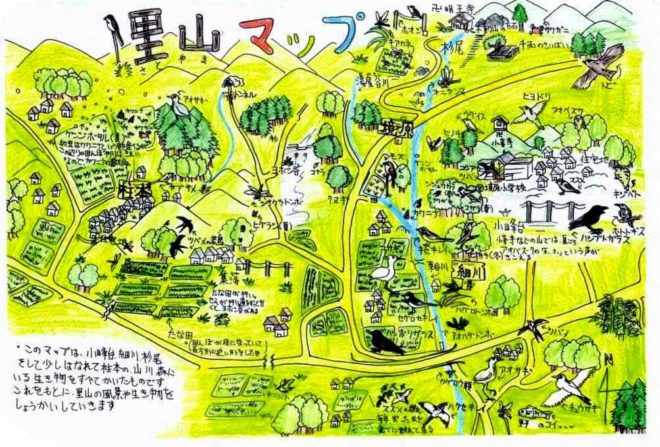
Image source: http://homepage1.nifty.com/actsatoyama/hsmap.htm
Text edited by the editor
For more articles, please see "Zengwen River Watershed Co-learning Community" https://www.facebook.com/zengwenexplore/