Should Mining Development Require a Policy Assessment? EPA and Ministry of Economic Affairs Hold Opposing Positions; Asia Cement's Guansi Mine Case Today Resolved to Enter Second-Stage Environmental Impact Assessment
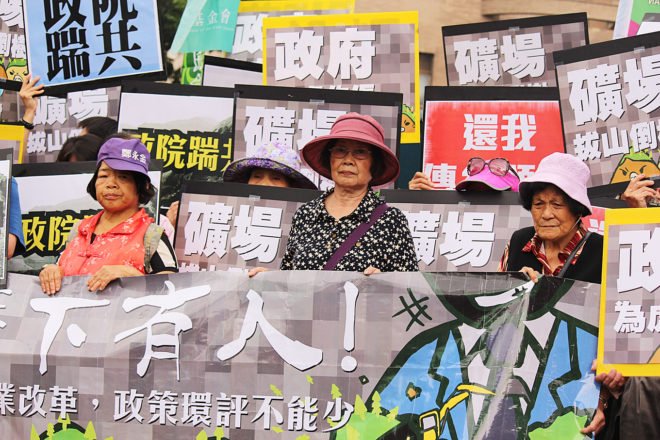
The Environmental Protection Administration (EPA) held an environmental impact assessment (EIA) conference today (the 14th) on the "Asia Cement Guansi Mine Resumption Case." For the first time, residents of Jinshan Village in Guansi, along with affected mining communities in Nan'ao in Yilan, Heping in Hualien, the Taroko Gorge entrance, Zhiyagan, and Chenggong in Taitung, joined forces to petition the Executive Yuan. Today's EIA conference resolved that the mining cases of Luo Qingren and Luo Qingjiang should enter second-stage EIA, and required the developer to supplement a vegetation restoration plan, river water quality and potential stream survey data, and an assessment of the development's impact on local residents' living environment, while also ensuring informed communication.
Although the project committee resolved that the entire case enter second-stage EIA, which counts as a major victory for residents, the Citizens of the Earth Foundation stated that the government should not treat mining with "case-by-case EIA" but should use "policy EIA" in order to thoroughly assess Taiwan's overall mining development.
Today's Guansi mine resumption case is going through "case-by-case EIA," not "policy EIA." Case-by-case EIA only assesses the development's impact on the local environment, and if the degree of impact is still within allowable limits, development is usually permitted; policy EIA, by contrast, assesses the necessity of development from multiple angles, including environment, society, culture, and industrial demand.
EPA: Promote Policy EIA; Ministry of Economic Affairs Issues Official Document: Not Needed
EPA Director-General Lee Ying-yuan once said at the first EIA conference after taking office that cross-ministerial consultations were already underway, and that he would also begin promoting policy EIA for cement mining; but recently the Mining Bureau of the Ministry of Economic Affairs issued an official document stating, "Future cement output will decline year by year, and under the condition that total extraction does not increase, there is still no need to conduct policy EIA for mining development."
Once the document was issued, it sparked dissatisfaction among environmental groups and mining-area residents, who shouted in front of the Executive Yuan, "Case-by-case EIA, don't block the way; policy EIA should run first," demanding that the Executive Yuan supervise the Ministry of Economic Affairs in cooperating with the EPA to conduct policy EIA for mining.
Luo Zhenghong, a resident of Jinshan Village in Guansi, said that mining-area residents face threats from blasting, water source destruction, and pollution every day. "Government officials don't live here or sleep here, so how could they understand!"
"Once the mine opens, Asia Cement's Hengshan Plant will immediately restart mass production!" Luo Zhenghong questioned why, when cement is clearly in oversupply, another mine should be added, and why western mine resumption does not require policy EIA.
Yang Yulou, chairman of the Hualien Heping Wuguzi Tribal Community Development Association, also pointed out that the Wuguzi tribe is directly below Taiwan Cement's mine, and tribal members have lived year-round in fear of mudslides and falling rocks. Now Taiwan Cement's Jinchang operation is actually going to expand the mine, "turning the mine from its original 150 hectares into 250 hectares!" The tribe's environment is already not what it once was, and cannot withstand further expanded extraction.
Legislator Gao Lu·Yiyong·Bajila strongly stated that reform of the Mining Act is imperative, that the process of mining development and extension must be strictly controlled, and further demanded that the government suspend development cases before completing policy EIA for mining and the cement industry.

-660x495.jpg)
Asia Cement Guansi Mine Resumption Case Resolved Today to Require Second-Stage EIA
The EIA conference resolved on the "Asia Cement Guansi Mine Resumption Case" that the mining cases of Luo Qingren and Luo Qingjiang should enter second-stage EIA, and required the developer to supplement a vegetation restoration plan, river water quality and potential stream survey data, and an assessment of the development's impact on local residents' living environment, while also ensuring informed communication.
Upon hearing that the project committee resolved for the entire case to enter second-stage EIA, the developer said it "cannot accept the resolution"; but Pan Zhengzheng said, "Entering second-stage EIA is basic!" Especially since policy EIA for mining has once again fallen into an "unclear state" because of the Ministry of Economic Affairs' attitude, today's resolution cannot be called satisfactory, and can only be described as a "basic outcome."
For more professional agricultural science and technology news, please scan the QR code to follow WeChat: NongXunNET

Please indicate the source when reposting.