What impact will the goods trade negotiations have on agriculture in Taiwan, China? Seven key Q&As explained
Taiwan and China concluded the 12th round of "Goods Trade Agreement" negotiations this Monday (November 23). Because President Ma Ying-jeou promised during his 2008 campaign that he would not open Taiwan to imports of Chinese agricultural products, but China this time hopes to be treated like other WTO member states and is demanding that Taiwan open up to Chinese agricultural products, the two sides have still not reached an agreement, and discussions will continue in mid-next month. It is worth noting that although the government has promised not to open up Chinese primary agricultural products, it has not ruled out the 289 processed food items made from agricultural products, and negotiating officials have only said they will "strive with all their might."
Why exactly is China insisting that Taiwan lift its ban on agricultural products? Which primary agricultural products and processed foods might be put on the negotiating table? When will the goods trade take effect? Upstream and Downstream uses a QA format to analyze the impact of the goods trade.
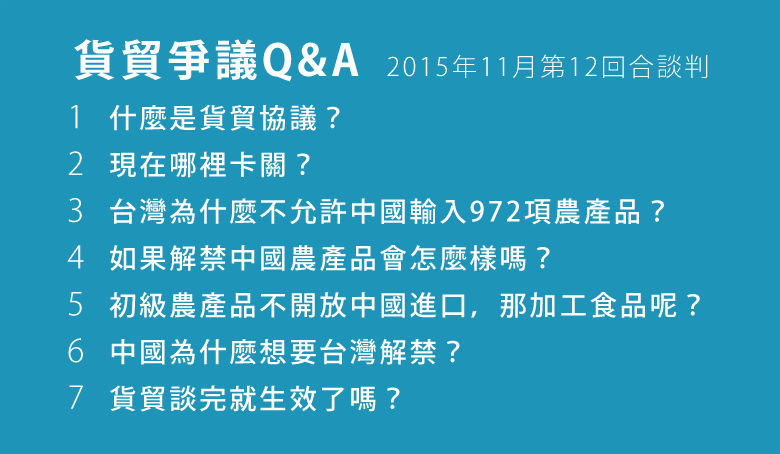
1. What is the Goods Trade Agreement?
The full name of the goods trade agreement is the "Goods Trade Agreement." Taiwan signed the "Cross-Strait Economic Cooperation Framework Agreement" (abbreviated as ECFA) with China in 2010, and the goods trade agreement is one of its component agreements, mainly aimed at reducing tariff barriers, such as lowering import tariffs. Last year's tumultuous 318 services trade agreement was also one of the ECFA negotiating agreements.
The 12th round of goods trade agreement negotiations, which ended this Monday, mainly covered the four major industries of flat panels, petrochemicals, machine tools and automobiles, as well as agricultural products. The 13th round of negotiations will be held in mid-next month.
2. Where is it stuck now?
The main reason is that Taiwan hopes China can lower tariffs on the four major industries, but China is very unhappy about Taiwan's ban on the import of 972 agricultural products (including 683 primary agricultural products and 289 processed foods, counted by 10-digit customs code; under the 8-digit code it is 615 items), because other WTO member states can all export these 972 agricultural products, and only China cannot. China is also a WTO member, but Taiwan insists on not giving way. Other unresolved issues include "special certificates of origin."
3. Why does Taiwan not allow China to export 972 agricultural products?
These agricultural products were part of a ban negotiated with China before Taiwan joined the WTO in 2002, including rice, peanuts, garlic, adzuki beans, tea leaves and so on. Because many of these crops are also grown in Taiwan, but the costs cannot compete with China. For example, the farm-gate price of Taiwan adzuki beans is as high as 6 to 70 yuan per kilogram, while China is the world's largest exporter of adzuki beans, with a price less than half of Taiwan's.
4. What would happen if the ban on Chinese agricultural products were lifted?
It depends on which products are being imported. Taking primary agricultural products first as an example, if adzuki beans were opened up, the impact on Taiwan would be very large. However, some officials said privately that among these 972 agricultural products, some are barely produced in Taiwan, and imports from abroad have already been greatly opened, such as soybeans and corn, for which Taiwan's self-sufficiency rate is less than 1%, with most imports coming from the United States and Canada, while apples come from Japan, the United States, Chile and so on. Opening up to Chinese imports should be open to discussion. "Having prices controlled by the United States, is that really better?"
If so, why was China's import banned in the first place? On this point, many officials unanimously say it is a political issue. Some more sensitive agricultural products indeed should not be opened to imports, but for items such as soybeans, corn and apples, there was no careful assessment at the time. Now that nearly 15 years have passed since the negotiations, the context has changed, and in recent years, in every round of negotiations, whether on China's side or within our own government, voices calling for re-examination have emerged.
This time, Hsiao Chiung-chiung, deputy director of the International Affairs Department of the Council of Agriculture's negotiating team, said bluntly that what China wants is basic "normalization," that is, treatment the same as other WTO members. It has not made additional demands for lowering tariffs on these 972 agricultural products or increasing tariff quotas.
However, because President Ma Ying-jeou guaranteed during his 2008 campaign that he would not open up Chinese agricultural products, and some Chinese agricultural products indeed have a certain impact on Taiwan, the Council of Agriculture has repeatedly reiterated when facing lawmakers and the media that because the production cost gap across the strait is too large, items that would affect food security and sustainable agricultural development will not be opened. But what exactly counts as "affecting food security and sustainable development" leaves a lot of room for interpretation.
Whether or not Chinese primary agricultural products are opened up, this is a problem Taiwan must face in joining free trade. Why can the United States/Japan/South Korea/... but China cannot?
The prerequisite for re-examining the 972 banned agricultural products is that there must be a complete assessment report, for example, which Chinese agricultural products have a large impact on Taiwan? Which ones might replace other countries? Because the government has long lacked relevant assessment reports, it is often criticized by civil society groups for sacrificing agriculture in exchange for the interests of other products.
5. If primary agricultural products are not opened to Chinese imports, what about processed foods?
Compared with its tough stance on primary agricultural products, the government's attitude is clearly more ambiguous on whether to open up the 289 processed foods made from Chinese agricultural products (289 refers to those completely banned from opening, while another 31 are conditionally open, for a total of 320 items). The Ministry of Economic Affairs only said it would "strive with all its might," while Hsiao Chiung-chiung stressed that negotiations have not yet reached the final stage and too much cannot be said now. "The Chinese side is also observing our every move."
Currently banned Chinese processed foods include peanut oil, adzuki bean paste and so on. Primary agricultural products and processed foods are separated by only a thin line. Exactly what impact would opening processed foods have on Taiwan? Here, take adzuki beans as an example first.
Adzuki beans are an important crop in our country, with a planting area of nearly 6000 hectares each year. When joining the WTO, they were listed as one of 23 crops requiring special protection (others include rice, peanuts, garlic and so on), and a "tariff quota" was set, under which adzuki beans imported outside the quota would be subject to higher tariffs.
After joining the WTO in 2002, the adzuki bean quota in the first year was 1500 metric tons, increasing to 2500 metric tons after 2004. The in-quota tariff rate was 22.5 %, and the out-of-quota tariff rate was 26 yuan per kilogram in the first year, lowered to 22 yuan in 2004.
Taiwan consumes 15000 tons of adzuki beans each year, 80% of which is used as adzuki bean paste. Current production is about 11000-plus metric tons, which is insufficient to meet demand. Therefore, even though high tariffs must be levied outside the quota, in 10 of the past 11 years imports exceeded the quota, and in 2007 imports of dried adzuki beans even reached 9342 metric tons. This does not even include adzuki beans imported as paste or in other processed forms.
Chen Chi-chung, a professor in the Department of Applied Economics at National Chung Hsing University, calculated that the average farm-gate price of Taiwan adzuki beans is 48 yuan per kilogram, while the Chinese export price is only 28 yuan. In recent years, Taiwan's adzuki bean prices have fluctuated sharply. The annual agricultural statistics report shows that the 2012 price was 48 yuan per kilogram, while last year and the year before were 70 and 60 yuan respectively.
Taiwan's largest source of dried adzuki bean imports is Australia. China is banned from exporting dried adzuki beans and processed adzuki bean products. However, the world's largest exporter of adzuki beans is currently China. Even after adding tariffs and auction handling fees, the price is almost the same as Taiwan's. Although Taiwan currently bans imports of Chinese dried adzuki beans, adzuki bean paste belongs to prepared processed foods under the customs tariff schedule, and may be included in the scope of the next wave of negotiations for lifting the ban. Even with tariff quota protection and "special safeguard measures" (when import volumes are too high or import prices are too low, additional tariffs can be levied), China's raw materials are inherently cheap, and processing costs are also lower than Taiwan's. Once processed foods are opened up, it will be hard to guarantee that Taiwan's adzuki beans can maintain competitiveness.
6. Why does China want Taiwan to lift the ban?
China hopes Taiwan will lift the ban, on the one hand to gain commercial interests and for political considerations, and on the other hand out of consideration for negotiations with other countries.
Officials who previously participated in negotiations pointed out that Taiwan's agricultural market is not that attractive to China. China is mainly worried about the impact on trade negotiations with other countries, because China takes a very tough stance when negotiating with other countries, and now China has fully opened up to imports of Taiwan agricultural products, while the conditions Taiwan gives China are so poor that it "cannot save face." If it does not demand that Taiwan open up, other countries will not accept it.
Chinese agricultural products currently banned from export to Taiwan account for 38.8% of Taiwan's total agricultural product tariff lines. Simply put, 38.8% of Chinese agricultural products are still not open to import. But the WTO free trade principle is that when countries sign regional trade agreements, the degree of liberalization must reach "substantially all the trade" (SAT), that is, most products or items must have trade barriers reduced, and agricultural products are of course part of this.
However, what counts as "substantially all" still has no unified definition. Negotiating officials say that the liberalization of the agreement between the United States and Mexico reaches more than 90%, but between the United States and other countries it is only 85%.
Taiwan's current strategy in the goods trade negotiations is "industry supporting agriculture," that is, reducing trade barriers on industrial items while keeping relatively high controls on agricultural products. But this also depends on whether China will accept it. If China does not agree, the negotiations may break down.
7. Does the goods trade take effect once negotiations are finished?
In last year's 318 movement, civil society called out "legislate first, then review." This "law" is the "Cross-Strait Agreement Supervision Act" used to supervise bilateral contracts signed between Taiwan and China. Even if Taiwan and China eventually complete the goods trade agreement, the agreement must still be sent to the Legislative Yuan, where legislators will review it in accordance with the "Cross-Strait Agreement Supervision Act." Therefore, the Ministry of Economic Affairs also admitted that even if it races to complete the agreement by the end of the year, it would be impossible for it to pass in the Legislative Yuan during this session (the session runs until December 15), and it would need to be reviewed by newly installed legislators next year.
Paradoxically, Taiwan currently does not even have a "Cross-Strait Agreement Supervision Act" at all. Including the Executive Yuan version, there are currently more than 8 draft versions of the supervision act lying in the Legislative Yuan awaiting review. In theory, the supervision act would require the government to report before signing an agreement with China, during negotiations and afterward. But now the goods trade has been negotiated first, so even if the supervision act is passed later, only post-hoc review remains. Therefore, some civil society groups believe that with the supervision act not yet passed, the goods trade should not be negotiated in such a hurry.
The Ministry of Economic Affairs is currently negotiating the goods trade according to the Executive Yuan version of the "Cross-Strait Agreement Supervision Act," but after all the negotiations are finished, can it pass Legislative Yuan review? Under which version of the supervision act will it be reviewed? At present, all of this is still unknown.