Houjing River polluted by wastewater; environmental groups call for comprehensive testing of water, soil and crops
The Advanced Semiconductor Engineering (ASE) Kaohsiung K7 plant discharged strongly acidic wastewater into the Houjin Creek, threatening to contaminate 940 hectares of farmland downstream. The Kaohsiung City Environmental Protection Bureau and Agriculture Bureau visited the site on two consecutive days, collecting sediment from the Houjin Creek, farmland soil and cauliflower to confirm whether they have been contaminated by heavy metals. Test results are expected in two weeks. However, environmental groups argue that Houjin Creek has been polluted by industrial wastewater for many years, and past sampling has been random and partial; this time, a comprehensive and detailed inspection should be conducted to fully grasp the extent of the contamination.
River sediment, farmland soil and crops collected and sent for testing; test reports due in two weeks
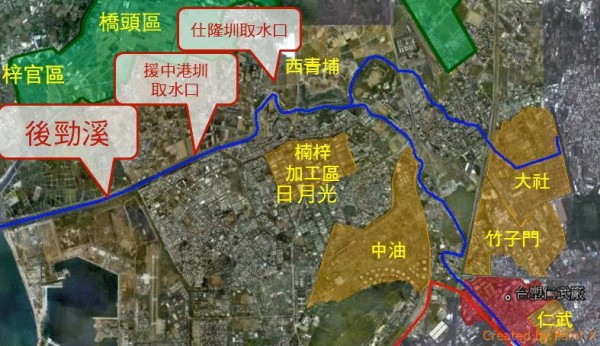
In the Qiaotou and Ziguan areas of Kaohsiung City, two of the irrigation intake points serving 940 hectares of farmland draw water from Houjin Creek, raising public concerns about whether crops have been contaminated. Hu Chung-yi, deputy director of the Irrigation and Engineering Division of the Council of Agriculture, said that seven water quality monitoring points have been set up near the two irrigation intake points affected this time on Houjin Creek, with sampling conducted once each in April, June and August this year, and the test results showed nothing unusual. Every year from October to January of the following year is the water suspension period during the rice harvest, and both irrigation intake points drawing from Houjin Creek are closed, so the farmland should not yet have been affected; currently only five hectares of farmland are planted with vegetables.
Ke Shang-yu, deputy director of the Kaohsiung City Agriculture Bureau, said that the irrigation canals are currently in the water suspension period, and the irrigation water for the five hectares of vegetables comes from groundwater rather than the water of Houjin Creek. However, for the sake of safety, the Agriculture Bureau has sent personnel to collect cauliflower from four farmland sites in the Jiujiawei area of Qiaotou District and sent them to the Wufeng Agricultural Chemicals and Toxic Substances Research Institute for testing. It will only be known in two weeks whether the crops have been contaminated. Vegetable farmers have now been required to stop harvesting, and harvesting for market will only be permitted once it is confirmed that there is no contamination. During this period, the Kaohsiung City Government will fully compensate the vegetable farmers for their losses at market prices.
The Kaohsiung City Environmental Protection Bureau, meanwhile, collected river sediment from four sites at the mouth of Houjin Creek near Yuanzhong Road, and collected soil from farmland in Qiaotou District. The river sediment and farmland soil will be sent for testing, and the test reports will take about two weeks to be released. However, Ma Chen-yao, section chief of the Soil and Water Pollution Prevention Section of the Kaohsiung City Environmental Protection Bureau, said: "Whether the soil and the river have been contaminated will only be known once the reports come out. Generally, test reports take two weeks to be released, but this time we hope to know the results within one week."
Starting in January next year, the two irrigation intake points on Houjin Creek will resume water supply. The Kaohsiung Irrigation Association stated that sampling and testing will be carried out ten days before the water supply resumes, and water will only be supplied after confirming there are no problems. At the same time, the sampling and testing frequency will be changed from once every two months to once a month, with additional irregular nighttime sampling.
In response to ASE's wastewater discharge, the Kaohsiung City Government has already imposed a fine of 600,000 under the Water Pollution Control Act and demanded a work stoppage. In addition, the Kaohsiung City Environmental Protection Bureau continues to investigate ASE's wastewater discharge situation. In addition to the already-fined K7 plant, the Environmental Protection Bureau issued a press release yesterday (12/11), pointing out that the ASE K11 plant has five violations, and it suspects that the K11 plant has also been discharging wastewater.

Houjin Creek has long been polluted by industrial wastewater; the photo shows the chemical soup discharged by the CPC Corporation refinery. Provided by / Citizen of the Earth Foundation