Amendment to the Act Governing Food Safety and Sanitation: illegal adulteration with additives resulting in death may carry a maximum sentence of life imprisonment
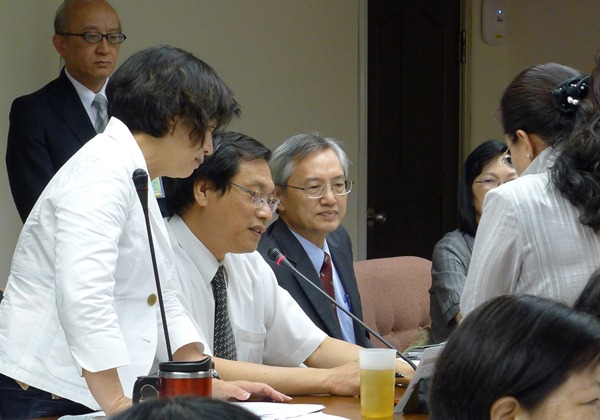
In response to the recent discovery of industrial-grade maleic acid illegally added to a number of food products, the Legislative Yuan yesterday passed a preliminary review of the draft amendment to the <Act Governing Food Sanitation>: the administrative fine for adulterating food with illegal additives will be raised substantially from a maximum of 6 million to 15 million; if a member of the public dies as a result, the maximum criminal liability of the person who added the substance will be changed from a maximum of 7 years' imprisonment to a possible life sentence, and the maximum combined fine will be doubled from 10 million to 20 million.
Because this case involved a "Teacher Wang" who instructed manufacturers to add maleic acid, the draft amendment specifically adds: the instigator may face not only up to 3 years' imprisonment, but prosecutors may also recover improper profits. Su Ching-chuan, convener of the Legislative Yuan's Social Welfare and Environmental Hygiene Committee, said he hopes to push for the third reading of the

Criminal liability included to deter unscrupulous manufacturers
After the plasticizer incident broke out two years ago, the Department of Health specially revised the
On the key penalty provisions, combining the versions of the Executive Yuan and various legislators, Article 44 of the draft amendment passed in preliminary review yesterday stipulates: if a manufacturer maliciously adds an additive not approved by the central competent authority, the maximum fine may range from 60,000 to 15 million.
Criminal liability is also substantially increased. If a consumer dies after ingesting an illegal additive, the person who added it may be sentenced to 7 years or more in prison, with a maximum of life imprisonment; if serious injury is caused, the sentence may be 3 years or more but less than 10 years. If prosecutors determine that the manufacturer added the substance accidentally rather than intentionally, the penalty is less than 1 year's imprisonment, detention, or a fine of no more than NT$6 million.
As the toxic starch scandal continues to expand, legislators from both the ruling and opposition parties not only have a consensus on heavier penalties, but also specifically added a "toxic starch clause" to Article 15, Paragraph 1, clearly stipulating that "adding an additive not approved by the central competent authority" is an illegal act.
Kang Chao-chou, Director-General of the Department of Health's Food and Drug Administration, said he hopes that heavier criminal liability can deter unscrupulous manufacturers; but how to determine whether a member of the public died or was seriously injured from ingesting an illegal additive must be determined by prosecutors and investigators.
New criminal provisions added for non-food-industry offenders
The chemistry teacher Wang Tung-ching, who was suspected of teaching manufacturers how to make toxic starch this time, does not have the status of a food manufacturer, so the
Legislator Cheng Ju-fen specifically proposed a motion to amend, adding to Article 49: if prosecutors find that someone has instructed a food manufacturer to adulterate with illegal substances, they may investigate and prosecute the person as an "instigator," seeking a sentence of less than 3 years' imprisonment, no longer limited to food manufacturers.
In addition, legislators also hope to follow the example of the Environmental Impact Assessment Act: if the instigator profits from the act beyond the maximum fine, and the circumstances are serious, prosecutors may recover the improper profits.
Whistleblower protection clause and food safety victim fund added
In addition to comprehensively increasing administrative penalties and criminal liability, legislator Tien Chiu-chin believes that adulteration with illegal additives has long been food industry's "open secret," and that a "whistleblower" clause should be added to encourage food industry employees to report violations on their own initiative and to protect whistleblowers' labor rights and related compensation for damages; if a whistleblower has previously helped with illegal acts, his or her criminal liability may also be reduced or waived for voluntarily reporting, helping the government safeguard food safety.
In addition, because it is very difficult for members of the public to prove the causal relationship between health damage and eating food with illegal additives, the Legislative Yuan passed an accompanying resolution, hoping that the central government will allocate part of the fines to establish a "food safety victim fund" to help victims with litigation and also allow victims to claim compensation according to different circumstances.
Apart from the main penalty provisions, other amendment articles still require cross-party negotiation because legislators and the Executive Yuan have not yet reached consensus. But Su Ching-chuan stressed that he hopes that on the last day of this session, today, at least the aforementioned draft amendment articles can pass the third reading, so that penalties can be determined as soon as possible and unscrupulous manufacturers severely punished.