Pomelo growers worry about typhoons before Mid-Autumn Festival and about price crashes after it. Where does the industry go from here?
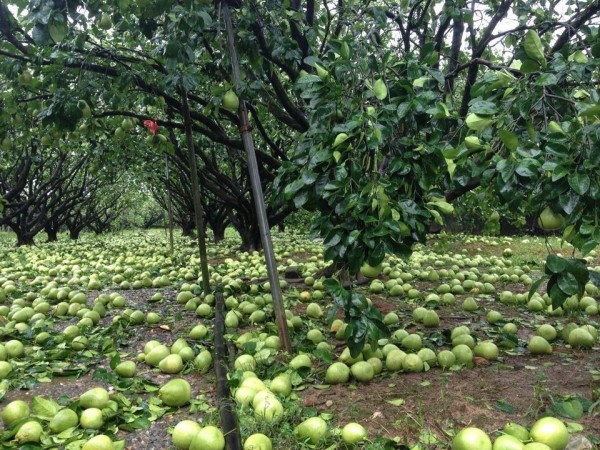
"There really is too much pomelo, we just cannot process it all!" This is not the "good news" of more orders than can be filled, but the heartfelt sigh of community volunteers helping farmers deal with a huge volume of fallen fruit.
The pomelo that every household must have at Mid-Autumn Festival is actually the crop that makes farmers most anxious. This year, because of Typhoon Soudelor, the 20 to 30 percent of pomelos lost by pomelo farmers in western Taiwan had nowhere to go, and they could only rely on community associations that "stand by them out of friendship" to help with processing and absorbing them; while pomelo farmers and sales channels in eastern Taiwan were less affected by the wind damage, they still had to face the problem of slow sales after the Mid-Autumn Festival.
Industry operators and farmers' associations admit that processing pomelo relies on manpower and costs more, and because just a little pomelo can be made into many processed products, the amount that can be absorbed is very limited; still, some food factories and sales channels try products such as yokan, cakes, bread and wine to help farmers absorb pomelos that have nowhere to go, and further raise the value of agricultural products.
The length of the gap between White Dew and Mid-Autumn Festival shapes pomelo sales pressure
Pomelo belongs to the citrus category of crops, and tangerines, liucheng oranges and grapefruit are all its "relatives." Its main production areas are Madou in Tainan, Douliu in Yunlin and Ruisui in Hualien, with some output also in New Taipei, Yilan, Miaoli and Keelung. Pomelo flowers in April and is harvested at White Dew, so the plum rain and frontal systems during flowering and the typhoons during fruit set are all important factors affecting that year's yield.
Besides yield and quality affecting farmers' selling prices, the closer the time gets to Mid-Autumn Festival the stronger the buying mood, but once the festival is over, the buying mood drops sharply; therefore the fallen fruit from natural disasters before the festival and the destination of pomelo after the festival are both headaches for farmers.
Last year, White Dew and Mid-Autumn Festival happened to fall together on September 8 of the Gregorian calendar, causing pomelo buying sentiment to be extremely low; plus Typhoon Matmo, which knocked down more than 90 percent of eastern pomelos, causing heavy losses for many farmers.

Developing processed products to increase the value of pomelo
One way to solve the production and sales problem of pomelo is to develop a variety of processed products, such as the Madou Farmers' Association's pomelo tea jam, mosquito-repellent patches, antibacterial hand wash, shampoo, body wash, soap and pomelo flower incense, among many other products. Director-general Li Yuxian said, "Dengue fever is severe in Tainan this year, and mosquito-repellent patch sales grew by at least 1 fold or more, while other cleaning products have also grown steadily in recent years."
In addition, Hongjie Foods also tried developing pomelo into candied pomelo dice and pomelo shreds for baking, used as fillings or external decorations for bread and cakes. General manager Gu Zhengmu said, "Pomelo is really hard to work with," and the bitter oil sacs on the outer rind must be dealt with, and the pomelo dice used as baking filling cannot contain fruit pulp, otherwise the shelf life will be reduced.
"Because we all use organic or pesticide-free pomelo peel for processing, if we use organic peel and then add things to extend the shelf life, it would feel very wasteful," Gu Zhengmu said, so Hongjie cooperated with Wuhui Food Factory, with Wuhui helping with the work of removing the fruit pulp, and Wuhui then deseeding the pulp and processing fruit tea and jam.

.jpg?resize=347%2C232&ssl=1 ", , . ()")
Fallen fruit as fertilizer, or processing it out of "friendship"
However, the raw materials used in the above pomelo products are all high-grade or ordinary grade, or at most "too large" items not accepted by the market, not defective fruit that fell because of typhoons, and how can these fallen fruits be handled?
Usually they can only be used as "field fertilizer." For one thing, rural areas have long suffered from labor shortages, with no one to hire to clear them, or high hired-labor costs; and the cleared fallen fruit also cannot enter the processing market, so after Typhoon Soudelor passed through this year, the Madou Farmers' Association, with the assistance of the military, disposed of the fallen fruit as waste.
He Lishan, director of the promotion department of the Ruisui Farmers' Association in Hualien, also said that the fallen fruit the farmers' association can help absorb is "really very limited," and just a little pomelo can make a lot of essential oil, so sales still focus mainly on fresh fruit rather than processed products.
Only a few communities, out of "standing by them in friendship," find ways to handle fallen pomelo, such as the Douliu Bade Community Development Association, which this year expanded its efforts to help community farmers deal with the fallen fruit caused by Typhoon Soudelor.
Director-general Lin Shujing said the association has mobilized 60 community volunteers to take back, peel and pulp the fallen pomelo of community farmers, then make it into jam, or separately into cleaner and mosquito repellent. "I really cannot calculate the amount, but the volunteers work 6 or 7 hours every day, and have already done this for more than 10 days."
At present the manpower mobilized by the community is all voluntary, and all the products are expected to bring in more than 100,000 yuan in community income; and "around Mid-Autumn Festival, we will also try making pomelo pastry," Lin Shujing said, but out of concern for manpower they still do not dare consider mass production or commercialization.

.jpg?resize=441%2C248&ssl=1 "860, , , . ()")
Only contract farming or expanded exports offer pomelo farmers a way out
Overall, the processing of pomelo must overcome the oil-sac problem, the pulp relies on manual picking, and one pomelo can be made into many products, making it hard to help farmers absorb excess yield.
Peng Yurong, who started the Hualien-Taitung Vegetable Market platform in Hualien, said that the market currently develops candied pomelo peel snacks from organic pomelo, with production expected to be around 10,000 packs this year, but converted into the amount of pomelo purchased, it is at most less than 1 metric ton, while "a single somewhat large-scale pomelo farmer can grow 7 or 8 metric tons of pomelo," so sales are very limited.
Although the Hualien-Taitung Vegetable Market is also developing pomelo yokan, pomelo wine and other pomelo processed products with longer shelf lives, how much can be sold and how much pomelo can be absorbed still needs further discussion.
Therefore, lacking more labor-saving, convenient and mass-producible processing technology and consumer demand, to ease the production and sales problem of pomelo, there is mostly only contract farming or adopting pomelo trees to ensure sales, and opening up overseas markets for processed products, to possibly absorb part of the excess pomelo.