Commercially sold stainless steel tableware fails to meet national standards, health ministry says it is not illegal
The Taipei City Department of Health yesterday released a survey of stainless steel containers sold on the market: among 20 samples, 8 items labeled with a stainless steel type symbol had manganese content that all complied with national standards; the other 12 products did not carry a stainless steel type symbol, and among them 5 items had manganese content ranging from 10.60% to 13.38%, already exceeding the manganese content standard (below 10%) for stainless steel products generally made from iron-nickel-manganese-chromium alloys (such as the 202 series).
Our country's current national standards CNS12325 (Metal Multi-layer Lunch Boxes) and CNS12324 (Metal Lunch Boxes) clearly stipulate that tableware must be made from 304-series stainless steel (with manganese content required to be below 2%). The aforementioned survey results confirm that the manganese content of many stainless steel lunch boxes far exceeds national standards.
But ironically, Tsai Shu-chen, director of the Food Division of the Food and Drug Administration under the Ministry of Health and Welfare, stressed: "This is merely an incentive regulation to encourage industrial development. If a manufacturer uses 304-series stainless steel to make products, that means their products are excellent, and we must give them credit; but those who do not do so does not mean they have violated the law, and not using 304 series does not violate health and safety standards."
FDA: We Don't Understand Why National Standards Are So Strict
Both Tsai Shu-chen and the Taipei City Department of Health stressed that stainless steel is a heat-resistant inert material, and when it holds ordinary food, the risk of harmful substances leaching out is relatively low; the European Union, the United States, New Zealand and Australia, among others, have not specifically set leaching test standards for manganese content in stainless steel. Tsai Shu-chen also said: "Personally, I also don't understand why the Bureau of Standards, Metrology and Inspection would set such strict regulations!"
As for the regulations in neighboring Japan, Tsai Shu-chen said there should also be no mandatory manganese content requirement for food containers, but she would need to further verify the specific details.
Last month, the Taipei City Government Department of Health visited food container specialty stores and other outlets within its jurisdiction and sampled 20 stainless steel food containers, conducting material tests and investigating the manganese content of the products in accordance with the Sanitation Standards for Food Utensils, Containers and Packages. Of these 20 products, lead (content below 10%) and antimony (content below 5%) all complied with regulations.
As for manganese content, 7 products were labeled with the stainless steel type symbol 304, and their manganese content all complied with the national standard of below 2%; 1 product was labeled with the stainless steel type symbol 430, and its manganese content also complied with the national standard of below 1%.
Of the 12 products without a stainless steel type symbol, 5 had manganese content between 10.60% and 13.38%, already exceeding the requirement for stainless steel type symbol 202 (manganese content must be below 10%). These 5 products are: "Caili Round Lunch Box," "Miaochushi Insulated Heart-shaped Carrying Pot," "Exquisite Square Lunch Box 14cm," "Chushi Square Lunch Box," and "Huagui Oval Lunch Box 14cm."
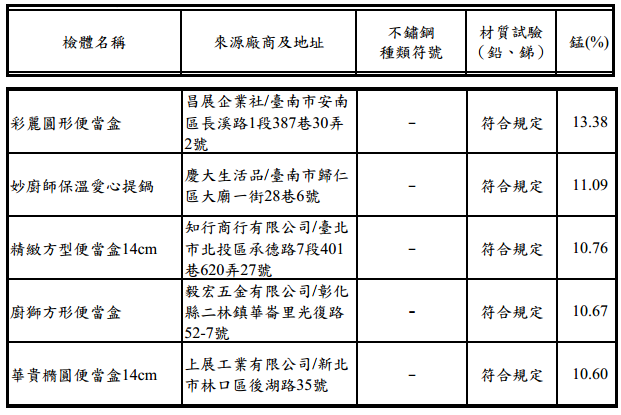
The above five stainless steel products have already exceeded the manganese content specified for "202," yet the government still calls them "compliant" (Source: Taipei City Department of Health)
Taipei City Government: Do Not Buy Products Without a Stainless Steel Label
The Taipei City Department of Health urged vendors to voluntarily and correctly label the type symbol of the stainless steel material (such as 202, 304, 430, etc.), so that consumers can make their own choices without worry; when purchasing, the public must choose products labeled with a stainless steel standard symbol, selecting according to their needs, and should not buy products that do not indicate a stainless steel standard symbol.
Yan Zong-hai, a physician at Chang Gung Memorial Hospital, has pointed out that excessive manganese may cause neurodegenerative diseases, leading to problems similar to Parkinson's disease and intellectual decline. The Food and Drug Administration of the Ministry of Health and Welfare said that on this point, they have asked the National Health Research Institutes to help analyze relevant scientific reports to serve as a reference for health risk assessment.