Food container safety oversight has loopholes: the FDA has regulations but no testing
On a cold winter day, many people like to warm themselves up with a cup of hot coffee, but some cup lids are not heat-resistant up to 90 degrees, and if the drink is too hot, cancer-causing substances may leach out. The Control Yuan investigated the Food and Drug Administration's responsibility last year, and the investigation report released yesterday pointed out that the FDA's annual sampling and testing numbers are insufficient, and that after the labeling regulation for food containers was promulgated in July last year, it had never been tested at all; it was only after the Control Yuan began investigating at the end of last year that it was included in routine inspection items in December. Control Yuan member Cheng Jen-hung criticized the FDA as far too negligent and dilatory.
FDA requires operators to label heat resistance, yet testing numbers are zero
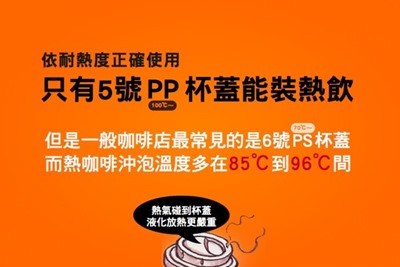

In addition to the labeling problem, the Control Yuan also criticized the FDA for not being proactive in quality control of food containers.
The investigation report pointed out that the FDA, limited by manpower and funding, can only conduct selective sampling. For example, in 2010 it inspected bisphenol A and plasticizers; in 2011 it targeted 157 commercially sold paper containers (paper cups, paper plates, paper bowls, paper boxes), inspecting materials, fluorescent whitening agents, and leaching tests; 101 samples of commercially sold disposable chopsticks were tested for sulfur dioxide, hydrogen peroxide, biphenyl, and other substances; in 100~101 it tested plastic containers of specific materials to see whether they met the hygiene standards for those materials; last year it targeted 100 containers and packaging such as polycarbonate and silicone for material and leaching tests.
Cheng Jen-hung said that the FDA's scope and number of sampled tests are both too small, and there is no regular follow-up. "Doing one project here and one project there is like looking for a needle in a haystack." He believes that with insufficient funding and manpower, the FDA should have a concept of risk assessment and, based on the assessment results, draw up an overall strategy, such as assessing the same substance over three years and then regularly sampling and following up, which would be a systematic approach.
In response, Tsai Shu-chen, head of the FDA's Food Division, said that currently disposable food containers are labeled by the "smallest sales unit," so consumers will not see labels on every plastic cup lid, and the numerical code is the Environmental Protection Administration's recycling code; however, when manufacturers sell to food and beverage operators, the outer packaging should clearly state the heat-resistant temperature, manufacturing date, and so on. She stressed that hot drinks should not exceed 7 or 80 degrees, the regulation must apply uniformly, and at present operators can only be encouraged to label the cup lids themselves, but in the future more data will be collected to discuss whether to label heat-resistant temperature on cup lids.
As for the insufficient number of sampled tests, Tsai Shu-chen said that inspection must start from source management, so the FDA mainly inspects upstream factories and, based on risk assessment, samples containers of specific materials; if the previous year's item had no violations, the next year it will switch to another item, but it will discuss with local health bureaus whether to expand the scope of sampling.
The Bureau of Standards, Metrology and Inspection and the FDA should formulate standards for stainless steel metals
In addition, regarding the much-discussed incident last year of excessive manganese in stainless steel, the Control Yuan also called on the Ministry of Health and Welfare and the Ministry of Economic Affairs' Bureau of Standards, Metrology and Inspection to expand the standards for metal leaching tests in stainless steel as soon as possible. Cheng Jen-hung said that although not all countries have set manganese regulations for stainless steel, Taiwan's use rate of stainless steel is extremely high, "we cannot let what consumers consider the safest thing become unsafe instead." Moreover, operators have also reported that stainless steel does indeed leach nickel, chromium, and manganese, and they hope the competent authority will set standards as soon as possible so that operators have something to follow.
However, Tsai Shu-chen said that the United States, Japan, and the European Union all have no relevant regulations, and "when Taiwan formulates policy, it must consider aligning with international standards"; moreover, stainless steel is relatively stable and leaching amounts are low, but since the public has this demand, the FDA has also collected data from many sources and is consulting with the Ministry of Economic Affairs on follow-up measures. As for whether to label stainless steel containers as 200-series or other items based on metal composition content, she suggested returning to the Commodity Labeling Act and leaving it to the Ministry of Economic Affairs.
On public education, the Control Yuan pointed out that the "Plastic Food Container Information Website" established by the FDA in 2010 and commissioned to the Plastics Industry Development Center had, as of September 12 last year, reached more than 190,000 views, showing initial results; however, it should include content on different containers, such as paper, metal, glass, ceramics, bamboo and wood, so that the public understands how to use them correctly and the related risks of different materials.
Cheng Jen-hung said that the investigation report has been sent to the Ministry of Economic Affairs and the FDA, and both agencies must, within 2 months, provide explanations and response strategies regarding the contents of the report.